

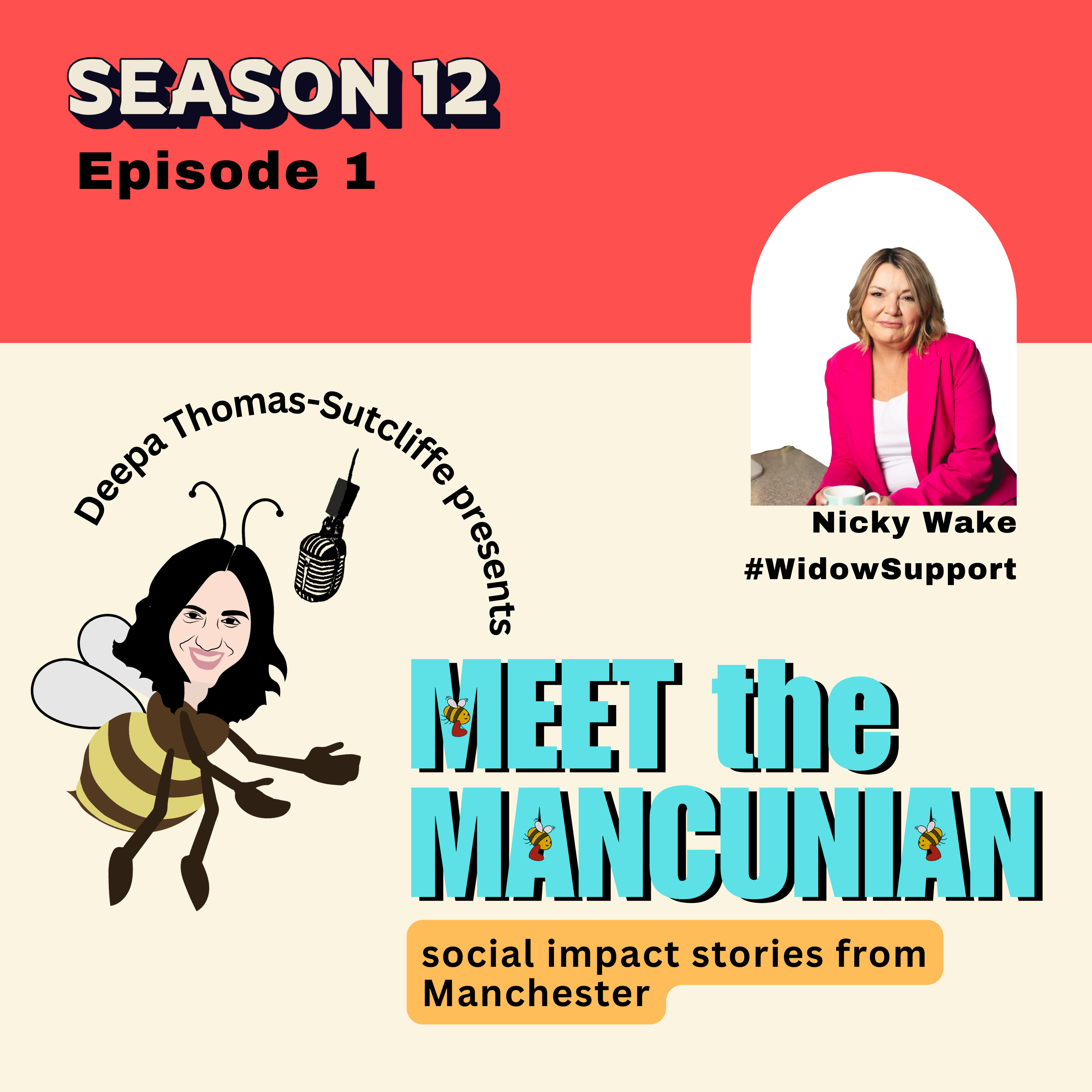


Host Deepa Thomas-Sutcliffe interviews Nicky Wake, founder of the Widowed Collective in the first episode. Nicky shares her lifelong passion for building community, and recounts the personal tragedy that led to her mission.
After finding support through Widowed and Young, she identified a gap for widowed people over 51 and launched the Widowed Collective as a free, inclusive, donation- and grant-funded not-for-profit offering UK-wide resources, forums, groups, and events. Nicky discusses early impact from their first event in Manchester, the need for volunteers and partnerships, her self-care routine, and advice to volunteers.
Did you know:
· There are 3 million widowed adults in England and Wales
· The vast majority of widows are female (2.2million as opposed to 730,000 male widowers)
Key resource:
Time stamps of key moments in the podcast episode &transcript:
(00:55) Meet Nicky Wake
(01:40) Community roots
(03:48) Life before loss
(04:52) Heart attack and aftermath
(07:23) Lockdown bereavement
(09:39) Why Widowed Collective
(12:39) Building the collective
(16:06) Motivation and next steps
(30:55) How to connect
Listen on Apple Podcasts, Spotify, YouTube or at
www.meetthemancunian.co.uk
#Manchester #SocialImpact #Podcast #WidowSupport #Community
I hope you enjoyed listening to the podcast episode. Please do check out my other podcast episodes for a bit of inspiration.
12.1 Nicky Wake episode transcript
Intro
[00:00:00] Hello and welcome to Season 12 of the Meet the Mancunian podcast: social impact stories from Manchester. I'm your host, Deepa Thomas-Sutcliffe and I'm so glad you're here today.
[00:00:13] This season, I'll be speaking with people who are driven by passion and guided by purpose, individuals working in different ways to shape Manchester and strengthen our communities. In each conversation we'll explore what motivates them, what keeps them going, and what impact their work is having across our city. These are honest human stories about why people care deeply about what they do.
[00:00:41] New episodes drop every Tuesday. You can listen on Apple Podcasts, Spotify, YouTube, or on www.meetthemancunian.co.uk.
[00:00:51] Thank you for joining me. Let's meet this week's Mancunian guest.
Episode 12.1 - Meet Nicky Wake
[00:00:56] Deepa Thomas-Sutcliffe: Passionate about channelling pain into purpose. We hear from Nicky Wake, founder, the Widowed Collective.
[00:01:03] Deepa Thomas-Sutcliffe: In Nicky's own words.
[00:01:04] Nicky Wake: Sometimes when you're running a business, it feels like you're pushing water uphill, but with a mission driven business, with social impact, it can be easier. You just need to be brave enough to ask. And people find it much harder say to say no to a not-for-profit than they do to a commercial organisation. So don't be afraid to leverage the heartstrings and emotions when making a request.
[00:01:30] Deepa Thomas-Sutcliffe: Thank you so much, Nicky, for joining me today.
[00:01:32] Nicky Wake: My pleasure. Thanks for having me. It's a delight to be here.
Community roots
[00:01:35] Deepa Thomas-Sutcliffe: Looking forward to hearing all about your latest passion project. First, tell us what sparked your passion for supporting the Manchester community.
[00:01:45] Nicky Wake: I think community is actually at the heart of almost everything I do. I'm involved in numerous businesses, projects, and I think probably the one thing uniting that is community. I'm an incredibly social person. I'm all about building communities, connecting people together. I'm a huge believer in the sort of six degrees of separation theory.
[00:02:06] Nicky Wake: And I love joining the dots with people and making magic happen. And what, what happens when you put people in a room together? Face to face? My very first, foray into anything community related was within the LGBTQ+ community in Manchester. I worked as a naked podium dancer at the Paradise Factory, but also then became the club promoter.
[00:02:30] Nicky Wake: My job was to play on club nights and bring people together in a celebratory fashion every weekend. I think almost the delight in community sparked from that very moment of realising that magic happens when you unite people through a common interest in one place or online now. And exciting stuff happens. And I think, I thrive on that activity if you like.
[00:02:57] Nicky Wake: My son often jokes that my social battery never wears down. He's one of those people who gets back from college and needs to go and decompress in his room. And that's alien to me. My social battery is charged by being around other people and communities are a perfect place to do that.
[00:03:13] Deepa Thomas-Sutcliffe: I love that about magic being when people are brought together online or in person. And that's something really special about it. And thanks for sharing your fun fact into how your passion for community happened. And it's always interesting because guests have such varied backgrounds that just makes it really special.
Life before loss
[00:03:36] Deepa Thomas-Sutcliffe: So tell us about your journey with the Widowed Collective, how did that journey start and was there a gap that you saw in the market or in the social impact sector? What made you step forward?
[00:03:48] Nicky Wake: The Widowed Collective is born out of a very personal experience. Probably best if I share some of that journey that brought me to being widowed, is which is why I started the Widowed Collective. So in 2017, I was literally living my best life. I was married to my soulmate Andy Wake. We'd met online back in the day in 2002.
[00:04:09] Nicky Wake: And we had a whirlwind romance. I fell head over heels in love. Thankfully, so did he. And fast forward 18 months and we're stood on a beach in Jamaica, hand in hand getting married in front of our closest friends and family. Years later, our beautiful baby boy burst into the world and we became this perfect little nuclear family.
[00:04:29] Nicky Wake: I started an events company with Andy called Don't Panic. And I was flying around the world delivering glamorous award shows in posh frocks, literally having a wonderful time. Andy was the perfect stay at home dad. He did every school walk, he cooked every meal. He kept the home fires burning.
[00:04:47] Nicky Wake: He was my rock, my soul, my foundation, my everything. And then in 2017, I returned from a business trip. And I came home and Andy was very subdued and I said, What's wrong babe?
Heart attack and aftermath
[00:04:59] Nicky Wake: And he said, oh, I'm sure it's nothing but I've got these chest pains. And he hadn't been to the doctors because he is a man. And men don't go to the doctors, do they? So, I dragged him to the doctors. Three more visits to the doctors, the doctor diagnosed stress. Now, Andy was the most laid-back man in the world. He was horizontal.
[00:05:17] Nicky Wake: And I insisted they did an ECG and it transpired he was having a heart attack, so he was blue lighted to hospital, went into theatre, had three stents fitted, recovered. I brought him home three days later and we were toasting a lucky escape. We were going to make some lifestyle choices. Things were going to change. He went to bed that night. I followed him to bed.
[00:05:38] Nicky Wake: He was snoring and that's possibly, the one thing I don't miss. And I slept in the spare room secret to any happy marriage, as we all know. And then at six o'clock in the morning, I was awaken by a terrible sound. And I went in to our bedroom and he was having another heart attack only so much worse than the one before.
[00:05:57] Nicky Wake: And I did CPR for 40 long minutes waiting for the ambulance to arrive. The ambulance arrived. I saved his life. He was rushed into ICU. He was put in an induced coma, and for two weeks we began a bedside vigil of hopes and prayers despite being atheist.
[00:06:15] Nicky Wake: Clinging to any hope and if life could be saved through Facebook likes and prayers would've been fine, but it can't. At two weeks, his consultant came to me and he said, I'm sorry, Mrs. Wake, but your story doesn't have a happy ending.
[00:06:29] Nicky Wake: And Andy had suffered a catastrophic brain injury. And that brain injury left him profoundly disabled, and he didn't know who he was, where he was. He couldn't walk; he couldn't talk. He required 24 7 round the clock care with a prognosis of no meaningful recovery.
[00:06:47] Nicky Wake: And so I was trying to solo parent, a grieving child. If you think about it. Finn, our then 11-year-old lost his daddy at that point. I was technically married, but emotionally widowed. And I lived in this horrible limbo land for three years of knowing that I was going to lose the love of my life. But not knowing when, and the love of my life was no longer the man I'd married and he was in a very specialist nursing home requiring one-on-one 24 7 specialist care, literally no quality of life.
Lockdown bereavement
[00:07:23] Nicky Wake: And then in 2020, COVID hit the headlines, and I just knew was the beginning of our end. And on the 17th of April of 2020, in the midst of lockdown, the nursing homes were closed. At this point, I couldn't visit and I got the call and the call to say that Andy had died…
[00:07:42] Nicky Wake: And so once again, my world fell apart only this time in lockdown when I didn't have access to friends or family, I couldn't even get a hug from my dad. And it was the deepest and darkest of days that I'll ever remember.
[00:07:58] Nicky Wake: And I was struggling to survive while I was trying to navigate parenting, a grieving child. Navigate an events company through COVID when we couldn't deliver events. So, I was facing heartbreak and bankruptcy nearly at the same time.
[00:08:15] Nicky Wake: And I saw, solace in the wine rack quite literally. And it was a very dark and challenging period in my life. But I did get some counselling signposted me to an incredible charity called Widowed and Young. And they help young widows, people who are widowed when they're under the age of 51, which I was technically just actually.
[00:08:35] Nicky Wake: And what I do like about Widowed and Young is once you get in, they don't throw you out when you get to 51. So, I will be forever young in that sense. So I quite like that as a site and Widowed and Young became my lifeline.
[00:08:47] Nicky Wake: The strength of help and love in the widow community is immense, right? And I tapped into that and I leaned into it, and I found my tribe of widow warriors who helped me rebuild my life and helped me get through this.
[00:09:03] Deepa Thomas-Sutcliffe: Thank you so much for sharing your very tragic story and how that pain you've been able to channel into purpose and using some of your life experience to help the widow community.
[00:09:16] Deepa Thomas-Sutcliffe: You share a little bit about the change that you trying to make and you're trying to give community to people, in their darkest moments or many years on, depending on which life stage they're at.
Why The Widowed Collective
[00:09:30] Deepa Thomas-Sutcliffe: What does success look like for you? How do you see Widowed Collective? I know it's just started this year. Looking ahead, can you tell me what that might look like?
[00:09:39] Nicky Wake: What I realised at that point so millions of widows, in fact, 3.12 million people are widowed currently in the UK. And I would say 75% to 80% of those are over 51. And there wasn't a not-for-profit or a charity to help those people, which is a huge void.
[00:10:03] Nicky Wake: I knew because of the help and benefits I got through Widow and Young, that I needed to do something to make a difference. I needed to make a change. What I'm passionate about is not letting tragedy define me. turning that pain into purpose and creating something tangible and beautiful.
[00:10:26] Nicky Wake: And it helps me if I can help other people find solace or joy, or hope that helps me make sense of my loss. That helps me understand why I lost Andy in the grand scheme of plan, of whatever the reason is that we're all here. It gives meaning to my life.
[00:10:43] Nicky Wake: And so, I started the Widowed Collective, also another opportunity, which was in creating a dating app for widows and widowers. So I was already very connected within the widow community and had a database of widows and widowers that I built for commercial reasons.
[00:10:58] Nicky Wake: Commercial reasons will only fill so much of my heart. There's a big part of me that didn't just want to financially benefit from community that actually saw that as a widow, I could do so much more and I needed to do so much more to help that widow community.
[00:11:18] Nicky Wake: Yes, I was touching people through my dating apps at a certain part in their widow journey, but actually there are so many people. Early-stage widows who needed so much more help and support in a very different vehicle than that of a dating app.
[00:11:33] Nicky Wake: And there were people older or people who chosen not to date who also needed the help in the community. And I thought there's something bigger I need to be doing here that is beyond just a commercial dating app. And I used that knowledge, those contacts, my ability to build communities to set up a not-for-profit, which we set up earlier this year called the Widowed Collective.
[00:11:57] Nicky Wake: And we are open to widows of all ages, all genders. So by widow, we mean someone who's lost a life partner. You don't have to have been married. We are completely and utterly inclusive. It really doesn't matter what your sexuality is. Whether you've had children or not children, anyone who is grieving a life partner is welcome to join the Widowed Collective, and membership will always be free.
[00:12:23] Nicky Wake: Look, as widows, we've paid the highest price for admission to this club, and we do not need to pay a penny more. And so we're funded entirely by donations or by grants or by funding, and some personal funds that I've put in to kickstart the whole thing.
Building the collective
[00:12:39] Nicky Wake: And what is the Widowed Collective? It's UK wide. And we have actually got some members who've joined from the US so we'll be starting a US contingent of it. Obviously cantered in Manchester where my heart is. I've been in Manchester for 30 years I feel as Mancunian as I come. And so we started our face-to-face first events in Manchester, but we will be UK wide.
[00:13:05] Nicky Wake: We have an online forum; we have pages of resources. We have a WhatsApp group; we have a Facebook group. And we are looking for local volunteers across the UK to stand up and be advocates in their region, to host coffee mornings, or yoga, sessions or a country walk or whatever.
[00:13:25] Nicky Wake: I want to build a community from the ground up, so it's as much question as what does the community want and need. But personally, I would love to see us have a chapter, if you like, in every town and city in the UK, led by a passionate individual. I think. Together, we are stronger.
[00:13:44] Nicky Wake: I want to run a collective, not a dictatorship. I would like, us to have thousands of members. I would like a vibrant programme of events, both in person and online that people can go to. I would like us to build funds through donations and grants to help widows and widowers who are struggling financially because, you're widowed, you can lose half of the household income overnight.
[00:14:11] Nicky Wake: Some widows are in the beneficial position of having had life insurance. So that in some ways, that they may be more financially better off despite being emotionally devastated. There are many widows where that's not the case. Had Andy been the main breadwinner and I had not had life insurance, there would be a huge financial issue and burden on me. So I would like eventually for us to be able to help people in those positions. I wanted to be a thriving, inclusive community.
[00:14:43] Deepa Thomas-Sutcliffe: Sounds wonderful, and I do wish you many good things coming your way. Being member focused really helps because then you can evolve to their needs, so that sounds like a great place to start.
[00:14:55] Deepa Thomas-Sutcliffe: What's been the toughest part of this journey? I know it's early days, but what does it take to set up this community? Is there something that you've had to overcome to successfully start?
[00:15:07] Nicky Wake: I think I'm beneficial in the sense that I have run multiple businesses before. And I'm blessed with some very good business connections, and I'm known within the widow community. So I think I've been lucky in the sense that I was well positioned to do this.
[00:15:25] Nicky Wake: I suppose the biggest challenge is hours in the day. I am the founder of an events company, a dating app company and also a sober not-for-profit organisation. Hours in the day is always a challenge, and that ability to multitask between multiple projects is undoubtedly a challenge.
[00:15:45] Nicky Wake: I think the idea that, finding the time to, to consult with the community and listen to the community that is something that, that I need to instil in myself. It's so much easier to just do it your way, isn't it? And sometimes, I need to remember the word Collective within the Widowed Collective, I think, and that's a mental note to myself.
[00:16:04] Deepa Thomas-Sutcliffe: Thank you for sharing that.
Motivation and next steps
[00:16:06] Deepa Thomas-Sutcliffe: When the works becomes really heavy or the progress is slow, as often happens when you're doing a passion project, what helps you stay motivated and hopeful?
[00:16:16] Nicky Wake: I think this last 12 months has been transformational for me individually. I checked into rehab last November. And so I'm a year sober next week. And, it has been a year of self-care and prioritising my health. So, things like swimming and yoga and meditation that perhaps weren't present in my life before I entered recovery have been really beneficial in helping me through those challenging times and helping me remain focused and driven.
[00:16:48] Nicky Wake: I swim 40 lengths every day and a routine is good. Again, asking for help, if you are doing something that is mission-driven and with social purpose, invariably people will want to help you. It's much easier than when you're trying to run a business.
[00:17:04] Nicky Wake: Sometimes when you're running a business, it feels like you're pushing water uphill, but with mission driven, with social impact it, it can be easier. You just need to be brave enough to ask and people find it much harder say to say no to a not-for-profit than they do to a commercial organisation So, don't be afraid to leverage the the heartstrings and emotions when making a request.
[00:17:29] Deepa Thomas-Sutcliffe: Great advice, and I like that very much about that investment into self-care, almost acting like a grounding ritual for yourself and giving you the energy you need for everything else.
[00:17:41] Nicky Wake: You've got to look after yourself first to make sure you're doing the right thing for your community. And if you are not looking after yourself, then you're not in the best place to serve that community that you so desperately want to.
[00:17:53] Deepa Thomas-Sutcliffe: What's next for you and your mission? What can we look forward to in the next few months?
[00:17:58] Nicky Wake: World domination, I think. We're very much in the embryonic stages of the Widowed Collective. We've literally launched the full membership website only a few weeks ago. So building that membership is critical. Expect to see me all over the UK popping up, speaking at events.
[00:18:17] Nicky Wake: I'm looking and hoping to create partnerships with people who can signpost to the Widowed Collective. My next approach is to someone like Coop Funeral Care, to see if they would support by having literature and poster within their undertakers’ storefronts. Being at the frontline where people are at the very early stages of widowhood so that we're there as a resource. And I think that's a big job for me to do through partnerships. So anyone who can help with any of that, please do reach out to me. There's a contact form on our website
[00:18:52] Nicky Wake: Also, very important that I can't do this alone. I would like to recruit an army of advocates. So they would, in my mind be later stage widows. So widows who've been through that initial raw grief and have some lived experience as a widow, have walked those paths and know the challenges ahead.
[00:19:12] Nicky Wake: So ideally people who've been widowed to five plus years I would suggest, would be better placed to help those in the early stages of widowhood. And ideally, we'd be looking for widows of all ages and all genders and all backgrounds. And, we want to be diverse and inclusive so anyone who feels they've got some time, and they can give some skills.
[00:19:35] Nicky Wake: And those skills can be anything. They can be organising a coffee morning locally, or they could be lobbying government about bereavement support payment if they have legal backgrounds or they could offer to step up and be our treasurer or they could help with fundraising.
[00:19:52] Nicky Wake: There are a million ways to get involved in the Widowed Collective. If you are a widow and you feel you have skills of any kind that you can help to bring, to grow this crucial movement that is a not-for-profit. Every penny that we raise will go back to help widow those and widowers on the front line. We don't have offices or salaries or staff or any of those things and, we appeal to volunteers to step forward and help us.
[00:20:21] Deepa Thomas-Sutcliffe: What would you say is the impact you have made?
[00:20:23] Nicky Wake: I think our very first event that we held was a few weeks ago in a bar in central Manchester. And it was interesting because I've run widowed dating events for my dating business and, and we often find it quite hard to find men to come to those events. I think men are quite intimidated by going to a dating event.
[00:20:45] Nicky Wake: The Widowed Collective event that we had. We actually have more men than we did women. So I think for me that was really refreshing to see that the men felt that they could come to something that was much more community based and feel comfortable.
[00:20:59] Nicky Wake: And at one point I looked over and there were 12 guys all stood around chatting that would never have known each other in real life. And those men will be going down the pub or going to the golf club or whatever it is they do, hanging out with friends who are happily married and still in their relationships and feeling incredibly isolated.
[00:21:19] Nicky Wake: And if I can create safe space for those men to come together and meet other men who are going through the same journey and the same experiences and make those connections, and just seeing those guys swap numbers and knowing that they will keep in touch and they will meet for a pint and they'll go to the football or whatever it is that guys do. I felt I walked away from that night feeling like I'd achieved something.
[00:21:43] Nicky Wake: There were people there who felt like they'd lost their place in society. Every aspect of your life changes. Your friends group change. The way you holiday changes, the way you live, changes your finances, change the way you parent changes, the way you cook changes.
[00:21:57] Nicky Wake: Widowhood touches every aspect of your life in a way that you cannot imagine until it happens to you. And I think if we can just help change some of that, even at the smallest level, then we're having an impact.
[00:22:13] Deepa Thomas-Sutcliffe: I love that about like creating a kind of bond because people have shared lived experiences, which can connect them in different ways from people who don't have that lived experience.
[00:22:24] Deepa Thomas-Sutcliffe: When you think about listeners who want to help and don't know how. What can individuals do to make a difference in a simple, everyday way? It may not be for supporting widows. It could be for just building community. What actions can they take?
[00:22:43] Nicky Wake: I think it's about stepping up, isn't it? And putting yourself forward in whatever community that you are in and you want to touch and engage. We all have the ability to make a difference and it's finding something that you're passionate about.
[00:22:56] Nicky Wake: So if if you are widow, then you know, reach out and join our Widowed Collective. If you are in a community that needs its own Widowed Collective, then step up and do that. Reach out, walk into a charity shop and volunteer.
[00:23:10] Nicky Wake: If we all as individuals in society, said to ourselves a commitment of for four hours a week, I'm going to do something for a community. And find a community that resonates with you. because if you're going to stick to something, you've got to love it, right?
[00:23:25] Nicky Wake: And make that commitment, make that your January New Year's resolution or whatever it is, and for four hours a week do some good. Because actually the karma that comes back from that. And the feel-good feelings that you get, way outweigh the time and the effort that you put in. I've found being in both this and the sober community I'm involved with, incredibly rewarding and it's lovely to go to bed thinking you've made a difference.
[00:23:54] Deepa Thomas-Sutcliffe: I love that very much because like you said, it could be volunteering, it could be joining or supporting a cause, but it's true. It's so important to choose a cause that really matters to you. So, over a period, I know my causes, they are animal welfare and inclusion, and I tend to work in those areas.
[00:24:14] Deepa Thomas-Sutcliffe: But there have been times before that when I volunteered on a variety of courses because I wanted to give my skills for good, but they don't help you see the impact of what you're doing. It's just an additional resource at that time. So I think I really like that about the advice that find your cause and then commit to making a difference in that cause.
[00:24:35] Deepa Thomas-Sutcliffe: Is there, something about your work or the voluntary sector that you might want more people to understand?
[00:24:42] Nicky Wake: Oh, for me, I would like people to understand the reality of widowhood and what that means. Unfortunately, if you are in a marriage, one of two things is going to happen. You are going to die, or your partner's going to die. The odds of that happening on the same day at the same time. Pretty slim.
[00:24:59] Nicky Wake: And so it is important that as individuals we understand being widowed does affect every single area of your life. To just stop and think about that. And then if, when you do meet widows, not to be afraid.
[00:25:13] Nicky Wake: Do you know what this is? I love it when people talk about Andy. I think people when they know I'm a widow, so they don't know what to say and they're very shy about them mentioning him or referring to him.
[00:25:23] Nicky Wake: We've got friends who don't even know if what's the right thing to do? Do I mention him? Do I not mention Yes. Talk about him. Because through talking about other people's late partners, you keep their memories alive.
[00:25:36] Nicky Wake: I can't hurt any more than I'm hurting about the loss of Andy. You mentioning his name is not going to hurt me more than I'm hurt. What it will do is make me think he touched your life, you remembered him, And you are remembering him now.
[00:25:51] Nicky Wake: And to me, that's beautiful and so that's the thing. It took me a while to get there, but that's what I want to drill in on is, just because we lose someone physically, we don't lose them emotionally in our hearts. And we should talk about them and celebrate them and remember them often.
[00:26:08] Deepa Thomas-Sutcliffe: Absolutely. That is really good advice. And I guess something for listeners to just think about when they support people, friends, family who may have gone through this or if they are going through this themselves that, cherish that memory of the partner who's gone, or the friend who's gone, or a family member who's gone, because that's how you keep their memory alive and that's how you keep them alive in a way.
[00:26:34] Deepa Thomas-Sutcliffe: Is there a community partnership or act of kindness that inspired you lately that you might want to talk about?
[00:26:42] Nicky Wake: I think probably my biggest inspiration came from the work that Widowed and Young did. That was certainly what gave me the idea. When I realised, because I was trying to signpost widows from my dating app. And I didn't have anywhere to signpost them to because they were over 51.
[00:27:01] Nicky Wake: Was speaking to a lady at an event who was 52, and I'm like this is ridiculous that at 52 she can't access help and services. 52 is still really young. and I know Widowed and Young because of its definition and its mission, has to have a cutoff point somewhere.
[00:27:16] Nicky Wake: You're as young as you feel and all that, it, they do need a cutoff point. And so I guess that was the inspiration was realising that all of a sudden, there was a problem that there wasn't a solution to. This was my mission to create the solution to that problem.
[00:27:34] Deepa Thomas-Sutcliffe: I love that it inspired you, but also then led you to think about like, how can you take it further and how can you support a wider spread of people.
Signature questions
[00:27:43] Deepa Thomas-Sutcliffe: I'm now going to move us, Nicky, to the signature questions I ask all my guests.
[00:27:47] Deepa Thomas-Sutcliffe: If Manchester had a superpower, what would it be and where have you seen it in action?
[00:27:52] Nicky Wake: It's back to the connection thing. I think what I love about Manchester is, it's quite easy to be a big fish in a small pond. I go to London and I don't know people and I haven't got those connections. Whereas in Manchester, I joke that I love the six degrees of separation rule that you can get to anybody through six people, six connections.
[00:28:13] Nicky Wake: In Manchester, it's three connections. And that's what I love about Manchester and its superpower is its connectivity. I can get to Andy Burnham if I need to by talking to three people. There is a way of doing that. You just have to choose the right three people obviously.
[00:28:30] Nicky Wake: But it's connectivity and it's vibrance I think is also, its superpower.
[00:28:35] Nicky Wake: Do you know what my favourite city is – it’s Manchester? And it is, it genuinely is. I love this city. This city has made me everything I am.
[00:28:43] Nicky Wake: From dancing on a podium in the Hacienda to running a community group for widows and every flavour of Nicky in between has happened in this city. And I don't think, I'd be the same woman if I'd done it in a different city. So, I have a huge love for this city, and it's super.
[00:29:01] Deepa Thomas-Sutcliffe: I love that about both vibrancy and connectivity. The reason I've spoken to so many guests is, as a brand new person is because my guest do this amazing kind thing of introducing me to new guests. And that's how I go into really interesting areas such as with yourself.
[00:29:18] Deepa Thomas-Sutcliffe: If you could gift Manchester one new value, habit, or mindset, what would you choose to strengthen community life here?
[00:29:27] Nicky Wake: I joke and it's not a value, but the one thing that Anthony H. Wilson, God rest his soul founder of Mr. Manchester and the Hacienda and all of those things, said the only thing this city is missing is a beach. And I still stand by that actually. We would be Barcelona if we had a beach and, I don't know if that's a value. I'll have it if I'm allowed to.
[00:29:46] Deepa Thomas-Sutcliffe: If that's the one you want, then absolutely. I like the sea, so I can do an up vote on that little petition. We just need to talk to Mother Nature.
[00:29:55] Deepa Thomas-Sutcliffe: If you could have a 10 minute conversation with a community hero from Manchester's past or present, who would it be with and what would you ask them?
[00:30:04] Nicky Wake: It would be Anthony Wilson Mr. Manchester, Music, Hacienda. I was blessed to know Anthony. I wouldn't say very well, but he came to my house a couple of times. And sadly, he died some time ago. And he was a fabulous raconteur, and he was a great community builder and a dreamer and an idealist.
[00:30:23] Nicky Wake: I would ask Anthony his thoughts on the development of Manchester and how it's become a very different Manchester to the one that he was part of. And is that for the good or not? The thoughts on how the city's developed in the past 10 years and, I would be intrigued as to what he made of it.
[00:30:44] Deepa Thomas-Sutcliffe: Definitely, I've heard so much about Hacienda and its influence on the Manchester music scene. And it's sad that it's just apartments now, like you said.
[00:30:55] Nicky Wake: I know.
[00:30:55] Deepa Thomas-Sutcliffe: Looking back, what's a life lesson or a piece of wisdom that your journey has taught you, something you carry with you every day?
[00:31:04] Nicky Wake: I think that grief and death isn't the end of everything. It can be the start of a new chapter. What it's taught me is I thought my world was over and my life had ended. Actually, what I didn't realise was it was universe turning a page for me. And I had a different story to write than the one I was in.
[00:31:30] Nicky Wake: And it's very hard when you are in the depths of despair to believe in hope. And to believe, that there can be light after darkness. But there can, and there is. You've just got to find that reason for being again, and that reason for meaning.
[00:31:48] Deepa Thomas-Sutcliffe: It is beautiful. Like you said, grief can be devastating. After a point, you work through it and you find that new chapter or new direction and new purpose. This is really beautiful. And I hope that is a thought listeners can take away with them as they think about their own journeys.
How to connect
[00:32:08] Deepa Thomas-Sutcliffe: What's the best way for listeners to connect with you, support your mission, or learn more?
[00:32:13] Nicky Wake: The first port of call will be our website, which is the WidowedCollective.com. And you can sign up for free there, or you can just join our mailing list if you're not ready to sign up. And you can contribute on our forums. You can access our resources regardless of whether you're a member or not.
[00:32:29] Nicky Wake: You can follow us on Facebook. We're on Insta. All of the links are on the website, so just click through and follow us there. We will always follow you back, I promise.
[00:32:39] Nicky Wake: You can join one of our online meetings or you can join one of our in-person meetings. And then we have a WhatsApp group that you can sign up to too.
[00:32:47] Deepa Thomas-Sutcliffe: Thanks, Nicky, for sharing all of that.
[00:32:49] Deepa Thomas-Sutcliffe: Great to talk to you. This is all we have time for, but I think it's been a really interesting conversation, and thank you for sharing your very difficult journey, but what you're making of that new chapter in life.
[00:33:02] Nicky Wake: Thank you so much and thank you for having me. It's been a pleasure to be here.
Outro
[00:33:05] Deepa Thomas-Sutcliffe: Thank you for listening to the Meet the Mancunian: social impact stories from Manchester. If today's episode resonated with you, please share it with someone who believes in the power of passion and purpose, or leave a review to help others discover the podcast.
[00:33:22] Deepa Thomas-Sutcliffe: You can connect with me on social media @MeettheMancunian on Instagram, Facebook, and Blue Sky. And @MeettheMancunianpodcast on YouTube.
[00:33:34] Deepa Thomas-Sutcliffe: I'm Deepa Thomas-Sutcliffe, and I'll be back next Tuesday with another story from the people shaping Manchester. Next week, we hear from Sebastian Linares talking about sustainability and food insecurity.
[00:33:47] Deepa Thomas-Sutcliffe: Until then, thank you for listening and for being part of this community.
