

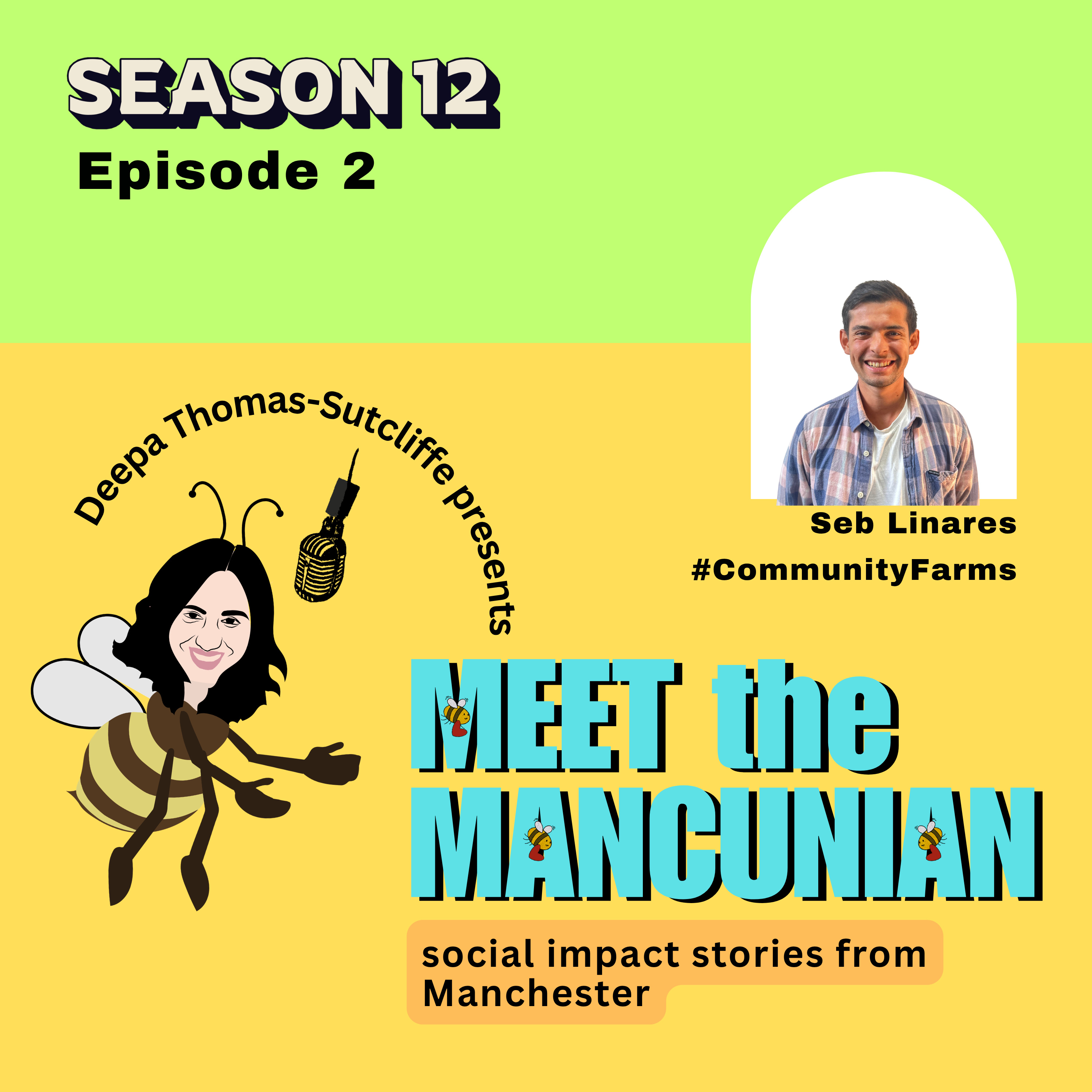


In the second episode of Season 12 of the Meet the Mancunian podcast, host Deepa Thomas-Sutcliffe speaks with Seb Linares, Development Manager at Farm Urban, about using sustainable, hydroponic urban farming to improve health and reduce barriers to fresh food access.
Seb shares how his early interest in fixing the food system led to joining Farm Urban, a social enterprise transforming towns and cities into greener, healthier, more inclusive places. He describes projects in Greater Manchester—including edible wall vertical farms in Gorton and at the Lowry— as well as work with schools, food banks, and partners in Bury.
Seb explains that success means behaviour change and increased food literacy. He reflects on what motivates him, upcoming projects in London and Scotland, and how listeners can help by volunteering their skills.
Did you know:
· Food poverty is the inability to afford oraccess a nutritious, adequate diet. This may involve skipping meals, reduced food quality or going hungry.
· An estimated 14 million people in the UKfaced food poverty.
Key resource:
Time stamps of key moments in the podcast episode &transcript:
(00:53) Meet Seb Linares
(01:41) Seb’s origin story
(02:36) Finding Farm Urban
(03:08) Mission in Manchester
(03:55) Edible walls explained
(05:22) Measuring success
(06:26) Impact stories
(10:29) Challenges and motivation
(13:11) Future Plans and Wrap
🎧Listen on Apple Podcasts, Spotify, YouTube or
www.meetthemancunian.co.uk
#Manchester #SocialImpact #Podcast #CommunityFarms #FoodLiteracy
I hope you enjoyed listening to the podcast episode. Please do check out my other podcast episodes for a bit of inspiration.
12.2 Sebastian Linares podcast
Intro
[00:00:00] Hello and welcome to Season 12 of the Meet the Mancunian podcast: social impact stories from Manchester. I'm your host, Deepa Thomas-Sutcliffe, and I'm so glad you're here today. This season, I'll be speaking with people who are driven by passion and guided by purpose, individuals working in different ways to shape Manchester and strengthen our communities.
[00:00:24] In each conversation, we'll explore what motivates them, what keeps them going, and what impact their work is having across our city. These are honest human stories about why people care deeply about what they do.
[00:00:39] New episodes drop every Tuesday. You can listen on Apple Podcasts, Spotify, YouTube, or at www.meetthemancunian.co.uk.
[00:00:48] Thank you for joining me. Let's meet this week's Mancunian guest.
Episode 12.2 -Meet Seb Linares
[00:00:54] Deepa Thomas-Sutcliffe: Passionate about sustainable farming? We hear from Seb Linares, Development Manager, Farm Urban.
[00:01:01] Deepa Thomas-Sutcliffe: In Seb’s own words.
[00:01:02] Seb Linares: In point A, they don't know how to cook. They have fresh produce and they don't know what to do with it. And point B is going through one of our programmes engaging over several weeks. And then at the end of it, knowing, I know how to grow it. I know how to access high quality, fresh produce. We believe food is ground zero for health and sustainability. And that's what success looks like, seeing communities that really have the tools and the food literacy to live healthier.
[00:01:28] Deepa Thomas-Sutcliffe: Thank you so much, Seb, for joining me today.
[00:01:30] Seb Linares: Deepa, thank you for the opportunity. It took a while to organise this one, but I'm glad we managed to make it.
[00:01:36] Deepa Thomas-Sutcliffe: Absolutely. I guess the timing was right in 2026, so all good.
Seb’s Origin Story
[00:01:41] Deepa Thomas-Sutcliffe: What first sparked your passion for working with the Manchester community? Is there a moment that set you on this path?
[00:01:48] Seb Linares: About three and a half years ago, I started my first business. I was just in college and I came across a bunch of people in North America trying to fix the food system. And I was like I'd to give it a go. I am really passionate about food and health and I was like, okay, I want to do it.
[00:02:07] Seb Linares: I saw that many of the founders and people in the industry were academics, people with a lot of years in academia. Then went into business and I was like, I'm not keen on spending eight-ten years of my life to do something. So I decided to just go and do it. And I started my first business supporting restaurants in the North West.
[00:02:27] Deepa Thomas-Sutcliffe: Thank you so much for sharing. There are a lot of challenges in the current food system. It's interesting that helped you take your next steps.
Finding Farm Urban
[00:02:36] Deepa Thomas-Sutcliffe: Tell us now how your journey with Farm Urban began, and I know it started in other parts of the North West before it came to Manchester.
[00:02:43] Seb Linares: Started in Liverpool, I was supporting restaurants, and then, came across this social enterprise called Farm Urban. And they were growing greens for restaurants, but also for food banks, which was something quite unique the way they worked.
[00:02:56] Seb Linares: And I loved it. I loved their mission, loved their vision, loved what they were trying to achieve, and I got involved. They called me in and started as a placement and three years in, I'm still with them.
Mission in Manchester
[00:03:08] Deepa Thomas-Sutcliffe: So tell us a little bit about what Farm Urban does. What's the vision? How do they work and what are they doing in Greater Manchester since it's Meet the Mancunian?
[00:03:16] Seb Linares: Farm Urban is on a mission to transform our towns and cities into greener, healthier and more inclusive places. And the way we do that is growing good food that connects people to culture, to communities. We started in Manchester about 18 months ago. And it was a project with the University of Manchester and community centres around, so we are now working with Healthy Me, Healthy Communities in Gorton.
[00:03:42] Seb Linares: We're working with the Lowry. We have projects around Bury, and that's all around how can we change behaviour, change attitudes towards food, and how that can lead to healthier communities using food as a mechanism.
Edible Walls Explained
[00:03:55] Deepa Thomas-Sutcliffe: Give us an example of how you work?
[00:03:57] Seb Linares: I'll give you an example of what we're doing with Healthy Me, Healthy Communities in Gorton, a community with amazing people, but also a lot of need. And we have these systems we call edible walls. And they're basically hydroponic vertical systems which look like a vending machine, but instead of sugar drinks and crisps, it has green leafy greens.
[00:04:20] Seb Linares: Fresh produce, growing free of pesticides all year round. And we put one of the systems in the community centre in Gorton. And we taught the community members, some of the volunteers, how to use it, how to grow, produce, using the system all year round.
[00:04:34] Seb Linares: And after about six to eight weeks they have all the tools, all the documents to take that system forward. And now they're growing all the produce that they want to grow. And supports the food pantry that operates every Thursday.
[00:04:48] Seb Linares: So that farm is growing a hundred percent of its produce and is supporting people with barriers to access high quality, fresh produce.
[00:04:56] Deepa Thomas-Sutcliffe: Really interesting. I came across hydroponics when I was living in Saudi Arabia, as you can imagine in climates like the deserts, it's very hard to get fresh vegetables and fruits. And actually, the hydroponic vegetables were tastier, if I may say so.
[00:05:11] Seb Linares: Absolutely. Part of our research is looking into nutrition and minerals in hydroponic produce.
[00:05:16] Deepa Thomas-Sutcliffe: Very interesting. And thank you for sharing what you're doing in the Gorton communities.
Measuring Success
[00:05:22] Deepa Thomas-Sutcliffe: When you think about the change that you're trying to make, what does success look like for you and the people that you serve?
[00:05:30] Seb Linares: I think success looks like the users and the people that we support, changing the way they approach health. Success looks like seeing where we go into a community centre. And they're in point A and in point A, they don't know how to cook. They have fresh produce and they don't know what to do with it.
[00:05:50] Seb Linares: And point B is going through one of our programmes engaging over several weeks, and then at the end of it, knowing, I can grow it. I know how to grow it. I know how to access high quality, fresh produce.
[00:06:02] Seb Linares: And we believe food is ground zero for health and sustainability. And that's what success looks like, is seeing communities that really have the tools and the food literacy to live healthier.
[00:06:12] Deepa Thomas-Sutcliffe: I love that word about food literacy because you're so right. We may know how to buy food from a supermarket, less so how to grow it and what's right to grow and what seasons, I can imagine.
Impact Stories
[00:06:26] Deepa Thomas-Sutcliffe: Can you share a bit about the impact of what you do? How is this transforming communities?
[00:06:32] Seb Linares: Absolutely. I'll give you an example of one organisation that we've supported in Bury North of Manchester. This is one of our corporate partners. They support donation of greens to food banks. They support some of our education programmes in primary and secondary schools.
[00:06:47] Seb Linares: And we started supporting them about three years ago. And when they would have an engagement activity, let's say a social, a summer social, they would order pizza huts and they would order hot dogs and they would order all these things, which every now and then are nice.
[00:07:02] Seb Linares: But when we first started, fresh produce and leafy greens and lettuce was like, what is that? What do I do with that? We've slowly done so many engagement sessions with them that now they have their own vertical farming system in their office.
[00:07:18] Seb Linares: And every single week, they take it for lunch, they take it to their families. So not only they managed to take it, but they've changed their attitudes and behaviours towards green food. They use it a lot more. They have access to it a lot more.
[00:07:30] Seb Linares: And it's going back to that food literacy piece. Like they now have the tools to really embrace that and live healthier through good food. What we're doing in the Lowry in Salford. And if you manage to go to the cafe area, in the restaurant area, you'll see our edible wall, which we maintain every Tuesday.
[00:07:47] Seb Linares: And last week we did an engagement session with some of the volunteers and staff. And again, the Lowry hosts so many events, so many people through the year and now also they have the tools. When people visiting, they see that the system, they see fresh produce is growing. The staff are equipped to answer, actually.
[00:08:05] Seb Linares: It's not just about a flashy tech piece of farming. It's a lot deeper than that. It is about behaviour change. Those are some of the successes that we've seen in Manchester and further afield. 'Because we want to keep expanding and keep going to new cities.
[00:08:17] Deepa Thomas-Sutcliffe: That sounds really interesting. I have been to the Lowry, I think last in September, but I'm so sorry I missed the edible wall completely. And I feel like the next time I go, I want to check it out.
[00:08:28] Deepa Thomas-Sutcliffe: I think it's very interesting what you're saying. It's changing of habits and educating people to make better choices because people do want to make better choices, but maybe lack some guidance and also ideas on what are the things they could make with those fresh produce. So it's quite interesting what you are sharing.
[00:08:49] Deepa Thomas-Sutcliffe: And is there a moment that made you stop and think, yes, this is why we do what we do?
[00:08:54] Seb Linares: Absolutely. Every time we go to a food bank or food pantry, about 80% of the produce that we grow ends up in the food bank. About 20% usually we save it for special projects. I'll give you one special project that we worked on, and that was with Alder Hay Children's Hospital in Liverpool. Not so much Manchester, but it's a children's hospital in Liverpool where again, that changing behaviour, changing attitude piece.
[00:09:18] Seb Linares: We were going every week, we were donating produce and we were doing engagement sessions with children and families. The whole idea was behind how can we use this, produce, this box of greens, and teach families how to make good food with it. Salad and fresh produce doesn't have to be boring. It can be sexy.
[00:09:37] Seb Linares: And what we do and what we try to achieve is how can we make it interested? How can we make it engaging? We were also hosting a school from Bury actually as well. Because we do a lot of programs with young people in primary and secondary schools.
[00:09:52] Seb Linares: And a lot of the program is how can they come up with solutions to the food system. So it's all around entrepreneurship, but also STEM skills, green skills, science, and oh gosh, what some of the ideas that these kids come up with.
[00:10:07] Seb Linares: And it's just wow. Makes me think, where did adults go wrong? Where has that creativity gone? And I get to see that every few months actually see students coming up with great ideas. And those are some of the moments that I say, wow, this is good what we're doing.
[00:10:21] Deepa Thomas-Sutcliffe: I cannot totally understand. Seeing the next generation embrace creative approaches will be very inspiring.
Challenges and Motivation
[00:10:29] Deepa Thomas-Sutcliffe: There must be tough moments in this journey. So what's been the toughest moment of the journey so far, and what helps you manage through it?
[00:10:36] Seb Linares: I think, of course, we want to continue to expand. We want to go to new places. Of course, we're a North West born organisation. And Liverpool and Manchester, it's where we've done most of our work to date. But a few years ago, we were in conversations with a very large corporate to expand some of our initiatives, some of our ideas, some of our projects to a lot more locations.
[00:11:01] Seb Linares: You would've taken Farm Urban from a 10 people staff to 50 in 12 months. It's one of those projects that you only dream about. And they came to us. It was honestly, wow. We were so excited.
[00:11:17] Seb Linares: And we experienced when values are not aligned, really, the project cannot go forward, and the impact cannot go forward. So that was a really frustrating time. Because we spent a lot of resources, time, money, effort to make this thing work.
[00:11:33] Seb Linares: And in the end it was never going to work when the values are not aligned. That was a really tough time, really tough moment. We learned so much. We learned that if we want to bring this mission to life in communities across the UK, we had to work with the right people.
[00:11:47] Seb Linares: And, that's what we did. We started working with the right people and we have businesses, we have universities working with us, and their values aligned. Our values are aligned, and that's what we've learned.
[00:11:57] Deepa Thomas-Sutcliffe: I think it's a very powerful lesson. I can understand it being very difficult, but you're right. If there isn't that value match. It is hard to make sure that something sustainable is built from it. Otherwise, it might be a one-off, is not helpful. Thank you for sharing that lesson.
[00:12:15] Deepa Thomas-Sutcliffe: When the work gets heavy or when the progress is slow, what helps you stay motivated and hopeful? Is there a ritual or a mantra or a belief that keeps you going?
[00:12:25] Seb Linares: I think what I like to do is always be in touch with everything that happens in the organisation. It can be sometimes be heavy writing proposals, writing grants, applications, or in meetings. But when I go to the frontline, when I look at the delivery, when I look at the impact. That brings it back, that brings that fire back to my belly.
[00:12:47] Seb Linares: That's what I try to achieve either from the research part of it, to food banks, to schools. I just like to be in the frontline, always be in touch with that, so I get to see the end product of what we do. I would say, that's what I do.
[00:13:00] Deepa Thomas-Sutcliffe: I think that's very powerful. You're right to reinforcing your mission to you every day and moving away from proposals and meetings to seeing it in action.
[00:13:10] Seb Linares: Absolutely.
Future Plans and Wrap
[00:13:11] Deepa Thomas-Sutcliffe: What's next for you and Farm Urban? What should we look out for in the months ahead?
[00:13:16] Seb Linares: We have so many projects in the pipeline. Which ones will come to fruition? Which ones will not? I still don't know. And we are so excited. Manchester is another home to us. And we'll continue to partner with new organisations.
[00:13:29] Seb Linares: We want to expand what we're doing in the Lowry and take it out even further. We are only in the restaurant area. We want to take that to different places of the Lowry. It's a very large theatre. And the staff and the team are just amazing. We want to do more there.
[00:13:42] Seb Linares: We want to do more in in the Gordon community. So we've planted the seed. And that can flourish, that can grow a lot more. So we are in conversations on how can that expand more.
[00:13:54] Seb Linares: And we are now in a very exciting project in London. And that's with impact in urban health, which sits under the St. Thomas Foundation, the very large hospital in London. And that's looking into tackling health inequalities in the south of London, mainly Lambeth and Southwark. And again, using food systems as a method to tackle those issues. And there's a lot going on around that.
[00:14:17] Seb Linares: We're also in Scotland again, projects with the council there, so there's a lot going on and so I just, I often tell people. Just stay up to date. Because we never know when these things will just start.
[00:14:29] Deepa Thomas-Sutcliffe: Thank you for sharing some of your very exciting future plans and also geographically expanding besides working with more partners in the. North West.
[00:14:40] Deepa Thomas-Sutcliffe: When listeners listen in, they're listening from about 70 plus countries. Many of them want to help, but they don't always know how. So where can they make a big difference in a very simple, everyday manner?
[00:14:53] Seb Linares: I think we all have skills. We all have talents of some sort. I would encourage you to use those skills to good use, put them to good use. There will be charities, there will be non-for-profits, there will be community organisations that could really benefit from your skill and from your skillset and from your talent.
[00:15:13] Seb Linares: So if you have the time, maybe your employer has volunteering days, maybe you have spare weekend here and there, put it to good use. There will be people that would really appreciate it.
[00:15:24] Deepa Thomas-Sutcliffe: It's a really great tip and thinking about the skills. Everybody has skills, they have time that they can give, and there's so many amazing charities and community groups that are just waiting for volunteers. Really good shout out there.
[00:15:40] Deepa Thomas-Sutcliffe: What's something about your work or the voluntary sector that you wish more people truly understood?
[00:15:46] Seb Linares: One thing is of course, hydroponics and technology that's very new, very innovative. If I were in the Netherlands, everyone would know what I do because of how the industry works there and how large it is in the Netherlands. But that's not the case in the UK.
[00:16:02] Seb Linares: Maybe people could understand that it's not just about growing produce and putting in a restaurant shelf, in a restaurant and or in a supermarket. And those things are great, but how can we use food to really empower communities? That's something that I really want people to just know about us. That's our work. That's why we are here. How can we remove barriers so communities and people can live healthier.
[00:16:25] Deepa Thomas-Sutcliffe: You're right. Maybe not new, but it is a new-ish concept until it reaches some level of scale. People may not understand it and also then think about the impact about on health, because that's such an important part of your mission, isn't it? That you want people to live a healthier life.
[00:16:43] Seb Linares: That's right.
[00:16:44] Deepa Thomas-Sutcliffe: Is there a community collaboration or a partnership, or even an act of kindness that has inspired you recently?
[00:16:52] Seb Linares: There is one. We are working what with one of the partners that we have in Bury. They support so many organisations. They support a hospice in Oldham. They support a Salvation Army Group in Salford. They support us. They support a food bank in Liverpool.
[00:17:08] Seb Linares: So many organisations in the North West, and they've acted like a magnet almost. They bring all these people together to do good work and and they just like to stay in the back. They don't want the highlight. They're a private business.
[00:17:20] Seb Linares: And I get to see them every week and chat to them. And what they've done that network of partner that they've built is truly inspiring. It is a business called The Mailing Room in Bury. And if you're around Bury, just give them visit. They're just a brilliant team and again, just a private business selling Frankie machines, but they deliver really good impact. I'm inspired by them.
[00:17:39] Deepa Thomas-Sutcliffe: I think that is something about being a facilitator or like you said, the magnet of attracting good people to then collaborate and do interesting things. Well done to The Mail Room and hope they can continue to partner with many more organisations and of course support the work you do.
Signature questions
[00:17:58] Deepa Thomas-Sutcliffe: I'll now move us to the signature questions that I ask all my guests.
[00:18:03] Deepa Thomas-Sutcliffe: If Manchester had a superpower, what would it be? And how have you seen it in action?
[00:18:08] Seb Linares: Manchester is so strong in networks. When you have a community group, when you have a business that knows someone, that network just comes together and does amazing things. We're part of a network called the Business Network in Manchester, and oh gosh, I've seen it. I asked a question and you have 20 people just jumping on board from Manchester saying okay this is what you can do. It's the power of connection.
[00:18:30] Deepa Thomas-Sutcliffe: I like that very much, and yes, we've had the Better Business Network on the podcast as well, and it's great stuff that they do.
[00:18:39] Deepa Thomas-Sutcliffe: If you could gift Manchester one new value, habit, or mindset, what would you choose to strengthen community life?
[00:18:46] Seb Linares: I think the power of grow of growing good food everywhere in Manchester. Food has the power of connecting people from different backgrounds, cultures, income, job. And we're seeing it in Manchester actually. But it everywhere, south, north, east, west, centre, just see more of it.
[00:19:06] Deepa Thomas-Sutcliffe: Like that about the power of growing your own good food that. It does sound really powerful and definitely had my own little experiments with some herbs and tomatoes, but not much else. So maybe I need to take a leaf from hydroponic here.
[00:19:23] Deepa Thomas-Sutcliffe: If you could have a 10 minute conversation with a community hero from Manchester's past or present, who would it be with and what would you ask them?
[00:19:33] Seb Linares: I think there is someone at the moment doing something really powerful. Hannah Cox, what she's doing across India, running so many marathons for 1% for the planet. I think she's a hero in Manchester and not just Manchester all across the world, I would say.
[00:19:49] Seb Linares: I encouraged people to look her up and see what she's doing and support her. I would ask, wow how have you done it? Because the body definitely told you no many times. And that's one person I admire.
[00:19:59] Deepa Thomas-Sutcliffe: Hannah's of course been on the podcast as well, and yes, her story is very inspiring and thank you for sharing that.
[00:20:07] Deepa Thomas-Sutcliffe: Looking back, what's a life lesson or a piece of wisdom that this journey has taught you? Something that you carry with you always.
[00:20:14] Seb Linares: I would say that life is less about taking and more about giving. And one of the greatest pleasures of life is the pleasure of serving. And how can you use what you have, your job or your skillset. Going back to what we spoke about is how can you use that to serve your community, serve others, and being selfless. I think that's a lesson that I carry with me.
[00:20:37] Deepa Thomas-Sutcliffe: Very powerful. And you're right. We need both. You need a collaboration to take place. We need that give and take. But we can do more by giving and serving and using our skills or our network for good.
[00:20:50] Deepa Thomas-Sutcliffe: What's the best way for listeners to connect with you, support your mission, and learn more? Where can they find you on websites, socials, or anything else?
[00:20:59] Seb Linares: You can always check in with our. Social networks. So Farm Urban is on Instagram as www.farmurban.co.uk, that's our website domain and that's our website. So you can always go to our website and see more of what we do. And LinkedIn of course is also a network that we are really active on.
[00:21:18] Deepa Thomas-Sutcliffe: Thank you so much, Seb. It's been a great conversation and thank you for sharing how people can get in touch with you. Hopefully listeners will get in touch. And thank you for your time today.
[00:21:28] Seb Linares: Deepa, thank you for the opportunity.
Outro
[00:21:30] Deepa Thomas-Sutcliffe: Thank you for listening to the Meet the Mancunian podcast: social impact stories from Manchester. If today's episode resonated with you, please share it with someone who believes in the power of passion and purpose, or leave a review to help others discover the podcast.
[00:21:47] Deepa Thomas-Sutcliffe: You can connect with me on social media @MeettheMancunian on Instagram, Facebook, and Blue Sky. And @MeettheMancunianPodcast on YouTube.
[00:21:58] Deepa Thomas-Sutcliffe: I'm Deepa Thomas-Sutcliffe, and I'll be back next Tuesday with another story from the people shaping Manchester.
[00:22:05] Deepa Thomas-Sutcliffe: Next week, we hear from Norton Robinson talking about mushroom farming to tackle food poverty.
[00:22:12] Deepa Thomas-Sutcliffe: Until then, thank you for listening and for being part of this community.
