


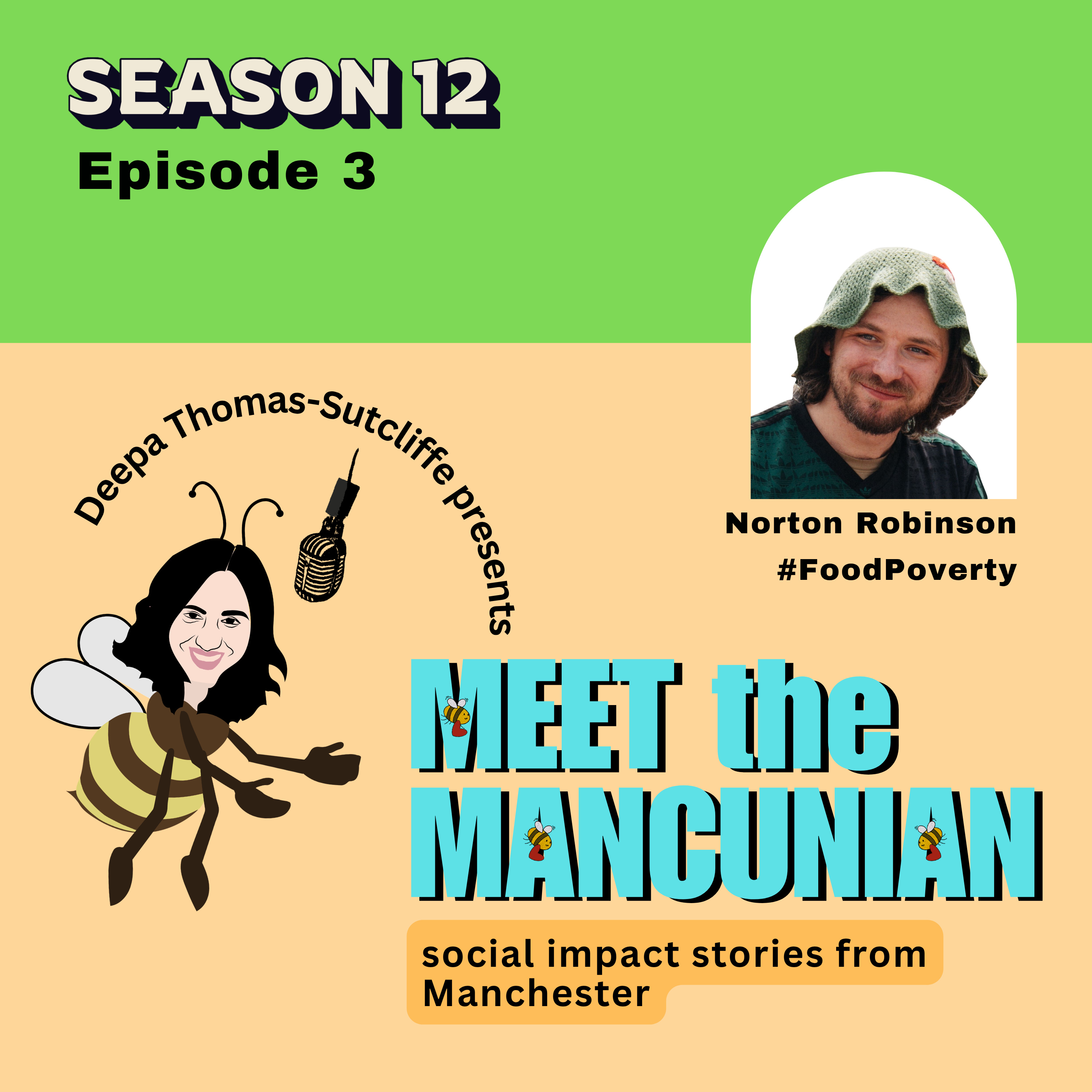






Host Deepa Thomas-Sutcliffe speaks with Norton Robinson, director of Fungall CIC, about tackling food insecurity sustainably through community mushroom farming. Norton shares how his interest began at university and through exploring “speculative futures,” leading to a bedroom mushroom lab and then community-based projects.
Fungall builds local mushroom farms that transform waste—especially brewing and coffee waste—into mushrooms that become community meals, supporting people facing food insecurity and loneliness.
Norton outlines a vision for a scalable, ethical, franchisable network of community-owned farms across city wards. He discusses the challenges of having no blueprint, managing burnout by setting boundaries, plans for a research master’s on brewing-waste scalability, and ways people can support or volunteer.
Did you know:
· Food insecurity is the limited or uncertain access to adequate, nutritious food needed for a healthy life, often due to lack of money or resources.
· Brewing waste in Manchester is being increasinglymanaged through sustainability initiatives, including converting wasted beer into green energy, reusing spent grains for livestock feed, and researching ways to extract chemical compounds from byproduct. Major efforts involve onsite composting, packaging reduction, and using waste for biogas.
Key resource:
Time stamps of key moments in the podcast episode &transcript:
(00:50) Meet Norton Robinson
(01:35) Origins and inspiration
(03:16) How Fungall works
(03:46) Scaling the vision
(05:29) Impact stories and meals
(09:06) Founder challenges
(10:31) Staying motivated
(13:05) Future plans and mushrooms
🎧 Listen on Apple Podcasts, Spotify, YouTube or www.meetthemancunian.co.uk
#Manchester #SocialImpact #Podcast #CommunityFarms #FoodInsecurity
I hope you enjoyed listening to the podcast episode. Please do check out my other podcast episodes for a bit of inspiration.
Norton Robinson 12.3 Episode transcript
Intro
[00:00:00] Speaker: Hello and welcome to Season 12 of the Meet the Mancunian podcast: social impact stories from Manchester. I'm your host, Deepa Thomas-Sutcliffe, and I'm so glad you're here today.
[00:00:12] Speaker: This season I'll be speaking with people who are driven by passion and guided by purpose, individuals working in different ways to shape Manchester and strengthen our communities. In each conversation we'll explore what motivates them, what keeps them going, and what impact their work is having across our city. These are honest human stories about why people care deeply about what they do.
[00:00:38] Speaker: New episodes drop every Tuesday. You can listen on Apple podcasts, Spotify, YouTube, or at www.meetthemancunian.co.uk. Thank you for joining me.
Episode 12. 3 Meet Norton Robinson
[00:00:50] Speaker: Let's meet this week's Mancunian guest, which continues our sustainability focus.
[00:00:56] Deepa Thomas-Sutcliffe: Passionate about tackling food insecurity sustainably? We hear from Norton Robinson, director, Fungalll.
[00:01:02] Deepa Thomas-Sutcliffe: In Norton's own words.
[00:01:04] Norton Robinson: I think the reason why the community projects are quite important at this time. It's because we are living in quite precarious times. I think we are quite divided at the moment. So starting projects that push back against that and put a focus on togetherness and community, I think that can just help the world heal a little bit.
[00:01:25] Deepa Thomas-Sutcliffe: Thank you so much, Norton, for joining me today.
[00:01:27] Norton Robinson: Thank you for having me Deepa and it's a pleasure to meet you. And hello to the audience listening.
[00:01:33] Deepa Thomas-Sutcliffe: Thank you for that. Hello to our listeners.
Origins and Inspiration
[00:01:35] Deepa Thomas-Sutcliffe: What first sparked your passion for supporting the Manchester community? Where did that start?
[00:01:40] Norton Robinson: In regards to Manchester, I guess it was whilst I was at university, so I was exploring how I could work with communities, and that led to me doing a RISE project. And I was working with refugees and asylum seekers. But alongside that I had a university project, which was exploring what I do today.
[00:02:04] Deepa Thomas-Sutcliffe: Lovely to know that you were helping refugees and asylum seekers.
[00:02:09] Deepa Thomas-Sutcliffe: And how did your journey with Fungalll start? I know that started in college as well.
[00:02:14] Norton Robinson: My journey with Fungall started when I was doing a fine art degree, and that led to me exploring speculative futures in the anthrop scene. Or to put that a little bit more simply, I was creating imaginations or assumptions about futures that I thought might exist in the future. And one of those was the mushroom farming, but that kind of started by a project, which was essentially I was exploring food system collapse.
[00:02:44] Norton Robinson: I tried to imagine how we could survive if food systems collapsed, and that was a mushroom lab in my bedroom that was made from found objects in and around the house or things that I could find and not purchase online. And that led to me creating mushroom farms in my bedroom, and then in the communities after.
[00:03:07] Deepa Thomas-Sutcliffe: That is so interesting and for anybody who's watched disaster movies, I can totally get maybe wherever you are thinking about this.
How Fungall Works
[00:03:16] Deepa Thomas-Sutcliffe: Tell us a little bit more about what Fungall does and how it works with communities to grow mushrooms.
[00:03:22] Norton Robinson: What Fungall does Fungall goes into communities, it builds mushroom farms and facilities that can turn local waste, like brewing waste or coffee waste into mushrooms. And then those mushrooms are turned into community meals which help people with food insecurity.
[00:03:40] Deepa Thomas-Sutcliffe: Really interesting. As a person who loves mushrooms, I'm looking forward to learning more.
Scaling the Vision
[00:03:46] Deepa Thomas-Sutcliffe: When you think about the change you're trying to make in food insecurity in a sustainable way, what does success look like for both yourself and the people that you serve?
[00:03:56] Norton Robinson: I've always had a vision as to what Fungall might finish up or where I would like it to lead. And the vision is a network of community owned mushroom farms that are spread out across the wards of a city. And they can collect things like brewing waste. They can process it, they can turn it into that food that I was mentioning.
[00:04:18] Norton Robinson: And that could be done in a ethical franchisable model that is scalable. And one of the things we're exploring at the moment is how viable brewing waste is as a substrate. Because if we go and collect that from a place like, I'm trying to describe this. In Manchester City Centre, you have a network of brewers which all work together and they produce a lot of brewing waste.
[00:04:44] Norton Robinson: And that is the the waste produce of the beer making process. So if we can find a way to transform that from a thing that is thrown away into a thing that can create tons and tons of food every week, then we are onto a winner there, which can produce lots of food for the community.
[00:05:07] Deepa Thomas-Sutcliffe: And you also use coffee beans waste for a similar purpose, is that right?
[00:05:11] Norton Robinson: We've worked with some companies to collect their coffee waste. We found that it works, but we can't quite reach the quantities logistically that we can with brewing waste. So that's why we're exploring the brewing waste at the moment.
[00:05:27] Deepa Thomas-Sutcliffe: Very interesting.
Impact Stories and Meals
[00:05:29] Deepa Thomas-Sutcliffe: What would you say is the impact that Fungall is making today, and then what's the possibilities?
[00:05:35] Norton Robinson: The impacts that we make, they look quite different depending on who we're working with. It could be that we're working with people on probation. They come down, they help us turn the waste into food, the food into meals.
[00:05:50] Norton Robinson: It could be that we're working with universities, so we go onto site, we teach them the processes, a bit more of the science behind it in a day. So they get a workshop. It could be the local residents who are getting to eat the food that we cook. It could be the local partners who we're working with, who are able to share what they're able to do in a community through supporting somebody like ourselves.
[00:06:19] Deepa Thomas-Sutcliffe: Is there one example that you'd like to just dimensionalise this impact.
[00:06:23] Norton Robinson: We have two mushroom farms at the moment, both located in two different places. So on wood location we have the Merseybank. We work directly with the people who are there on the Merseybank and that looks a lot like just cooking food for people in a cafe. So out the back of the cafe is where we have the mushroom farm. We produce food and that essentially just becomes plates on tables for the local community so they could eat and share food together.
[00:06:55] Norton Robinson: We also have the Ingham Road location, which is St. Mag's Community Center. So same setup, community mushroom farm in a community cente where we can cook the food that we grow and give it to the community who are affected by things like food insecurity. But it could also be things like loneliness as well. So sometimes people just want to sit down and have a nice meal together with a new friend.
[00:07:27] Deepa Thomas-Sutcliffe: I like that. I think food insecurity is obviously extremely concerning, but also loneliness and isolation is probably one of the biggest societal evils we're all facing regardless of where we are. And if you can bridge that gap through food and conversation, that's really good.
[00:07:48] Deepa Thomas-Sutcliffe: Is there a moment that makes you stop and think, yes, this is why we do what we do.
[00:07:53] Norton Robinson: I think it's whenever I get to whenever we're sitting down together and eating, I think that's always like a very rewarding moment for me when when we cook a nice dish, like the other week we made sausage. I'm from Yorkshire, so they seem very much a part of my childhood, let's say.
[00:08:12] Norton Robinson: So being able to cook something which is symbolic of my childhood, but also super delicious and it sharing a little part of me as well as the business, which is a little part of me as well. But it's sharing a little bit of a personal touch. So adding the recipes, I think the recipes can bring a lot. I feel quite special depending on the recipes.
[00:08:38] Deepa Thomas-Sutcliffe: My husband's from Yorkshire, that's why I smiled. And I did also think that there's something such a lovely thing about food that it connects us in a way. It almost brings back memories of childhood or loved ones or special memories in a very nice way. And that's brilliant that you also get the chance to taste the benefits of your hard cooked or hard grown mushrooms, I would say in this case.
Founder Challenges
[00:09:06] Deepa Thomas-Sutcliffe: What's been the toughest part of the journey so far, and what's helped you navigate that?
[00:09:10] Norton Robinson: I guess the toughest parts are you're going into something completely blind. There's not many people doing things with mushrooms in communities and community food, so you are having to piece together, lots of things what are quite new to you. There's no blueprint.
[00:09:28] Norton Robinson: So when it comes to the business, naturally I'm quite creative, but the business isn't something that I was particularly well skilled up. There's the cooking and the growing all of these things. I knew how to do it, but it was definitely learning on the job.
[00:09:45] Norton Robinson: But you're taking on multiple different roles wearing so many different hats that it's quite a lot to juggle. But it's great because I love that I'm learning all of these things little by little. And that's feeding into the business and it's helping me grow as a person, but also helping the business find something. It feels unique and it feels like it's novel, which I think is quite important.
[00:10:14] Deepa Thomas-Sutcliffe: There's something powerful about being a pioneer, isn't there? So the fact that there's no blueprint, yes, that's daunting, but you also then get to shape your own way. Like you said, learning little by little as you navigate a particular stage or phase.
Staying Motivated
[00:10:31] Deepa Thomas-Sutcliffe: When the work becomes heavy or the progress is slow, what helps you stay motivated and hopeful? Is there a particular ritual or a mantra or a belief that keeps you going?
[00:10:43] Norton Robinson: Initially I just used to panic and, overwork myself and burnout. And it was causing me all kinds of like health and wellbeing problems to the point where I'm not sleeping properly. Grinding my teeth or just constantly stressed, and I'm bringing that out in my relationships with people, and it was having quite a detrimental effect in my life.
[00:11:07] Norton Robinson: What I've started doing more recently is I focus. I create a lovely schedule for myself. So the work works around my schedule now to some degree. So I know that every week I'm going to go do yoga. On this day, I'm going to go to the gyms on this part of the evening, I'm going to have board game nights, so I'm going to do whatever it might be.
[00:11:28] Norton Robinson: There's something there. And that is my hard, what's the word? Is it like a hard nose? I've created boundaries for myself where it's not just me just constantly focusing on work. It's like this setting myself a timeframe around the fun things that I can add to my life. Taking advantage of that flexibility, so it's benefiting me in a positive way so I can give my all to the business essentially.
[00:11:58] Deepa Thomas-Sutcliffe: I really like that. So powerful because the way you expressed it that your work is now fitting around your life or life boundaries. And that's really wonderful because you're right, if we don't have the energy and a bit of recharge moments, you're not going to be able to bring that same passion and energy.
[00:12:19] Deepa Thomas-Sutcliffe: And that's probably why some level of that stress is what you were experiencing. But this is really good and more power to you and definitely something that I'm sure listeners will be taking note of as they think about their own situations.
[00:12:37] Norton Robinson: I think just having those things in place, sometimes the week might force you to do something like, as I was mentioning, I've got a holiday coming up, so I'm probably missing a few of these nice things whilst I get ready for my holiday. And I live by it, but as long as you know that these are your boundaries, I think it's really nice to have them in place.
[00:12:57] Deepa Thomas-Sutcliffe: I think there's a little bit of flex we need to create to accommodate new things that are coming in as well. So that's great.
Future Plans and Mushrooms
[00:13:05] Deepa Thomas-Sutcliffe: What's next for you and your mission? So what should we look out for in 2026?
[00:13:10] Norton Robinson: I'm really excited about this actually. I'm hoping to be starting a master's degree this year, which will be a research master's around Fungall. So that would be collecting the brewing waste and just gaining a better understanding for its scalability. Whilst we've done certain tests with it, we're going to be exploring how we can add micronutrients, how we can help to improve the water structure of the brewing waste and understand the scalability of it.
[00:13:39] Norton Robinson: So if that is something that we can produce on mass. I think I mentioned this earlier, but it'll be exceptional for the growth of Fungall, but also for my academic career, academic understandings. And it'll just open a lot of doors.
[00:13:56] Norton Robinson: And I think it enables scalability to this whole project where it's not just one or two communities. It could grow into a network of mushroom farms in Manchester or further afield.
[00:14:10] Deepa Thomas-Sutcliffe: It sounds really exciting. Good luck to you as you navigate both the academic side and the practical side of the research and all the various experiments. It'll be interesting to hear more about it.
[00:14:24] Norton Robinson: Thank you.
[00:14:25] Deepa Thomas-Sutcliffe: Out of my curiosity, what mushrooms do you grow? Is there a particular kind of mushroom, just because they all look very big in the pictures.
[00:14:32] Norton Robinson: The main mushroom we tend to grow is oyster mushrooms because they are very quick growing. They're very forgiving. So if things go wrong , the speed at which the oyster mushroom grows up tends to cover the issue. You don't have too much trouble with them. But we do grow lion's mane. We do grow carly seps. We will plan to grow more in the future, but yeah, they're the main.
[00:14:56] Deepa Thomas-Sutcliffe: Was the third one? Lions Man. And what was the third one?
[00:14:59] Norton Robinson: Carly Seps
[00:15:00] Deepa Thomas-Sutcliffe: Okay. I don't think I know these two at all, so I should look them up just out of curiosity and interest, to know more.
[00:15:09] Deepa Thomas-Sutcliffe: Back to the podcast.
Get Involved and Wrap Up
[00:15:11] Deepa Thomas-Sutcliffe: Now many listeners want to help and they don't always know how. Where can listeners make the biggest difference in a simple, everyday way?
[00:15:20] Norton Robinson: I would say just being actively involved in a movemen t. It's just sharing support for the people doing things. It's always nice to receive a nice comment. If we're doing a project and somebody gives some kind words, it does inspire you. You can also find other ways to contribute, whether that would be digitally creating resources. That might be something that.
[00:15:48] Deepa Thomas-Sutcliffe: Thank you. I like that very much about getting more active in the greener space or the sustainability space, but also giving a bit of a shout out for the good work happening around you and encouraging that and considering digital resources as well.
[00:16:05] Deepa Thomas-Sutcliffe: What's something about your work or the voluntary sector that you wish more people truly understood maybe take mushroom farming, because I guess people haven't thought about that.
[00:16:16] Norton Robinson: I think the reason why community projects are quite important at this time. It's because we are living in quite precarious times. I think we are quite divided at the moment. So starting projects that push back against that and create or put a focus on togetherness and community, I think that can just help the world heal a little bit. I think that's a nice thing that we should be aiming for.
[00:16:41] Deepa Thomas-Sutcliffe: Thank you for sharing about community projects and togetherness in a world that is slightly divisive at the moment. I do think that's important.
[00:16:51] Deepa Thomas-Sutcliffe: Is there a particular community collaboration or a partnership or even an act of kindness that has inspired you recently?
[00:16:59] Norton Robinson: It's more of a team, so I'm going to shout out Matty and Ellie.
[00:17:04] Norton Robinson: Matty and Ellie, who have recently started working with Fungall and yeah, it started off and they just popped along into a workshop and then recently they've been getting a lot more involved and it just feels really natural.
[00:17:22] Norton Robinson: We became super, super close friends just through, through what was essentially just a workshop initially. And now they're finding ways to contribute to Fungall and contribute to the communities through the workshops, to the point where I'm able to take a step back from the workshops now to a degree.
[00:17:41] Norton Robinson: And I feel I very much trust that those guys can take over and just do something really amazing within that space. Give something back to the community locally. That's what sprung to mind,
[00:17:55] Deepa Thomas-Sutcliffe: I'll now move us to the signature questions I ask all my guests.
[00:17:59] Deepa Thomas-Sutcliffe: This is Meet the Mancunian. If Manchester had a superpower, what would it be and where have you seen it in action?
[00:18:06] Norton Robinson: Is rain a superpower?
[00:18:08] Deepa Thomas-Sutcliffe: Go for it.
[00:18:09] Norton Robinson: it's very green. If Manchester's superpower is rain, and that's why we've got such a beautiful local green landscape. If you go out to the peaks, you'll find beautiful hills of green and that is because of Manchester's superpower.
[00:18:26] Deepa Thomas-Sutcliffe: So Rainchester is a superpower in that sense? It is beautiful and definitely, keeps the surroundings green, which is really nice.
[00:18:37] Norton Robinson: I remember when I was a little bit younger, I'd been on holiday and I'd been in just spent a lot of time outside of England. And then I remember flying back over the UK and from Manchester and just like looking at the fields and being like, oh, wow. That's so green.
[00:18:55] Deepa Thomas-Sutcliffe: It is definitely green and also blue, isn't it? There's a lot of canals and rivers.
[00:19:00] Deepa Thomas-Sutcliffe: If you could gift Manchester one new value, habit, or mindset, what would you choose to strengthen community life?
[00:19:08] Norton Robinson: I'm very blessed to be in. lot of communities that are very much what I aspire Manchester to be like as a whole. So very much caring and empathetic. I think everywhere would benefit from being a bit more caring and empathetic. And I would give that to Manchester.
[00:19:30] Deepa Thomas-Sutcliffe: It's definitely got a warm heart, but I can understand that there's definitely more that could happen to be more caring and empathetic and understanding of different backgrounds.
[00:19:41] Deepa Thomas-Sutcliffe: If you could have a 10 minute conversation with a community hero from either Manchester's past or present, who would this community hero be and what would you ask them?
[00:19:51] Norton Robinson: I remember when I was doing my. I looked at the Lindow Bog Man. So it was a guy who was preserved in the peat bogs. He passed away about 2000 years ago and he was rediscovered quite recently. And I guess, that person's always interested me a little bit. I'm always quite intrigued.
[00:20:19] Norton Robinson: There's the iceman, have you heard of Otzi? So they discovered lots about Otzi because he had two different types of mushrooms on him. And one was like a Tinder fungus, so we could create fires with it. And then the other was a Polypore so we could heal wounds with it. But yeah, I guess the Lindow Bog Man is Manchester's version, but perhaps a little bit more dirty.
[00:20:42] Deepa Thomas-Sutcliffe: And what would you ask this bog man man?
[00:20:45] Norton Robinson: I guess we just sit down and have a meal together.
[00:20:48] Deepa Thomas-Sutcliffe: That is a good one.
[00:20:49] Deepa Thomas-Sutcliffe: I'm going to have to look up thisLindow Bog Man and Otzi see both of which I have not heard of.
[00:20:55] Deepa Thomas-Sutcliffe: Looking back, is there a life lesson or a piece of wisdom that this journey has taught you so far?
[00:21:01] Norton Robinson: I think it's taught me a lot about resilience. It takes a lot to build something up from an idea and to stick at it, even though financially it's not always makes the most sense. It can take a lot out of you, just in general. But it's allowed me to having something to focus on has been good for me and just helped me to be a functional adult. I can be proud of myself to some degree.
[00:21:30] Deepa Thomas-Sutcliffe: What would you say is the lesson that has helped you particularly, is it resilience? Is it something else?
[00:21:36] Norton Robinson: The lesson is some, in some part resilience and just self-belief. Resilience, and just I also feel like I've learned lots of things which have just done a massive small things that I'm, I probably will be able to get a job in.
[00:21:55] Norton Robinson: But I'm very good at little things so I can understand what lots of jobs look like through the the mass of different roles that I've taken on. I feel like I've been able to learn a whole lot of things.
[00:22:09] Norton Robinson: What's the thing? Jack of all trade. Master of none.
[00:22:13] Deepa Thomas-Sutcliffe: I guess this is part of the founder pains, isn't it? Till you build a team, you will be doing everything from, strategy to execution. But it's really interesting that you've called out both the resilience but also self-belief to carry you through the hard times. There will be hard times in all lives.
[00:22:36] Deepa Thomas-Sutcliffe: So what's the best way for people to connect with you, to support your mission and to learn more?
[00:22:42] Norton Robinson: Yes. So we have a Instagram page. First of all that is Fungall. Cic that's F-U-N-G-A-L-L cic. That would probably be the best place to connect with us. You can send us a message there if you want to know a little bit more. We have a website, which is Fungall.org.
[00:23:02] Deepa Thomas-Sutcliffe: Are you looking for volunteers or supporters or other people to come forward for community farms?
[00:23:10] Norton Robinson: I guess we're looking local volunteers. If there's people who think they can contribute from further afield, I would say feel free to reach out and suggest something because I'm always looking to find new ways to improve what we're doing. And if there's some way that somebody feels they can contribute, I'd be happy to hear how they might do that. Reach out. Let's have a conversation.
[00:23:36] Deepa Thomas-Sutcliffe: Do you want to say anything about local volunteers? What are you looking for them to help with?
[00:23:41] Norton Robinson: In regards to the local volunteers, we always need people to come down and help us cook. We always need people to come down, help us grow, so it's grow, cooking and eating. So as long as you enjoy doing any of one of those three, just come get involved.
[00:23:55] Deepa Thomas-Sutcliffe: I hope volunteers do come forward and digital collaborators too. Today's world, we do a lot digitally. I'm sure there'll be some interesting reach outs.
[00:24:07] Deepa Thomas-Sutcliffe: Thank you so much. It was so nice to talk to you today, Norton.
[00:24:11] Norton Robinson: Thank you for reaching out and suggesting that we should do this. It's been fun.
Outro
[00:24:16] Thank you for listening to the Meet the Mancunian: social impact stories from Manchester. If today's episode resonated with you, please share it with someone who believes in the power of passion and purpose, or leave me a review to help others discover the podcast.
[00:24:32] You can connect with me on social media @MeettheMancunian on Instagram, Facebook, and Blue Sky, and @MeettheMancunianpodcast on YouTube.
[00:24:43] I'm Deepa Thomas-Sutcliffe, and I'll be back next Tuesday with another story from the people shaping Manchester. Next week, we hear from Alun Morris talking about community farming.
[00:24:54] Until then, thank you for listening and for being part of this community.
