
 Apple Podcasts
 Spotify
 RSS Feed
 Amazon Music
 YouTube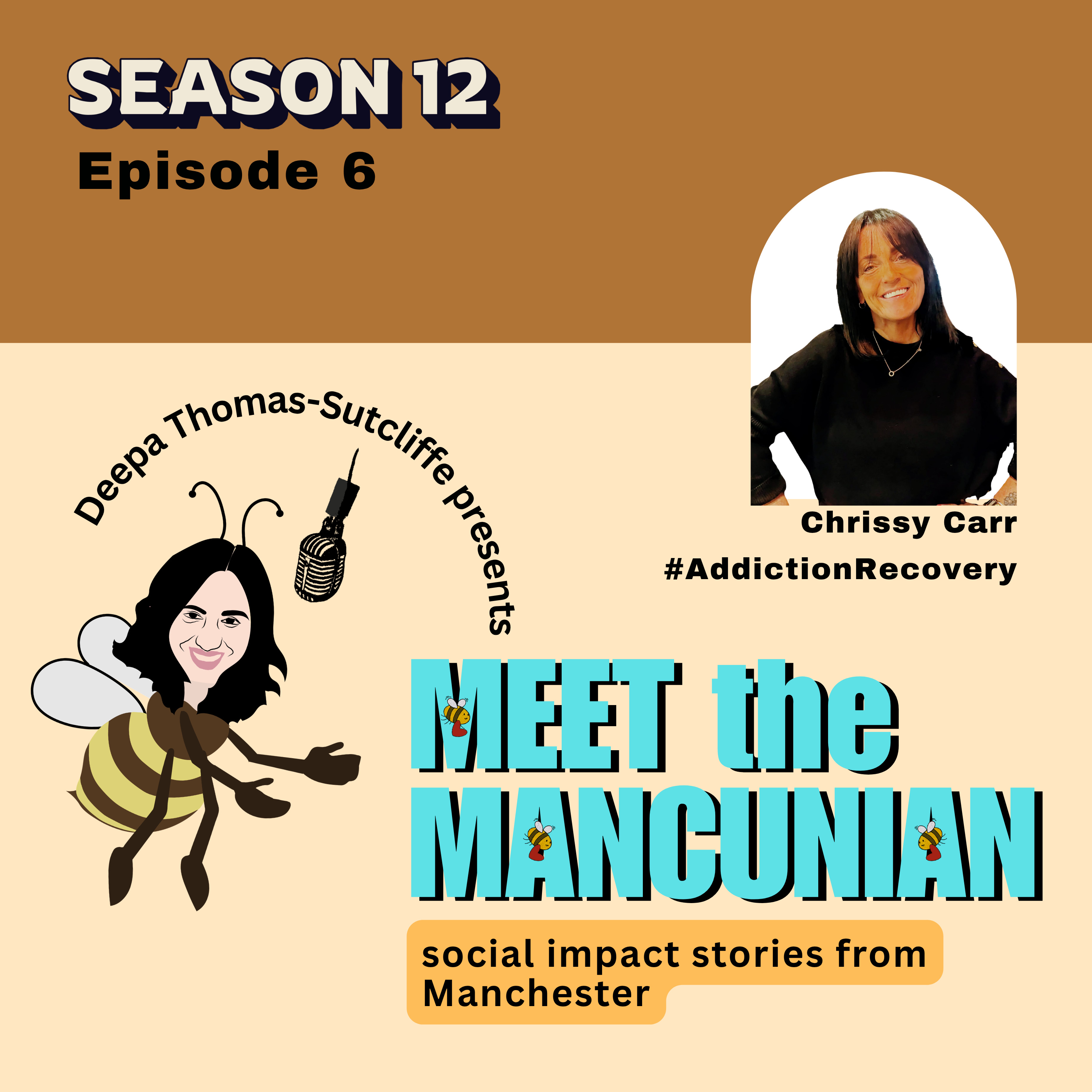
Host Deepa Thomas-Sutcliffe introduces the sixth episode of Season 12 of Meet the Mancunian and speaks with Chrissy Carr, co-founder of Mums in Recovery, about supporting mothers recovering from addiction and rebuilding family life. Chrissy shares how her lived experience and NA fellowship inspired her to help women who feel stuck, and how the group began after supporting a mother whose baby was taken at birth.
Mums in Recovery offers connection and understanding through weekly free Zoom wellbeing check-ins, WhatsApp community, workshops, events, advocacy, and a behavioural change programme focused on boundaries, relationships and wellbeing. Chrissy highlights tackling stigma and the impact of peer support. She discusses using 12-step principles like acceptance, plans to accredit and scale training nationally, and encourages listeners to make a difference by simply listening to people who are going through a hard time.
Did you know:
· An estimated 3 million people in the UK have successfully overcome alcohol or drug addiction.
· 329,646 adults are in treatment for drug and alcohol addiction in the 2024-2025 period.
Key resource:
Time stamps of key moments in the podcast episode &transcript:
(00:51) Meet Chrissy Carr
(01:45) Passion from lived experience
(03:08) Founding Mums in Recovery
(04:50) What the group offers
(09:32) Defining success and fighting stigma
(12:18) Impact stories
(17:52) Hardest parts and staying motivated
(23:33) What’s next and how to help
(30:15) Signature questions
🎧 Listen on Apple Podcasts, Spotify, YouTube or www.meetthemancunian.co.uk
#Manchester #SocialImpact #Podcast #AddictionRecovery#Mothers
I hope you enjoyed listening to the podcast episode. Please do check out my other podcast episodes for a bit of inspiration.
Episode 12.6 Chrissy Carr Transcripts
Intro
[00:00:00] Hello and welcome to Season 12 of the Meet the Mancunian podcast: social impact stories from Manchester. I'm your host, Deepa Thomas-Sutcliffe, and I'm so glad you're here today.
[00:00:13] This season, I'll be speaking with people who are driven by passion and guided by purpose, individuals working in different ways to shape Manchester and strengthen our communities. In each conversation we'll explore what motivates them, what keeps them going, and what impact their work is having across our city. These are honest human stories about why people care deeply about what they do.
[00:00:38] New episodes drop every Tuesday. You can listen on Apple Podcasts, Spotify, YouTube, or www.meetthemancunian.co.uk
[00:00:49] Thank you for joining me.
[00:00:51] Let's meet this week's Mancunian guest talking about recovering from addiction.
Episode 12.6: Meet Chrissy Carr
[00:00:57] Deepa Thomas-Sutcliffe: Passionate about helping mothers recovering from addiction. We hear from Chrissy Carr, Co-founder, Mums in Recovery.
[00:01:05] Deepa Thomas-Sutcliffe: In Chrissy's own words.
[00:01:07] Chrissy Carr: Having someone listen to you in a time of need is just something that is so minuscule to do. But not a lot of people do that. So I try now to listen whether it be a child, an older person, a professional, anyone. I'll listen and I'll try and help anyone in any situation they're going through.
[00:01:33] Deepa Thomas-Sutcliffe: Thank you so much, Chrissy, for joining me today
[00:01:36] Chrissy Carr: Hi, Deepa. Thank you for inviting me on your podcast.
[00:01:39] Deepa Thomas-Sutcliffe: Great to have you, and I'm really looking forward to hearing all about your inspiring journey.
Passion from lived experience
[00:01:45] Deepa Thomas-Sutcliffe: What first sparked your passion for supporting the Manchester community? Is there a moment or a turning point that set you on the spot?
[00:01:54] Chrissy Carr: I think that it directly comes from my own experience. Being stalked, being lost, convincing myself that nothing's ever going to change in my life. And what inspired me was seeing other people who were further along than me doing really well. And then people I'd known in my life in addiction and growing up on the council estate that I grew up on and seeing the change in them.
[00:02:20] Chrissy Carr: And the passion ignited because I realised that anything is possible because I never believed some of the people I see would even still be alive from their addiction. I think that just helped me along the way.
[00:02:34] Chrissy Carr: And also knowing that I felt so stuck in this situation, and I can see that in other women. have to let them know that there is a way out. And that's the passion because in that situation, we're lost and we don't feel like we have any way out. And it's only from hearing from someone who's been there.
[00:02:54] Deepa Thomas-Sutcliffe: I can understand. Lived experiences are very powerful and like you said, seeing people further along as well as the opportunity to help people who are starting their journey both together inspired you.
Founding Mums in Recovery
[00:03:13] Deepa Thomas-Sutcliffe: So tell us about how your journey with Mums in Recovery began. You started that with two friends. So tell us about that.
[00:03:16] Chrissy Carr: I remember, I think it's nearly four years ago now. I was in an NA (Narcotics Anonymous) meeting for my addiction. And I'd been in recovery and we have to support other people that come into the rooms. And I remember Colette, my colleague coming into the room and she was broken. And obviously I seen that hurt inside her.
[00:03:39] Chrissy Carr: And you know how she felt because I've been there. And she actually got up and walked out crying and I followed her and asked her where she was going. And she broke down saying that her child had been taken from her from birth just a few days before. And she needed help and I held her hand and I said, please come back into this meeting.
[00:03:58] Chrissy Carr: And she came in and we just became best friends and I supported her and she supported me. And then we met Kathy also in the fellowship. And we all coincidentally started volunteering together in the same sector and we realised that we couldn't talk about it to anyone else? Only each other.
[00:04:20] Chrissy Carr: And that there was a bit of a niche there, and we decided that we would go through another service who had already created Mums in recovery, but it wasn't being used. We decided to ask them, could we do it? And that's where it stemmed from and that's how we created it. Initially it was just us three at the beginning, but now it's not, it's thriving.
[00:04:42] Deepa Thomas-Sutcliffe: It's really nice to hear how you all came together through your lived experiences and being part of the NA support group.
What the group offers
[00:04:50] Deepa Thomas-Sutcliffe: Tell me more about what Mums in Recovery offers the women who are part of it.
[00:04:56] Chrissy Carr: First and foremost, it just offers connection, which is massive for a mom in recovery, especially a mother that has lost her children to either social services or family members have had to take them on because they're addiction, they just can't manage their life.
[00:05:11] Chrissy Carr: And they haven't got anybody. So it offers that connection and support and obviously that understanding that we get you completely. I can look at every single mom that joins our group and say to them, I know exactly where you've been without you even telling me.
[00:05:28] Chrissy Carr: Because there's an understanding with mum's in recovery that we all understand. We know where we've been, and if a lady comes and she's broken, she don't have to tell us because we've been there.
[00:05:39] Chrissy Carr: So we offer free Zoom meetings a week. They're at nighttime, at half past eight till 10. And they are connect and wellbeing meetings. And we just give the moms a chance to check in where they're at.
[00:05:54] Chrissy Carr: If they're struggling with something, either a court proceeding or they're struggling with a conversation with their social worker or maybe with a partner or with a child. because some mums get the children back, who are teenagers and they haven't mothered a teenager.
[00:06:09] Chrissy Carr: And we were able, not just me, myself and Kathy, we also now have two admin as well on the group who came through Mums in recovery and we give them volunteering roles. We give them our own lived experience advice on how we dealt with it. Instead of text, paper, books and, forums and that it comes from our mouth and we tell them how we dealt with it. And that might not work for them, but sometimes it does.
[00:06:34] Chrissy Carr: We also do a, programme behavioural change, and that is just basically working on boundaries. Working on, what they want in their life and who they want in their life. Relationships with the children, teenagers healthy eating, the five ways of wellbeing. It covers all of that.
[00:06:57] Chrissy Carr: We do workshops. We've got a workshop around court proceedings because some moms have the children taken, they never even been in a courtroom. They don't know who's who. And it can be really daunting. And we explain who's who, what their rights are, what the different orders are. The contact orders are the different limitations of what they're being given to access their children basically.
[00:07:22] Chrissy Carr: And we do events. We did at Christmas, we went out to a pantomime, a local pantomime with all the mums and the children. Because, in recovery, some mums haven't got funds to do stuff like that. They haven't even got friends or family.
[00:07:40] Chrissy Carr: So we offer a family network and we are on the group and we are all like family because none of my friends from my past. Just only a few who don't use, I can turn to in, in hours of need. And the same with the mums. So we all rely on each other.
[00:07:59] Chrissy Carr: We've all built this trust up and this community, and so we have to do social engagement, meetups. We offer mums support going to court, advocating with them. We offer just basically love, love and community altogether.
[00:08:17] Chrissy Carr: We've got mums from all over the UK. Some mums are just sat in a room daily and we just offer them advice and, just try getting out of bed today. Maybe they're doing this, doing that, and you slowly see that come from the mums.
[00:08:32] Chrissy Carr: We've had mums come on to our meetings and they're still using, because we say that any mom can come on at any time in their recovery. because we know that if they see all as other mums doing well, just like my experience right at the beginning it will have an impact and it does.
[00:08:50] Chrissy Carr: We've watched their moms come on still using, then stop using, going to meetings, doing connection, then getting the children back to live with them. And some moms have just done that through our group which is amazing. We just offer a lot of love.
[00:09:03] Deepa Thomas-Sutcliffe: I think that's so much about, not just support, but also like you said, a sense of family and community, which I can understand for people going through a very tough time. You can feel very isolated or you may feel like I'm the only one going through it and just fostering that sense of connection through the Zoom group. And I think you said WhatsApp as well and as well as all the events and drop-ins and social engagement sounds really powerful.
Defining success and fighting stigma
[00:09:32] Deepa Thomas-Sutcliffe: when you think about this change that you are trying to make what does success look like for you and for the people that you serve?
[00:09:41] Chrissy Carr: Stigma has always driven me. Literally driven me in this process because there was a massive stigma around mum's in recovery and especially a mother who's had a children taken. And the stigma is, you use drugs. So that's what happens. You put them at risk and yes, we did. We know that.
[00:10:02] Chrissy Carr: But what people need to understand is that we are living with a disease that we're completely powerless to, and. It takes away everything we have as a mother. And we're just tossed aside by people's views. And that's not everyone. It really isn't. But getting people to understand that there is actually a mother under there that loves her children and she just needs to be shown away how to live.
[00:10:31] Chrissy Carr: So just removing that stigma and going forward, just making sure that every single person we help, they go on to help another person. And that's how we can make this massive change.
[00:10:46] Chrissy Carr: Also with services as well. because in services, I found over the past few years that even when you are a mum in recovery there wasn't much for us. together. There's a lot of like programmes and everything everyone can do, but it's mixed and it doesn't focus on that one thing that our mom struggles with in recovery.
[00:11:07] Chrissy Carr: So we wanted to change that, and we wanted to make an impact. And we have done, we, we recognised now through, through services and through the council and social services and drug and alcohol services and, the power of networking and just speaking about it has worked for us and the impact of all the mums coming together and the mums on the group sharing that as well. Our social media has 2000 members and it's daily. It's receiving more and they are mum's asking for help. And that's through the power of speaking and so we're not going to stop.
[00:11:46] Deepa Thomas-Sutcliffe: I hope this podcast helps you as well, and thank you for sharing what you're trying to do. Both, like you said, battle the stigma, the stereotypes which are associated, and also to encourage people who recover to pay it forward. That's really powerful because as you said, the lived experience and seeing people further along or going on to have really good thriving lives of their families will be very good for encouragement when people are feeling really low.
Impact Stories
[00:12:18] Deepa Thomas-Sutcliffe: So you were talking about the impact of what you did. Can you talk a little bit more about the impact?
[00:12:23] Chrissy Carr: Our impact as for the group been massive. And we made a promotional video around one of our clients, Lucy who now volunteers for us. Now, Lucy is just an amazing woman. Like she lived through addiction and a very grim addiction, it was, if anyone wants to see that video, it is on our Facebook.
[00:12:47] Chrissy Carr: And she ended up having a child and having him removed. Then she went into a rehab. And now she was originally given a rehab for her and the baby, but once the baby was born, she was unable to get funding for him because it's classed as two people.
[00:13:05] Chrissy Carr: So he had to be taken to foster care and then she had to go on her own and work on recovery in order to get him back. And she moved to a completely different city from Manchester because she knew she had to get away all on her own determination to get him back.
[00:13:21] Chrissy Carr: And Lucy did that. Lucy entered the rehab, then she did exactly what she was told to do and she now has him back with her and she lives now in her own home. She advocates for us, she volunteers for us. And that impacts that video because I believe that when we go out anywhere and we talk, do talks, or we do events and we show that video, it shows Lucy right from the very beginning, pregnant to right to the end, and the change.
[00:13:54] Chrissy Carr: Because Lucy said at the beginning of the video, she's a drug addict just like myself. But when we present as we are now, it's hard to see that visually.
[00:14:05] Chrissy Carr: So she allowed us to do that and show visual the actual change and the impact that her recovery had on her. And it's massive when we show that, and especially when Lucy gets up and she talks because she doesn't filter. And we're very proud of her. We're really proud of her.
[00:14:23] Chrissy Carr: And now she does exactly the same. She's working, she now lives in Sheffield. She hosts for us. She's working alongside the services that, that took her son and to help other moms. And by her doing that them services then tell other people. And that's the impact. That's just stems from one story.
[00:14:46] Deepa Thomas-Sutcliffe: I can understand that being really powerful. I'll definitely check out Lucy's story.
[00:14:52] Deepa Thomas-Sutcliffe: Like you said, seeing the entire journey from being in addiction to then being in recovery and now being absolutely the champion at volunteer and helping other people.
[00:15:06] Deepa Thomas-Sutcliffe: Can you share a moment that made you stop and think, yes, this is why we do what we do? Has there been such a moment that you've come across in your journey?
[00:15:16] Chrissy Carr: Yes. I think there's been many, but the one massive moment for me would be Colette. Now Colette's, one of my best friends, and Kathy is, and then women are unbelievable, so strong.
[00:15:31] Chrissy Carr: And Colette has three children. She has actually more children who are older, but she has the three children that obviously her addiction impacted the most at the time. And the two elder ones were taken to live with their father. And she got the younger one back and. Just last year, towards the end of the year Colette actually gained full custody of the older two as well. And them girls was never supposed to go back to her. And now they live with Colette. And when she told me that news,. I got that feeling. You get what? Say. So when you know many people fall in love and they meet the love of the life and they have the children when they first meet the children.
[00:16:18] Chrissy Carr: And I got that feeling of complete love inside me for this person because I realised that by her doing exactly what we said we would do, she's got her children back, and it's. And they're happier. And she's happier and it's how it's meant to be. And that's all through her doing what we said we would do, taking her own advice, and that was a moment for me. It really was.
[00:16:46] Chrissy Carr: Also, we have a lady from down south who used to come on the meeting, still under the influence, and she also got her daughter back last year living with her. She's on her own, just her and her daughter.
[00:17:01] Chrissy Carr: And posted some pictures last year on the group of her and her daughter on holiday. And that just made me cry. because I just from seeing at the beginning to on a beach smiling, that's when I realised what we're doing actually matters. It really matters because I don't believe if our group was running, that some of these women would've actually succeeded because how powerful the disease of addiction is and how powerful connection is and what we need.
[00:17:30] Deepa Thomas-Sutcliffe: Thank you for sharing two really powerful stories and I can well imagine that. I can imagine how you would've felt that seeing all the good work you are all doing, coming true to life and that individual stories that that are being helped that families, which are being brought together again from much separation.
Hardest parts and staying motivated
[00:17:52] Deepa Thomas-Sutcliffe: What has been the toughest part of your journey so far, and what helps you push through it?
[00:17:57] Chrissy Carr: Currently, I'm with a new partner. We've been together three years. He's also in recovery, the most amazing man. And we have a new son. He's seven month old, but my son, who is five who his dad took, which was rightly I can openly admit that I was neglecting that little boy. He might have been dressed and fed, but emotionally I was not a mother to him.
[00:18:21] Chrissy Carr: And thank goodness his father did that. And we find in this group as well, you have to lose everything in order to gain some perspective. And that's what happened to me. And, even though all my proceedings ended last year I'm still on, on an order where I only see him a certain amount once a week.
[00:18:39] Chrissy Carr: So I don't get to put him to bed. I don't get to wake him up or take him to school. And that absolutely kills me at times. I actually had him yesterday. That little boy's so happy. His father is an amazing man. He loves his dad and he loves me. He loves his brother, and he's got two older sisters and an older brother. He isn't missing anything because his father didn't allow that, which is amazing.
[00:19:06] Chrissy Carr: But it does still hurt at times. But I know that will change because obviously I can now because of my recovery, go back to court and get that looked at, which I am going to do this year. But he's not unhappy and I'm not unhappy about it.
[00:19:23] Chrissy Carr: There's women on the group that are, I've come after me and, they've got their children staying over and stuff like that. And, I'm so happy for them. Really am. And I have to be happy for myself because I might have killed myself. I might not, never have been able to see him even that once a week or have my new son and partner. But there is times, I do get emotional about it and then I have to bring myself back into reality and remember he's okay. He's with his dad. He's fine.
[00:19:57] Deepa Thomas-Sutcliffe: Thank you for sharing that. I can imagine that there is a lot of pain that you are working through. But like you said, it's ultimately all about the child and the child being in the best possible place. So I hope that does change. Blended families are so in that I hope you do get more time with your older son while you keep cherishing the younger one.
[00:20:20] Deepa Thomas-Sutcliffe: But I am also really struck by what you said. You need to lose everything to gain perspective. And that's true. It's only when you go through, I'm thinking about my own life and not so serious as yourself, when you are at your low, that's when you just take a fresh look and think, what can you actually do. And what's the way forward from here? So really powerful things.
[00:20:45] Deepa Thomas-Sutcliffe: When the work gets heavy or sometimes progresses slow. What helps you? What keeps you motivated and hopeful? Is there a ritual or a mantra or a belief that keeps you going?
[00:20:57] Chrissy Carr: Obviously I've spoken about, I'm in the fellowship. So I've done the 12 steps and we have to live those steps daily. And I always turn to some keywords that I've taken from that programme.
[00:21:11] Chrissy Carr: Acceptance. I can never ever change anything that's going to happen to me, but I can change the way I deal with it, being able to know that. I am powerless over the fact that tomorrow I could wake up and my house could fall down.
[00:21:30] Chrissy Carr: In reality, what could I do about that? Absolutely nothing. So why am I going to make myself miserable over something I’ve got no power over.
[00:21:39] Chrissy Carr: And that's what programme acceptance gives me. And I've worked that programme through my recovery because during my recovery I've had some dark times. Because obviously when we use on feelings and now I have to feel those feelings and deal with them.
[00:21:55] Chrissy Carr: So during my past life in addiction, just before I came into recovery, I'd lost a child. And, experiencing that I nearly killed myself with grief and depression and using on that. And then in recovery, just the beginning of the year before the same thing happened.
[00:22:16] Chrissy Carr: And even though it was devastating it, I was able to accept that I did nothing wrong and I couldn't change that. And I certainly wasn't going to sit like I did the previous year two years before and make myself really ill over something I've got no power over. So I accepted it and I carried on and I made myself deal with a situation that for some people I know they can't deal with it, but my programme let me deal with that and move forward and that power of being able to do that for me has changed my life completely.
[00:22:55] Chrissy Carr: It really has changed my life. I don't have power over anything or anyone, just myself and being able to know that the control I've got now over me and my feelings and how I react. Is something I will forever be grateful for really well to empower in as a woman.
[00:23:14] Deepa Thomas-Sutcliffe: I think so I think this concept of whether it's acceptance or doing what you can control and what you can only maybe influence or what you have, nothing that you can do about it is actually, like you said, very empowering and a good philosophy to live by.
What’s next and how to help
[00:23:33] Deepa Thomas-Sutcliffe: So what's next for you and your mission at Mums in Recovery? What should we watch out for in the months ahead?
[00:23:41] Chrissy Carr: So the next thing is getting our programmes accredited. Getting them delivered all over the UK, training people in services to deal with mums in recovery from a trauma informed person, centred point of view. There's a lot of people in services and that's doctors, nurses, social workers, health visitors that don't understand. It's giving them a bit of knowledge from a lived experience point of view.
[00:24:16] Chrissy Carr: And we've also developed a training programme to do that. So it's just getting them delivered and getting help in every single city in this, country we're living in for mums in recovery, getting our name known nationally, and when we recovery walks into a doctor's surgery or an A&E or a rehab, or a school office struggling and asking for help, we want people to say, we know exactly where to refer you to. Mum's in Recovery UK. That is the tvision, and we're slowly but surely achieving that.
[00:24:52] Deepa Thomas-Sutcliffe: Thank you and more power to you and your mission. And I hope you can reach all the moms who need help during this journey and also encourage them to then help other people. It sounds like you're taking a nice holistic perspective, including educating the people in services, service providers, because it's really important that people are, like you said, trauma-informed way that people are seen without judgment and understanding where they're coming from. I can imagine that to be very powerful.
[00:25:25] Deepa Thomas-Sutcliffe: Now, when you think about listeners, we've got listeners around the world and many listeners want to help, but they don't always know how. Where can individuals make the biggest difference in a simple, everyday manner?
[00:25:37] Chrissy Carr: Listening to somebody, if they're talking to them about a situation or if they're entering a room or an environment and they can see that something's going on with somebody, just ask them, are they okay? And if. If they say that they're not, and they tell you what's going on, just try and help in a way where either professionally, where you can help them or just listen to somebody.
[00:26:06] Chrissy Carr: Having someone listen to you in a time of need is just something that is so minuscule to do. But not a lot of people do that. So I try now to listen whether it be a child, an older person, a a professional, anyone, I'll listen and I'll try and help anyone in, in any situation they're going through, and that's the same, when you say listeners all over the world.
[00:26:35] Chrissy Carr: There is mums in recovery all over this world and people struggling all over this world. And if you really look, you can see that. So it's basically just looking for that situation in wherever you are in your life.
[00:26:48] Deepa Thomas-Sutcliffe: I think that is very powerful. It's, a bit of human connection, compassion, and listening that you're suggesting listeners can do. And it feels very achievable because you're, it's all in your hands, so to speak. Of course, if you are a trained professional or if you know of a support group, definitely you can do more, but at least you can give them that support when they need it most.
[00:27:13] Deepa Thomas-Sutcliffe: What's something about your work that you wish more people truly understood?
[00:27:18] Chrissy Carr: Short and sweet that just because we've been in addiction and we're now in recovery doesn't mean we know less. In fact, we can give more, that from a professional point of view, yes, there's certain aspects we can't do. But from a lived experience point of view, we can actually make a bigger impact.
[00:27:42] Chrissy Carr: And that, now when I see other people volunteering and even if they've only been there two weeks, volunteering at, wherever I am. It gives me immense, like the drive they've got because they've got this, they've got this position now and they need support to, to become that professional.
[00:28:04] Chrissy Carr: Just like me, Kathy and Colette now are, we're doing that now. And that is through support of other people with lived experience, but there's a lot of people in and around services that have not got that, and they'll go off textbook to do a certain type of job.
[00:28:19] Deepa Thomas-Sutcliffe: Thank you for sharing that, Chrissy. I can understand. And that like you said, the power of seeing people, one, being able to then volunteer, but also you wish people would treat you. I believe people are basically good. So just treat you as people and people with something to give back to the world as well. So I can understand that being quite powerful.
[00:28:41] Deepa Thomas-Sutcliffe: Is there a community collaboration, partnership, or act of kindness that has inspired you recently?
[00:28:48] Chrissy Carr: Obviously, we partnership quite often with a few different communities in Manchester. And one of them, a couple of them, there's Project Freedom and that is for people coming out of prison, men especially they're helping them, create a new future. There's also Rehab Fitness as well run by Kate and Sean who so they were in recovery. They're in recovery and they're now trained yoga teacher and PT
[00:29:18] Chrissy Carr: And they help through their fitness and we all come together at events, to deliver as service. And those collaborations when I see us all together and the people we bring together, because we all work with different. With different groups of clients, and it's truly inspiring because they've come, each project has come right from the route up.
[00:29:41] Chrissy Carr: And to be able to see us stood alongside other services, big high flying services in drug and alcohol services is amazing. And to be able to partnership with them and knowing that when we make partnerships and we do stuff together the passion's right there, because we've got that passion as well.
[00:30:00] Deepa Thomas-Sutcliffe: Thank you, and actually Rehab Fitness will be on the podcast quite soon.
[00:30:04] Chrissy Carr: Oh, amazing. They're amazing.
[00:30:06] Deepa Thomas-Sutcliffe: Great that you're finding like-minded partners with similar lived experiences. Even if you're treating slightly different audiences.
Signature questions
[00:30:16] Deepa Thomas-Sutcliffe: I'll now move us to our signature questions that I ask all my guests.
[00:30:19] Deepa Thomas-Sutcliffe: If Manchester has a superpower, what would it be and how have you seen it in action?
[00:30:24] Chrissy Carr: Oh, I'd definitely say it'd have to be our language and how we speak. A very long time ago, I used to, I am very broad Manc, and I'll be 46 soon. And I speak, if someone asks me if I'm all right, I say, Yes man, and you are all right. And I'm very Manc, but I used to hide that. And now I don't.
[00:30:47] Chrissy Carr: And when I see another Mancunian saying to somebody, Hey, you're all right. It's from the heart, because that's what we say, you'll be right. Or what can I do? And it's the way we speak. That's our superpower because we speak with such passion and empathy and compassion. We can't filter the way we speak.
[00:31:10] Chrissy Carr: So it comes across as unfiltered love. And I remember reading an article from a famous actor, Patrick Stewart. And he said when he gets out of Piccadilly Station and he gets in a black cab and that driver says, are you all right mate? He said, he knows he's home.
[00:31:26] Deepa Thomas-Sutcliffe: I did see that.
[00:31:28] Chrissy Carr: He said he just knows that he's home because that's how we are. He said the Manchester people are just lovely people. So it's a superpower. And now I will never, ever mask the way I speak and I don't, wherever I go, even if I'm in a room full of very trained, highly trained, important people in services, I'll still be me. And it is a superpower because I can engage with the way I speak and I love it.
[00:31:54] Deepa Thomas-Sutcliffe: I think that's really powerful. I love that about, the language is all about unfiltered and truly it resonates. This is how Manchester is and Mancunians are.
[00:32:05] Deepa Thomas-Sutcliffe: If you could give Manchester one news value, habit or mindset, what would you choose to strengthen Its community life.
[00:32:14] Chrissy Carr: I reckon it'd just be receive. Receive each other and everything around us for what it is. Don't try and change it. Don't try and change anything that's received in this sitter. And that comes from anything like, like religion, political, education. Just let it be, receive it, and accept it.
[00:32:37] Deepa Thomas-Sutcliffe: I like that because it's so multicultural and there's so many different perspectives, and if we can just be a bit open-minded magic can happen. So really powerful.
[00:32:49] Deepa Thomas-Sutcliffe: If you could have a 10 minute conversation with a community hero from Manchester's past or present, who would it be with and what would you ask them?
[00:32:58] Chrissy Carr: You know what. He isn't actually from Manchester, but he lives in Manchester. He works in services, he's in the fellowship and he's called Brother Ben. And he's written a book and he's the most inspiring man I think I've ever met. I love him dearly and it'd probably be him.
[00:33:17] Deepa Thomas-Sutcliffe: And what would you ask him?
[00:33:18] Chrissy Carr: Just why. Tell me that, that why, what drives it? I have read his book and but there's never been an opportunity to speak to him on that personal type of level. I think I'd like to hear that why and see it because. He's just an amazing man, what he does, and how he treats people and how he, and how people receive him as well, is a wonderful man.
[00:33:43] Deepa Thomas-Sutcliffe: Does sound very inspiring. I'll definitely have to look him up. I haven't come across him before.
[00:33:49] Deepa Thomas-Sutcliffe: Looking back, what's a life lesson or a piece of wisdom that this journey has taught you and something that you carry with you always?
[00:33:57] Chrissy Carr: Keep my mouth shut in times where I want to say something. And I want to because I have ADHD, and at times I used to be very opinionated or I used to think I could change the world by saying something. But now if I want to say something, I don't. I just keep my mouth shut.
[00:34:24] Chrissy Carr: I wait, and then I'll say what needs to be said at the right time. Or maybe to the right person. Because it's important that I don't harm people with my words because I've realised that we can harm with what we say.
[00:34:43] Chrissy Carr: So I have to now, especially with my disorder, think about the impact that can have. So I can keep my mouth shut now which has took time. That's the one thing.
[00:34:54] Deepa Thomas-Sutcliffe: I think I have something similar. The power of the pause, right? You don't always have to express everything that you have, like you said, a well-chosen moment or a well-chosen point, rather than saying, oh, no, I disagree with everything you said. That's just going to put people off and not help my cause.
[00:35:15] Deepa Thomas-Sutcliffe: So I do understand what you're saying and I think it's a very sensible way to navigate the world. It's hard for people who are neurodiverse because I know I have friends and colleagues who struggle a little bit with this filtering.
[00:35:29] Chrissy Carr: It got me in so much trouble in the past and that's just words. So now I keep my mouth shut even if, the situation's a different situation where what I could be saying might be a really nice thing, but it might not be the right time.
[00:35:45] Deepa Thomas-Sutcliffe: Yes, the person may not be ready for it at that time.
[00:35:49] Deepa Thomas-Sutcliffe: What's the best way for listeners to connect with you, to support your mission or to learn more?
[00:35:54] Chrissy Carr: They can find us on Facebook. Now we are called Moms in Recovery uk, but on Facebook we are Mamas Recover. They can go onto that. And basically, it's a recovery community. So what that is for services, people in recovery, Families in recovery.
[00:36:12] Chrissy Carr: But on there, we also have an extra page for our Mums in Recovery, UK, which is private. Our Zoom meetings are never posted publicly. If anyone wants to get in contact, they have to email us, which is also on the Facebook, and we get their number and we give them a ring and then we add them to the WhatsApp and then our Zoom links are created there. Our email and our contact number is on the Facebook. It's a public Facebook. You still do have to request to be joined, but all the information is on there.
[00:36:48] Deepa Thomas-Sutcliffe: I'll make sure I signpost to the Facebook group then.
[00:36:52] Deepa Thomas-Sutcliffe: Thanks so much, Chrissy. This has been a really nice conversation. Appreciate your sharing some very difficult moments, but also how you are successfully creating that impact for moms in recovery across the UK.
[00:37:07] Chrissy Carr: Thank you. Thank you for inviting me.
Outro
[00:37:10] Chrissy Carr: Thank you for listening to the Meet the Mancunian: social impact stories from Manchester. If today's episode resonated with you, please share it with someone who believes in the power of passion and purpose, or leave a review to help others discover the podcast.
[00:37:27] Chrissy Carr: You can connect with me on social media @MeettheMancunian on Instagram, Facebook, and Blue Sky, and @MeettheMancunianPodcast on YouTube.
[00:37:38] Chrissy Carr: I'm Deepa Thomas-Sutcliffe, and I'll be back next Tuesday with another story from the people shaping Manchester.
[00:37:45] Chrissy Carr: Next week, we hear from Sean Chaplin, who also talks about addiction recovery.
[00:37:51] Chrissy Carr: Until then, thank you for listening and for being part of this community.
