
 Apple Podcasts
 Spotify
 RSS Feed
 Amazon Music
 YouTube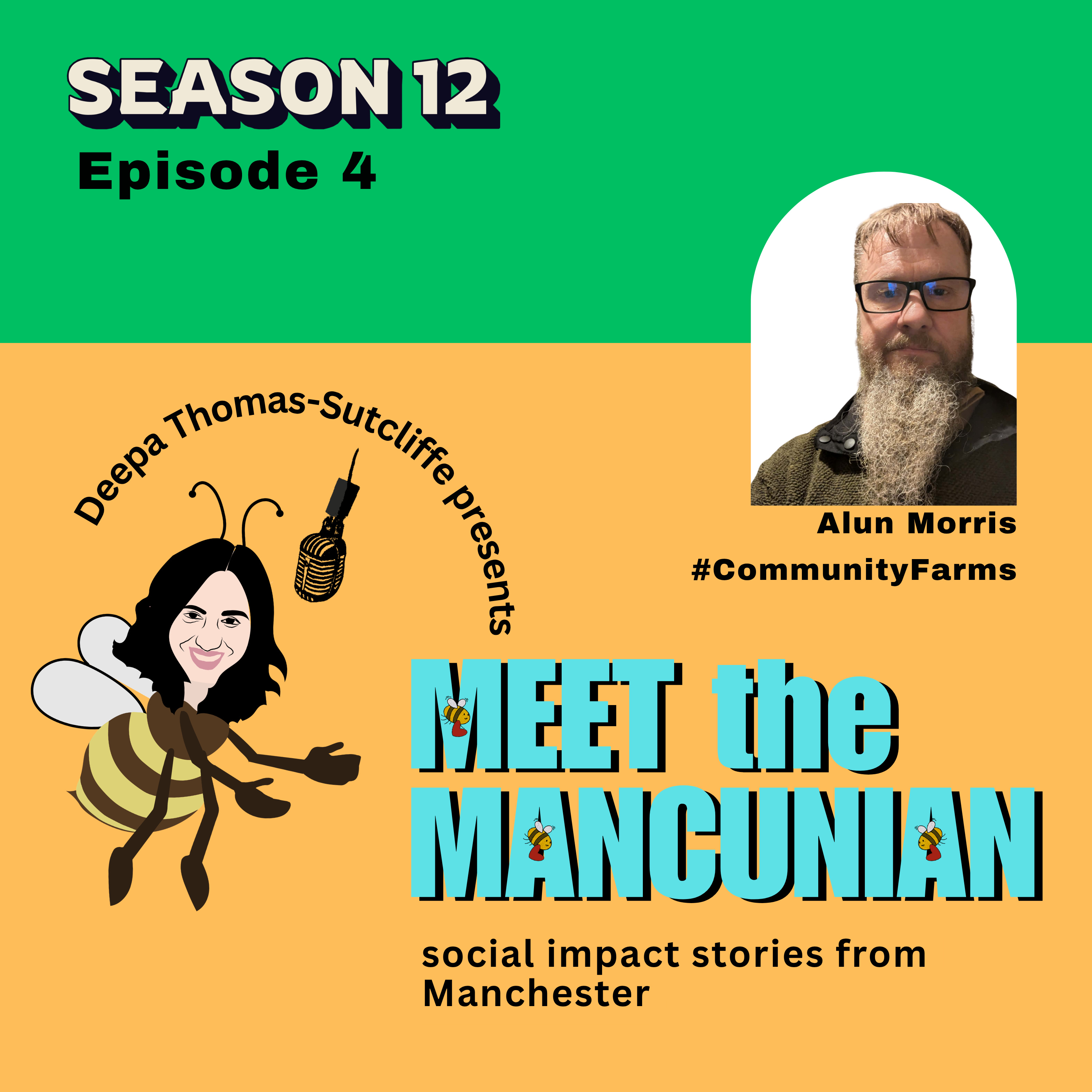
In the fourth episode of Season 12 of the Meet the Mancunian podcast, host Deepa Thomas-Sutcliffe speaks with Alun Morris, creator of the Red Lane Growing Project in Bolton and a community engagement worker with Bolton at Home. Alun shares how moving from Buckinghamshire led him into outdoor volunteering and conservation, and how a derelict former playground became a secure community growing space.
He describes the project’s evolving focus, including a “grow it, cook it, eat it” approach, family activities drawing around 2,000 visits a year, plant giveaways, and plans to expand beekeeping classes. The conversation covers impact on community connection and mental health, challenges, the value of flexible “drop-in” volunteering, and Alun’s view of Greater Manchester’s superpower as community, alongside a call for greater patience and tolerance.
Did you know:
· Community gardens are shared plots of land, often managed by local volunteers, where people grow fresh produce, herbs, and flowers.
· Found in urban or suburban areas, thesespaces—ranging from allotments to rooftop gardens—foster social connection, promote environmental sustainability, and provide access to nutritious food while revitalising unused spaces.
Key resource:
Time stamps of key moments in the podcast episode &transcript:
(01:37) Alun’s volunteering roots
(02:42) Red Lane origins
(03:44) Grow Cook Eat together
(05:17) Measuring community impact
(07:55) Safe space and wellbeing
(11:05) Funding, volunteers, motivation
(14:34) Beekeeping and how to help
(21:07) Signature Questions
🎧 Listen on Apple Podcasts, Spotify, YouTube or
www.meetthemancunian.co.uk
#Manchester #SocialImpact #Podcast #CommunityGardens #Volunteering
I hope you enjoyed listening to the podcast episode. Please do check out my other podcast episodes for a bit of inspiration.
Episode 12. 4 Alun Morris episode transcript
Intro
[00:00:00] Hello and welcome to Season 12 of the Meet the Mancunian podcast: social impact stories from Manchester. I'm your host, Deepa Thomas-Sutcliffe, and I'm so glad you're here today.
[00:00:12] This season I'll be speaking with people who are driven by passion and guided by purpose. Individuals working in different ways to shape Manchester and strengthen our communities.
[00:00:25] In each conversation, we'll explore what motivates them, what keeps them going, and what impact their work is having across our city. These are honest human stories about why people care deeply about what they do.
[00:00:40] New episodes drop every Tuesday. You can listen on Apple Podcasts, Spotify, YouTube, or at www.meetthemancunian.co.uk
[00:00:51] Thank you for joining me. Let's meet this week's Mancunian guest. Hope you are enjoying the sustainability focus.
Episode 12.4 Meet Alun Morris
[00:01:01] Deepa Thomas-Sutcliffe: Passionate about supporting community gardens? We hear from Alun Morris, creator of the Red Lane Growing Project.
[00:01:09] Deepa Thomas-Sutcliffe: In Alun's own words.
[00:01:11] Alun Morris: There's a few people have said, oh I love this place. It's my safe space. And these are people that may not necessarily come along and to engage in the work particularly, but we've got a nice shed, which is more like a luxury hotel these days with a nice balcony and they sit there in the chairs and they can put their feet up. Or they can join in. And that seems to be quite a common expression because it is a secure site. It has got a gate, the gates can be shut. And once you're in there, you are shut out from the rest of the world.
Alun’s Volunteering Roots
[00:01:37] Deepa Thomas-Sutcliffe: Thank you so much, Alun for joining me today.
[00:01:40] Deepa Thomas-Sutcliffe: What first sparked your passion for supporting the Greater Manchester community? Is there a particular moment or a story or a turning point in your journey?
[00:01:49] Alun Morris: I moved up here probably about 14 to 15 years ago now to Bolton from leafy Buckinghamshire, and I came up with no job. And within the first week there was a volunteer job fair in Bolton Town Centre, and I did with a try before you buy on various groups. Ended up volunteering with the Lancaster Wildlife Trust. I was still a volunteer for them. And about 10 years ago, started my own group in Bolton, which was to do with outdoor education and wildlife conservation. And then I've since moved onto the Red Lane Growing Project as part of my job role with Bolton Home, which is a social housing provider.
[00:02:29] Deepa Thomas-Sutcliffe: Thank you so much for sharing that. And it's interesting because Lancashire Wildlife Trust has actually been on the podcast as well, and it's great that you volunteered with them. And also great to hear about your own wildlife conservation group.
Red Lane Growing Project Origins
[00:02:42] Deepa Thomas-Sutcliffe: Tell us more now about Red Lane Growing Project and how did that journey begin? You said it was part of your day job.
[00:02:49] Alun Morris: I started working as a peer navigator for Bolten Home and jointly employed by Bolton CVS who were the leaders of the VCSE sector in Bolton. And it was a development role, community based at the time coming out of COVID. So COVID was still going on and there was a big shift generally, I think across the country in terms of getting outdoors and outdoor projects. And I have a history of working in arboriculture. I've always been gardening, beekeeping. We learned all that in school. So this piece of land, this project was presented to us. A derelict piece of land, which was originally a playground going back to 1928. Had some previous development, but essentially abandoned for the last 10 years before I got there. Basically starting with a blank canvas really.
[00:03:38] Deepa Thomas-Sutcliffe: And tell us more about. So you took this abandoned playground. What did it become?
Grow Cook Eat Together
[00:03:44] Alun Morris: The initial idea was to grow for the community. Have the local community come in and there were some existing raised beds in there. They would grow food and do general gardening, but like any projects they evolve quite organically. And over the last four years, we are still doing community food growing.
[00:04:03] Alun Morris: We've tried different ways of delivering that. This year, we have a volunteer that we know will not be moving on to find employment or move away, and he's going to be leading on a, grow it, cook it, eat it theme. So what we are going to be focusing on is growing it and eating it on site rather than just giving the food away.
[00:04:26] Alun Morris: That way we can make sure people know what to do with fresh food because it seems to be a common theme these days that you give somebody something a bit different and they're just not too sure. And just also inspire them with different ideas and it'll allow people to come in from different countries, different backgrounds and just add their spin on it., What might be a green bean one day, it might be six different dishes the next. So it is just a way of bringing people together and sharing the food.
[00:04:53] Deepa Thomas-Sutcliffe: Sounds really interesting. I like that about growing it, cooking it, and then eating it on at the way at the garden itself. Because it's, you're right to say that there's lots of interesting ways people are doing community farming, but you don't give people the chance to do know what to do with it. They may not always know what's best, so it's really interesting.
Measuring Community Impact
[00:05:17] Deepa Thomas-Sutcliffe: Tell us a little bit more about the change that you are trying to make, and, when you think about that change, what does success look like both for your, for the organisation you work with and the people you're trying to serve?
[00:05:31] Alun Morris: I think there's different ways of looking at success. Getting people through the door, if you like, or through the gates in this case. We put on a lot of family activities throughout the year. And I run both of my groups from there. So we have a footfall of around 2000 people a year coming through. So there's success there because we are out there engaging in those communities, we're given opportunities for communities to come together, especially in the summer holidays where the kids might go to school together for each term time. They don't see each other. Families are split up now, you don't go to school locally anymore.
[00:06:02] Alun Morris: So we provide those sorts of opportunities for people coming in and joining in, sharing the produce that we have. We are introducing beekeeping this year. We've had some hives for the last couple of years as bit of a trial. We're going to have four or five hives this year and we're going to be running evening classes on the beekeeping for the community.
[00:06:18] Alun Morris: My role in community engagement, we are bringing our community together. Most of the housing stock around there belongs to our housing association, although there are three or four others in the area. But it's just bringing together those people in that social housing. Those social housing estates where they're quite often not a lot to do, they could be quite crowded and people are still isolated.
[00:06:38] Alun Morris: So it is bringing those people together. But if we can encourage people to grow their own, which we have done, we give away a lot of plants every year, take it home. Even if the kids take home, a couple of plants that need it, or a chili plant or a tomato plant. And it is helping them understand where food comes from, reducing wastage, all the things we probably, at my age probably took for granted because it was quite normal.
[00:07:00] Alun Morris: We didn't just go to a supermarket. We didn't have everything in plastic. If there was food waste, there wasn't waste. It was food left over, it didn't get wasted, it would get eaten. And it's just encouraging people to look at the way they see food. And I think we've lived certainly until recently coming up to COVID where there has been an abundance of food, there has been reasonably priced, we've had access to an awful lot of things, and it's slowly, that's changing.
[00:07:22] Alun Morris: The climate is changing. Whether you want to call it climate change or not is another story, but it is changing. It is affecting the way crops grow globally. It is affecting our imports. There's lots of things to factor and it's about building resilience in the communities and for individuals as well.
[00:07:37] Deepa Thomas-Sutcliffe: Really interesting and I like that about one, bringing the communities together and helping, combat isolation, which is real problem today, but also creating awareness about how food grows and building some food resilience in the UK or in Greater Manchester.
Safe Space and Wellbeing
[00:07:55] Deepa Thomas-Sutcliffe: When you think about the impact of what you do, you talked about 2000 people coming through the gates. That's a large number. Is there something you can talk about to share that impact, whether it be one person's story or any other way that you want to dimensionalise the impact?
[00:08:11] Alun Morris: We do see people coming back, time after time, and you see the changes in them. You see what they're become enthusiastic in. And one of the things is, I've certainly learned is that if you want to get families outdoors you got to get the kids out. And we only run family activities because you've got to take the parents because then the kids go back and then they mither their parents to go and do it again.
[00:08:33] Alun Morris: And it's been successful, but it has meant that people know how to get outdoors safely. They know how to access outdoors. They know what to expect. They know what's out there.
[00:08:42] Alun Morris: This year for probably the last nine, ten months now, we've been doing some mental health support work with men on the site. And that's encompassed that some of the growing side, the cooking side we are looking at doing stone carvings, wood carving, making walking sticks next week. And there's been some real positive impacts on mental health. And that's very noticeable. That's because it's quite current.
[00:09:06] Alun Morris: But we have had volunteers that have come along maybe for the summer. They've moved on because of universal credit, or they've got jobs or, for whatever reasons. And they've found that it's a nice way just to get out rather than that you've been unemployed. It can be quite monotonous every day. It can be hard work when you've got to do 30 odd hours of job searching and you're getting nowhere and you're bashing your head against a brick wall. And the garden just provides that nice peaceful space because although we're in the middle of a housing estate, it's like an island of tranquility in there. So the mental health side has been great for a lot of people, for a lot of ages, from a lot of backgrounds, all looking for different things.
[00:09:41] Deepa Thomas-Sutcliffe: I think that's wonderful that the Red Lane Growing Project can be that garden of tranquillity and give people a moment of calm in a very busy world. And that's brilliant.
[00:09:53] Deepa Thomas-Sutcliffe: Is there a moment that made you stop and think, yes, this is why we do what we do?
[00:09:58] Alun Morris: I think I have those little glimmers quite regularly. I can't think of anything specific off the top of my head, but there's quite often the odd comment that just makes me think that, this is why we're here.
[00:10:07] Deepa Thomas-Sutcliffe: What kind of comments might they be?
[00:10:09] Alun Morris: There's a few people have said, oh I love this place. It's my safe space. And these are people that may not necessarily come along and to engage in the work particularly, but we've got a nice shed, which is more like a luxury hotel these days with a nice balcony, and they sit there in the chairs and they can put their feet up. Or they can join in.
[00:10:26] Alun Morris: And that seems to be quite a common expression because it is a secure site. It has got a gate, the gates can be shut. And once you're in there, you are shut out from the rest of the world. It's not like an open garden where everybody can see you. If you want to get away from everything without going too far, you're there. You could live across the road and people wouldn't know you were there. That's quite a common theme. It's just that having that break from what's happening outside those gates.
[00:10:50] Deepa Thomas-Sutcliffe: I think that's lovely to have something in the community that you feel safe in. And a safe space that is very valuable. Both from a mental health perspective, but from anybody who's looking for peace in general.
Funding Volunteers Motivation
[00:11:05] Deepa Thomas-Sutcliffe: What's been the toughest part of the journey? What's helped you navigate that?
[00:11:08] Alun Morris: There's probably a couple things. Think the biggest challenge always is been getting funding to fund these projects. Although I work for a large organisation, we do find our own funding. That can be a challenge, especially in the early days where you've got no kind of pedigree and you're still trying to prove who you are and what you're doing and how valuable it is.
[00:11:25] Alun Morris: It's one of those things that does get easier over time, but , it is a struggle and there's less money around these days and there's more competition. And getting volunteers as well as a struggle. We go through phases with volunteers. The changes to universal credit last year had a big impact on who was available.
[00:11:41] Alun Morris: There are more people working part-time, so they have less hours, to give. If they were maybe coming for a few hours when the kids were at school, they can't do that anymore. We lose a lot of volunteers as well because they get older, ill health.
[00:11:52] Alun Morris: And we find it a big struggle taking on younger volunteers. It's something not quite attractive about being outdoors this time of year at the moment. You can understand why there's still work to be done, but it is. We don't encourage screens and that kind of stuff when we're out. The whole idea is to be out in nature in that natural environment. The biggest challenge, funding and getting volunteers, I think are the two key ones.
[00:12:14] Deepa Thomas-Sutcliffe: I hope we can help you with volunteering. Hopefully people listening to the podcast come forward.
[00:12:20] Alun Morris: I think there's still a bit of a misconception with volunteering. Volunteering doesn't have to necessarily be work. You can just be a participant for an hour or two hours. You come on a regular basis. Some people come along and just deadhead flowers. Some people come along and just make brews. There's no set workload, if you like for volunteers, and I think there needs to be a shift away from it being called voluntary work to just volunteering, and try and break down those barriers.
[00:12:44] Alun Morris: And also outdoor work is still, I think, still seen as very white middle class activity. because when you look at volunteering historically, that's what it was. And we are getting there. We are slowly getting there. We are seeing changes, but it is a slow progress.
[00:12:59] Deepa Thomas-Sutcliffe: I can understand that.
[00:13:01] Deepa Thomas-Sutcliffe: When the work becomes heavy or the progress is slow, what helps you stay motivated and hopeful? Is there a ritual or a mantra or a belief that keeps you going?
[00:13:11] Alun Morris: I think there are times when you do get disheartened, and it is this time of year really because everything's a bit dull and you don't really see the benefit of what you're doing. I think once you're in doing this kind of work. So I've been volunteering in different ways outdoors for about 14 years.
[00:13:27] Alun Morris: When that spring and summer comes, that's when you notice your work. And it's having that bit of patience to see what difference you're making. And it takes time because you can't force nature. And it's always that, and I think it's, it is a thing with gardeners in general. It's always, oh, this next year this will be this, and next year this will be this.
[00:13:44] Alun Morris: And that's what you're creating over winter. So although you might just think, I'm actually getting nowhere, and you're struggling to, to motivate with the dark days and the cold and the wet. Once you see that in spring, that motivates you and that keeps you going the next year as well. Because you think, yes, it does make a difference. I want to see that again, or I want to improve on that.
[00:14:00] Deepa Thomas-Sutcliffe: Think that's so true. I tend to completely neglect my garden except for feeding the birds in the winter season. And I totally get that dedicated gardeners might be doing a lot of necessary activities, whereas I start in spring, summer, autumn, and then take a break from any gardening.
[00:14:20] Deepa Thomas-Sutcliffe: But it's really, like you said, it's self-perpetuating. You're seeing the good improvement that you've been able to make and those building blocks that you were building during during the resting season. That's really useful.
Beekeeping and How to Help
[00:14:34] Deepa Thomas-Sutcliffe: What's next for you and your mission? What should we watch out for in the next few months?
[00:14:39] Alun Morris: Our mission we've are just in the process of creating our apiary, it's an area for keeping bees. So we have been hive building, we've still got some work to do. We have separated an area of the site fenced off. It's going to be planted with hundreds of wild flowers bulbs, flowering shrubs.
[00:14:58] Alun Morris: We are going to be inviting people along to do taster sessions on beekeeping to come and learn how the bees work. We've got bee suits that go down to two, 3-year-old in age, all the way up to the biggest ones we can buy so everybody can have a chance. It's something which people have been asking for.
[00:15:14] Alun Morris: It's something which I think will get people excited about being outside. And I also think it is really valuable in people experiencing being around insects that sting because there is just so much fear of them these days and there's no need. But bees, everyone loves bees.
[00:15:31] Deepa Thomas-Sutcliffe: Everyone loves bees, especially in Manchester. The podcast has got bees on it as well.
[00:15:37] Alun Morris: We'll be doing our food, growing, we'll be running our summer activities. We'll be going out in nature on the meadows. We will be doing all the things we do, but we'll also be adding. I'm not sure I'm going to get the time yet, but we'll work on that one.
[00:15:48] Deepa Thomas-Sutcliffe: That's wonderful. We are very fond of bees here in Manchester.
[00:15:52] Deepa Thomas-Sutcliffe: So many listeners want to help, but they don't always know how. Where can individuals make the biggest difference in a simple, everyday way?
[00:16:01] Alun Morris: I think I think generally in volunteering, I think it's making a difference is just being there. And I think there's more of a shift now where some organisations or a lot of organisations will allow people just to drop in and do a bit of volunteering as and when they can.
[00:16:15] Alun Morris: Volunteering at one point used to be a case of there was a quite a commitment to turning up every week or every fortnight, or. If you're working in a charity shop, you've got to have your shifts. And it's more organised some of the bigger organisations, which I understand has to happen.
[00:16:28] Alun Morris: But with the outdoor projects, there's more of a drop in and just be in there. Somebody last year used, they used to come along and they would spend two or three hours just deadheading all the flowers, and they were more than happy. That's all they wanted to do. They're just there.
[00:16:38] Alun Morris: They're benefiting. I'm benefiting. The gardens are benefiting. And it is just being present. You don't have to have any particular skill set that's all about learning. That's what we're there for. Or if you've got skills and you want to share them, ev even better. But it's, regular volunteers or irregular volunteers, dropping volunteers, all as equally as important as each other, and all as welcome as each other. So there's something there for everybody, but it is just being there.
[00:17:03] Deepa Thomas-Sutcliffe: I like that very much about being there because yeah, volunteering is so good for the soul and you can benefit as much as a volunteer, as the person, as the charity or the cause you are supporting, so I do believe that's really important.
[00:17:17] Deepa Thomas-Sutcliffe: What's something about your work or the voluntary sector that you think wish people understood better?
[00:17:23] Alun Morris: The thing I think that we need to get over to people is that volunteering can be an hour, it can be a day, it could be three days a week. I've got a new volunteer who's happy to come down every time I'm on site. We've got somebody else who might just pop along once a week. And all of those have got equal value.
[00:17:42] Alun Morris: People feel that there's, there has to be a commitment, whereas there's so many groups now where there doesn't have to be that commitment. The job market has shifted now, the way people work. The shift patterns have changed.
[00:17:52] Alun Morris: Time, availability, everything is constantly changing and the voluntary sector needs to keep up. And a lot of organisations are keeping up, especially the smaller ones to cater for that. And it's just, people need to think well. I'd like to do it, but I can't do it because I haven't got time. The chances are you have got time.
[00:18:10] Alun Morris: There'll be an organisation out there somewhere and it's, I encourage people to if somebody wants to say, I want to come and volunteer, I say, come down and give it a try. If they're not, if it doesn't suit them, then I know. 101 other groups that they could go and try. Somewhere along the line there'd be something that fits in with their lifestyle and what they can commit to, or the skillset or just the general dynamic of a group. Not every dynamic of every group suits every individual.
[00:18:34] Alun Morris: I'd say to people, just go out and just join in a few and just see how you get on with people. See, because you'll find something that you click with and then you know it's right. And I think it can be, people can easily be put off by going along and they're nervous, they don't know what to expect, and then everybody's getting on with their jobs and they feel a bit left out.
[00:18:55] Alun Morris: And it can be hectic because a lot of the people that lead volunteer groups, they're also volunteers, so they don't maybe necessarily have the same time to commit to one-to-one training. So just give it a try before you buy. And just get out there, explore the groups and find what's right and try something completely different to what you normally do. You never know.
[00:19:13] Deepa Thomas-Sutcliffe: I like that very much about try before you buy. I think that's really important. Even I found that really useful since in some wonderful charities and volunteer groups that I've gone along and supported as a one off, but not felt like that's my long term and there's others that I'm more associated for multiple years.
[00:19:31] Deepa Thomas-Sutcliffe: So I do understand that like you said, it's not everything's for everyone but you. There is an opportunity out there if you have skills to give or time to give. So definitely go and explore. Really good shout out.
[00:19:45] Deepa Thomas-Sutcliffe: Is there a community collaboration or a partnership or even an act of kindness that has inspired you recently?
[00:19:53] Alun Morris: In terms of collaborations, I think the one which. It's been the most inspiring in the last 12 months has to be the Bolton Ambassadors and the ambassadors in the community, which is a project that was set up by Adam Warbeck when he was working at Bolton Home and his colleagues.
[00:20:09] Alun Morris: And it was all about providing mental health support for men but not just sitting in a room and having a chat. It was about sports. It was about being outside. So there's rugby, there's gyms there's us doing, we do Camp Jams and another project in Farm Worth with Hay men just getting together, playing guitars sitting around a campfire. And that's really taken off and it really is bringing people together.
[00:20:36] Alun Morris: Adam, when he started up, really did recognise that gap, and knew there was something missing and he's made it work. And I think it's one of those that's really going to keep expanding. But at the same time, it's introducing people to the voluntary sector.
[00:20:50] Alun Morris: My volume of volunteers have all come from that background. People are getting that try before you buy. They are getting to meet new people. People that wouldn't maybe have the confidence to go out and do something normally. They've got the opportunities and that's really inspiring and long overdue.
[00:21:05] Deepa Thomas-Sutcliffe: That sounds really inspiring.
Signature Questions and Wrap
[00:21:07] Deepa Thomas-Sutcliffe: I'll now come to the signature questions that I ask all my guests.
[00:21:10] Deepa Thomas-Sutcliffe: The first one for you is, if Manchester had a superpower, what would it be and how have you seen it in action?
[00:21:17] Alun Morris: Greater Manchester superpower to me has to be community. The diversity. I've moved up here from down south, lived just outside London, not in London. So an equally as busy place as where Manchester easily as busy now as London in many respects. London never had that community which they do in the northwest.
[00:21:38] Alun Morris: Bolton is such a friendly place. I cycle a lot. I go around all the different boroughs of Manchester and I find it friendly. I find it a nice place. There is community and when something goes wrong, the community is there. People do stand together, they do fight injustice. And it's very heartwarming and encouraging.
[00:21:57] Deepa Thomas-Sutcliffe: I think you're totally right to say a community is what really stands out. That definitely you can feel it everywhere in Greater Manchester. but I do feel like it's a very friendly place.
[00:22:08] Deepa Thomas-Sutcliffe: If you could give the city one new value, habit, or mindset, what would you choose to strengthen community life?
[00:22:16] Alun Morris: Wow, that's a big one. I think despite the fact we have got a fantastic community up here, there is still a greater need for patience and tolerance. I think the world is changing at such a pace and lifestyles are changing at such a pace that we are losing our focus as people sometimes.
[00:22:33] Alun Morris: If I had to give something, if I had to say to people, one thing is just stand back and a bit more patience and a bit more tolerance. because it doesn't cost anything. It doesn't take any effort. It doesn't burn calories and it could make such a difference. And I think to some degree we're all guilty of it. Somewhere along the line, however small or however big we don't want to become another London because that's been like that for a long time.
[00:22:55] Deepa Thomas-Sutcliffe: Alun, I think you're right to say especially tolerance. I think that one, everybody can do better on. How can we accept the difference and in fact, welcome the difference. It's something that definitely, there's lots of examples where you can say that, that we could do better.
[00:23:14] Deepa Thomas-Sutcliffe: If you could have a 10 minute conversation with a community hero from Manchester's past or present, who would it be with and why? What would you ask them?
[00:23:24] Alun Morris: I think being from Bolton, I think Fred Dibnah is one that springs to mind. My dad was a blacksmith. He worked in the industry. He worked on steam engines. Not quite a steeple Jack, I don't think. My dad was very keen on going up ladders, let alone chimneys. But I think he just had so much knowledge about the way, not just about the machines he worked with, but the way the communities worked, how society worked, how, just how everything worked.
[00:23:50] Alun Morris: But not from an academic point of view, from a lived point of view, from that lived experience. And he was respected just for being a regular kind of guy. He never saw himself as being a hero. He never saw himself as being anything special. And yeah, so I think Fred Dibnah would've to be the one if it was someone from locally.
[00:24:09] Deepa Thomas-Sutcliffe: And what would you be asking?
[00:24:11] Alun Morris: What would I be asking him? Oh, I think I'd like to know what actually inspired him, or was he inspired. There must have been something that's inspired him somewhere for him to take that, the pathway that he took and for the progression from. From what he did, it may have been driven by the fact he needed to earn money, feed his family.
[00:24:28] Alun Morris: It might have been, he had a specific interest in steam engines, but he also had a fascination in chimneys. And it is they're great things to look at, but the whole idea of making a living, climbing up and down them, and he just takes it all in stride. I've seen the the TV documentaries where he is just sat up there with no ropes on having a cigarette, just chilling out with a flask of coffee and you just think. How would you get inspired to just be that confident and that relaxed in life and that outlook?
[00:24:55] Deepa Thomas-Sutcliffe: Sounds interesting. I haven't heard of him, so now I'm going to look him up today. This sounds like a very interesting character who had a lot of influence and personality.
[00:25:07] Deepa Thomas-Sutcliffe: Looking back, what's a life lesson or a piece of wisdom that this journey has taught you? Something that you carry with you.
[00:25:14] Alun Morris: A life lesson, from volunteering. I think I know right. My lifestyle, not been a bed of roses, some of the problems I've created myself. And I think the one thing you can't do, and I'm sure a lot of people say this is you just can't hang on to the past.
[00:25:24] Alun Morris: You've got to keep going forward. And it's so easy to dwell on the past. It's so easy to think what if I could have changed that? You can't, can you? It's done. Move on. And you've just got to be realistic.
[00:25:36] Alun Morris: My girlfriend just calls me practical because I just have a practical outlook on things without dwelling on too much. Volunteering's really helped me with that, I think. Because volunteering is something you do it. Because hopefully we all go to work and enjoy the job we do. But some people just have to go to work because they've got to earn their bread and butter, haven't they?
[00:25:54] Alun Morris: And that's it. Whereas volunteering, it's a personal choice. It's like the difference between going to school and going to college. One is mandatory. The other one's a choice. And I think it gives that time for you to find yourself and reflect and look at your own strengths and weaknesses or, and just you can be yourself in a volunteering environment, which you wouldn't be able to in any other more formal environment.
[00:26:15] Deepa Thomas-Sutcliffe: I liked a lot of things that you said, but the one that stood out to me is to be yourself. That the fact that you can actually be yourself in a volunteering environment or even maybe try new things that you didn't have the confidence to do in a work environment, in a volunteering environment. And that's really powerful.
[00:26:34] Deepa Thomas-Sutcliffe: I agree with you. I trying to think of the past as things you can't change and you can't control. And you want to be moving forward and putting your energy into things that matter. So similar thinking, I think.
[00:26:48] Deepa Thomas-Sutcliffe: So my last question for you is, what's the best way for listeners to connect with you to support your mission and learn more?
[00:26:55] Alun Morris: We do have Facebook page the Red Lane Growing Project. I'm must admit, I'm not of an age where I'm overly familiar with things like Instagram, although I do believe Facebook and Instagram do link in together these days. We are part of the, we are registered with the Bolton CVS the VCSE sector and also Bolton Green Umbrella, which is, another smaller organisation, which we don't coordinate outdoor projects.
[00:27:21] Alun Morris: But it's a place where you can find all the info on, smaller, larger projects and guard projects. Maybe a men in sheds or a lit picking group, or a gardening group or a conservation group. So there's information out there for people to shop around, if you like, and see what they like the look of.
[00:27:35] Alun Morris: But certainly going through the voluntary the VCSE sector is a very good way of, for volunteering in general. I'm here to talk about Red Lane Grown project, but as we've said, it may not be for everybody. It may be in the wrong area. The times that we're open might be different.
[00:27:48] Alun Morris: Certainly the Bolton CVS is a really good point to or place to start if you're looking for volunteering.
[00:27:54] Deepa Thomas-Sutcliffe: That's a really good shout out. And I have used a website called Reach Volunteering in the past, but you're right that the local VCSE sector will actually give you local opportunities and because it was a pandemic. I chose virtual opportunities in those days and but I do understand what you're suggesting.
[00:28:13] Deepa Thomas-Sutcliffe: So thank you so much, Alun. It's been a really great conversation. Really lovely to hear more about the Red Lane Growing Project
[00:28:20] Alun Morris: Thank you. I could talk for hours on this subject, but it's been absolutely fantastic to have the opportunity.
Outro
[00:28:26] Thank you for listening to the Meet the Mancunian: social impact stories from Manchester. If today's episode resonated with you, please share it with someone who believes in the power of passion and purpose or leave a review to help others discover the podcast.
[00:28:42] You can connect with me on social media @MeettheMancunian on Instagram, Facebook, and Blue Sky, and @MeettheMancunianpodcast on YouTube.
[00:28:54] I'm Deepa Thomas-Sutcliffe, and I'll be back next Tuesday with another story from the people shaping Manchester.
[00:29:02] Next week, we hear from Charlie Baker talking about green homes.
[00:29:06] Until then, thank you for listening and for being part of this community.
