
 Apple Podcasts
 Spotify
 RSS Feed
 Amazon Music
 YouTube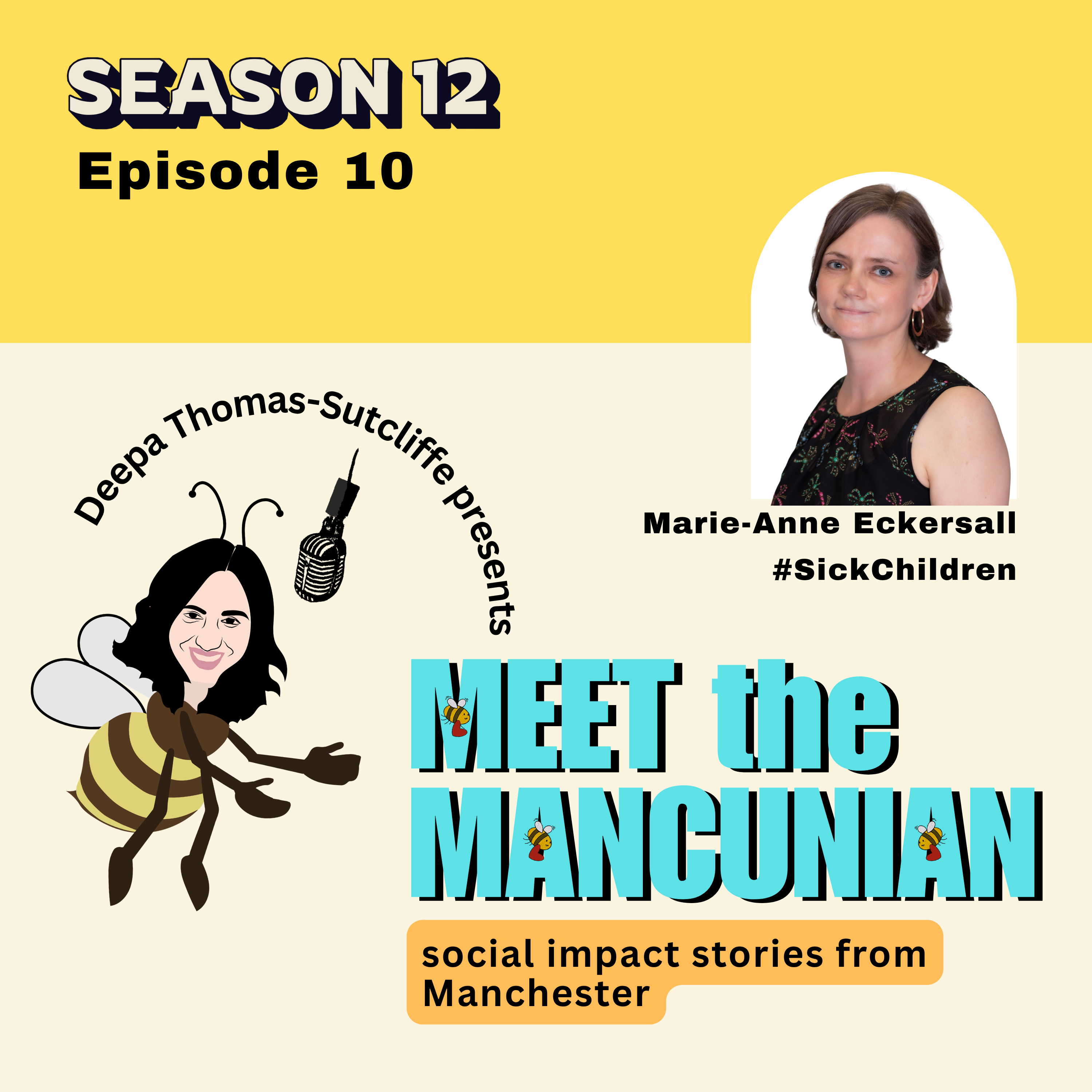
In the tenth episode of Season 12 of the Meet the Mancunian podcast, host Deepa Thomas-Sutcliffe speaks with Marie-Anne Eckersall, Fundraising and Communications Co-ordinator at Transport for Sick Children, a small charity founded in 1977 that provides volunteer-led transport to children’s hospital appointments. Marie-Anne shares how volunteering on her children’s school PTA sparked her move from a corporate career into the VCSE sector, and how she grew her part-time role after joining in 2019.
She explains that success means supporting as many children as possible by recruiting volunteer drivers (about 35 currently), especially in areas including North Manchester, Oldham, Rochdale, Bolton, and Bury. The conversation covers the charity’s impact on families facing financial hardship or new to the UK, post-COVID rebuilding, 2026 plans, and ways individuals and businesses can help through driving, donations, trustee expertise, and skills-based volunteering.
Did you know:
· Across the UK, 8-10% of children have a long term health condition.
· In Greater Manchester, approximately 65,000-75,000 children and young people are estimated to have a long-term health condition.
· Specialist facilities like the Royal Manchester Children’s Hospital manage over 160,000 children’s outpatient appointments annually.
Key resource:
Time stamps of key moments in the podcast episode & transcript:
(01:52) PTA spark story
(03:06) Joining the charity
(04:19) Success and drivers
(05:31) Family impact stories
(07:55) Challenges and motivation
(09:54) Future plans
(12:38) How you can help
(17:58) Signature questions
🎧 Listen on Apple Podcasts, Spotify, YouTube or www.meetthemancunian.co.uk
#Manchester #SocialImpact #Podcast #Transport #SickChildren
I hope you enjoyed listening to the podcast episode. Please do check out my other podcast episodes for a bit of inspiration.
Episode 12.10 Marie-Anne Eckersall transcript
Intro
[00:00:00] Hello, and welcome to Season 12 of the Meet the Mancunian podcast: social impact stories from Manchester. I'm your host, Deepa Thomas-Sutcliffe, and I'm so glad you're here today.
[00:00:13] This season, I'll be speaking with people who are driven by passion and guided by purpose. Individuals working in different ways to shape Manchester and strengthen our communities.
[00:00:24] In each conversation, we'll explore what motivates them, what keeps them going, and what impact their work is having across our city. These are honest human stories about why people care deeply about what they do.
[00:00:38] New episodes drop every Tuesday. You can listen on Apple Podcasts, Spotify, YouTube, or at www.meetthemancunian.co.uk.
[00:00:47] Thank you for joining me. Let's meet this week's Mancunian guest talking about supporting families with sick children
Episode 12.10 - Marie-Anne Eckersall
[00:00:57] Deepa Thomas-Sutcliffe: Passionate about supporting sick children, we hear from Marie-Anne Eckersall, Fundraising and Communications Co-ordinator, Transport for Sick Children.
[00:01:08] Deepa Thomas-Sutcliffe: In Marie-Anne's own words.
[00:01:11] Marie-Anne Eckersall: Success for myself is just knowing that I'm there supporting the children, supporting the drivers really. Success is obviously supporting as many children as we can, helping as many as we can. So a big part of my role is recruiting new volunteer drivers. so we have a team of about 35 at the moment.
[00:01:31] Deepa Thomas-Sutcliffe: Thank you so much, Marie-Anne, for joining me today
[00:01:33] Marie-Anne Eckersall: Thank you very much for having me, Deepa. It's lovely to be on.
[00:01:37] Deepa Thomas-Sutcliffe: We've been looking forward to this conversation for a little while, so I'm so glad that it worked out that you could come to the 12th season.
[00:01:44] Deepa Thomas-Sutcliffe: Tell us what first sparked your passion for supporting the Manchester community. Is there a particular moment that set you on this path?
PTA spark story
[00:01:52] Marie-Anne Eckersall: I've got two children who are now seven and 11. Back when my oldest child started in reception, I wasn't working. I got involved with the school PTA. And specifically I helped to organise an event for the school, which was called Bubbles and Bingo.
[00:02:07] Marie-Anne Eckersall: It was a night for mums, dads, parents, carers to basically play bingo, have a bit of fun with fellow parents and carers. And I helped to organise the night and to find prizes from local businesses. So it was a great event. Went really well, raised nearly £2,000 for the school which was brilliant. We spent the money on some work in the playground, which was much needed. That kind of sparked my interest really in doing something that was worthwhile.
[00:02:34] Marie-Anne Eckersall: A corporate background really before I had children. I Did think when my second child came along, I did think I'd like to do something. I'd like to get back into work, but I don't want to just go back to a corporate environment. If I'm taking time away from my children, I want to do something that I really feel is worthwhile.
[00:02:52] Deepa Thomas-Sutcliffe: It's really interesting that you started with first volunteering for your children's school PTA association and then that sparked your passion in doing something different, taking your corporate skills but working in the voluntary sector.
Joining the charity
[00:03:06] Deepa Thomas-Sutcliffe: tell us how your journey with Transport for Sick Children began.
[00:03:09] Marie-Anne Eckersall: I started back in 2019. It was initially a kind of mixed job really. It was partly an admin job, partly helping to organise the transport for the children and part of supporting the communication side as well. It was 12 hours a week and I thought, "Actually, I can do this. I can probably fit this in with having two young children." It gives me a chance to get back into the workplace and it's something really worthwhile as well.
[00:03:36] Marie-Anne Eckersall: Transport for Sick Children is a really well-established charity, but it's probably not that well known. Because we are quite small. We've been going since 1977. It's an amazing team of drivers that take children to hospital appointments.
[00:03:49] Marie-Anne Eckersall: I just thought, "I can support this. I can use some of the skills that I've got to improve the charity and to help." I started back in 2019, have built my hours up from then really in terms of building up my role, my level of responsibility, and how much I've been involved in the
[00:04:05] Deepa Thomas-Sutcliffe: It's really interesting that so many unique charities in Manchester, and I love that your purpose is really how do you get sick children to hospital and hospital appointments and using the community for that.
Success and drivers
[00:04:19] Deepa Thomas-Sutcliffe: When you think about this change that you're trying to make with the charity, what does success look like for both yourself and the people that you serve?
[00:04:27] Marie-Anne Eckersall: Success for myself is just knowing that I'm there supporting the children, supporting the drivers really. Success is obviously supporting as many children as we can, helping as many as we can. So a big part of my role is recruiting new volunteer drivers. so we have a team of about 35 at the moment.
[00:04:47] Marie-Anne Eckersall: And we're always looking for new drivers, particularly in certain areas of Manchester that are quite deprived. So that's kind of North Manchester, Oldham, Rochdale and parts of Bolton and Bury as well. So those are the areas that I focus on because knowing that the more drivers we have in those areas, the more we can help children and, the more successful the charity will be basically.
[00:05:10] Deepa Thomas-Sutcliffe: I'm glad you did a bit of a shout-out and hopefully people will listen to this podcast and maybe get in touch with you. And it's really good that the success is about reaching more children and supporting them by getting them to hospital appointments for which you need volunteer drivers to come forward.
[00:05:28] Deepa Thomas-Sutcliffe: Can you share a bit of the impact of what you do?
Family impact stories
[00:05:31] Marie-Anne Eckersall: The impact is huge for some of the families that we take. We take such a big range of families. It's all sorts of families from, the ones that are just struggling financially. It might be ones that are new to the country. They might be asylum seekers or refugees. They might not even know where the hospital is, never mind how to get to it.
[00:05:50] Marie-Anne Eckersall: They might have a very poorly child that they're really struggling to get to an appointment. And we do a wide range of appointments. It can be anything from speech therapy appointment or a hydrotherapy appointment, for example, to taking a poorly child all the way to Alder Hey Hospital in Liverpool.
[00:06:08] Marie-Anne Eckersall: We do trips over to Leeds, as far afield as Newcastle and Birmingham as well. So particularly those children that have quite specialist conditions and needs, they probably wouldn't be able to get there without our assistance. So it's an amazing thing really to be able to help them.
[00:06:24] Marie-Anne Eckersall: And it's twofold in terms of the volunteer drivers really, because a lot of the volunteer drivers are mainly retired or semi-retired and are looking for something to do. They're looking for something, a way to help their community. That need and what they're looking for in terms of supporting people and at the same time obviously helping those children.
[00:06:46] Deepa Thomas-Sutcliffe: Thank you for sharing both the impact on the families that you support, but also the impact on giving, purpose and meaning for the volunteer drivers who might be seeking something new.
[00:07:01] Deepa Thomas-Sutcliffe: Is there a moment in this journey that makes you stop and think, "Yes, this is why we do what we do"?
[00:07:06] Marie-Anne Eckersall: We cover Greater Manchester, basically. That's what we're funded for. But it was actually a child just outside Greater Manchester with a very unusual bone condition. So she has bones that continue to grow basically, and it's a very debilitating and painful condition that she has.
[00:07:23] Marie-Anne Eckersall: So they were outside Greater Manchester, had to go and see a specialist within Manchester, and they basically wouldn't have got there without our assistance. So helping to find that driver, find the right driver with the right car to make sure that she was comfortable on the journey.
[00:07:38] Marie-Anne Eckersall: It's quite a long appointment, so the driver hanging around in Manchester to make sure that they then get brought back as well. We take them generally about once or twice a year, but I think that's something so unique to what we do that as far as I'm aware, there isn't anybody else that would do that sort of thing.
Challenges and motivation
[00:07:55] Deepa Thomas-Sutcliffe: It's a very valuable service, and it's really nice that you were able to support somebody just outside Greater Manchester as well, especially given the rare circumstances.
[00:08:06] Deepa Thomas-Sutcliffe: There must be tough moments in this journey, and what helps you navigate that?
[00:08:11] Marie-Anne Eckersall: There can be tough moments because we work with health professionals to help families, basically. We're not a taxi service, so families can't just ring us. We get referrals sent in from health professionals, so it might be social workers, health visitors, nurses, et cetera.
[00:08:26] Marie-Anne Eckersall: And sometimes things are put in place between them and us to help a family that's in need, that's struggling, and sometimes it doesn't always work out. And that's, that can be difficult and frustrating because you feel like you let the child down in a way.
[00:08:41] Marie-Anne Eckersall: But sometimes families can be having such a difficult time, and circumstances can be against you, and you don't quite always get there. So you've just got to think of the next, "Okay, the next family, who else can we help? Unfortunately, we've not been able to support that one, but there's so many more out there," and, the drivers are so willing to, to go out and support those families. So that keeps you going.
[00:09:04] Deepa Thomas-Sutcliffe: I can understand that it's hard because you'll have resource constraints, and also other constraints. So it's really motivating that you're able to find that next family that needs help and then find a way for that support to be available.
[00:09:20] Deepa Thomas-Sutcliffe: When the work gets heavy for you or the progress is slow, is there a ritual or a mantra that helps you stay motivated and hopeful?
[00:09:30] Marie-Anne Eckersall: I guess it does make me think about my own children a lot of the time when I'm at work and how lucky I am that I have healthy children. So that kind of keeps me going really thinking about not everybody's so lucky.
[00:09:43] Deepa Thomas-Sutcliffe: We really need to count our many blessings because there's so many people in very difficult circumstances. And I understand what you're saying here.
Future plans
[00:09:54] Deepa Thomas-Sutcliffe: What's next for you and Transport for Children? What are the aims for 2026?
[00:10:00] Marie-Anne Eckersall: The aims for us are having more time and putting more focus into the future of the charity, basically. We're a very small team so it's working with the trustees to look at what's next. So at the moment, we're actually hiring an admin assistant who will be supporting myself and the charity manager and our transport organisers with admin in the office.
[00:10:22] Marie-Anne Eckersall: So just supporting us with the day-to-day things, answering the phone, putting through driver expenses, helping us with new driver recruitment, that kind of thing. So taking that everyday workload off myself and Laura, who's our charity manager so we can focus on the future. There has been discussions about expansion to other areas.
[00:10:45] Marie-Anne Eckersall: I'm not sure whether it's the right time to do that yet. I think we are still partly recovering from COVID. Following on from COVID, we weren't taking any children, and we've gradually had to build our numbers back up. obviously since then, there's a lot of video appointments now.
[00:11:01] Marie-Anne Eckersall: There aren't quite as many as appointments, so it's, for us, it's about building back the service to the numbers that we were pre-COVID. So getting out there, making sure that we are getting to all the areas that we really need to.
[00:11:15] Marie-Anne Eckersall: So hoping that once we have this admin person in place, myself and Laura can really focus on that, about getting to the people that we need to, the right teams, whether it's health visiting teams, social work teams, whoever it might be. We know there's some pockets in Greater Manchester that we're not accessing that we need to get to.
[00:11:35] Marie-Anne Eckersall: So having time to do that and just making sure that what we're doing really well we do have quite a couple of members of the team are quite new and only joined us last year. Previous to that, we'd actually had two very experienced ladies who retired.
[00:11:51] Marie-Anne Eckersall: So we had one who was with us for 25 years, and the other was with us for 11 years. that's been quite an adjustment as well. So just making sure that as a team we're working as well as we can be basically. And that we're proactive and we're getting out there to people that, that need it. That's the focus for us this financial year.
[00:12:10] Deepa Thomas-Sutcliffe: I think that's a really important one. One, thinking about that future focus, but also stabilising the team and creating that cohesion, especially when you have longstanding people who have left.
[00:12:23] Deepa Thomas-Sutcliffe: It's really good that you're bringing in more resource that so you and your colleague have the time to do the, do some of this thinking with the trustees as well, and wish you good luck as you expand and as you are thoughtful about the future.
How you can help
[00:12:38] Deepa Thomas-Sutcliffe: When we think of our listeners, they are around the world and many listeners may want to help but not always know how. Where can they make the biggest difference in a simple, everyday way?
[00:12:50] Marie-Anne Eckersall: In an everyday way, obviously you could become a volunteer driver. If you are anywhere in the Greater Manchester area, that would be amazing. If that's something you are interested in, you can have a look at our website which is transportforsickchildren.org or give us a call anytime on 0161-443-4100.
[00:13:10] Marie-Anne Eckersall: If not, there's other ways you can get involved. Any donations are obviously always appreciated. Again, can be done through the website. And we are looking for corporate support as well. So if there's any businesses out there that, think, "Oh, that sounds interesting. I think I can support you with either donations, fundraising."
[00:13:30] Marie-Anne Eckersall: It can be any expertise. We're always looking for kind of legal expertise on the board from a trustee point of view. We're always looking for expertise with technology, with social media. Because I think when businesses sometimes think of volunteering with charities, they think of going for a day and building a wall or digging a garden.
[00:13:53] Marie-Anne Eckersall: But actually, there's a lot of charities like myself around that we could really do with the expertise from businesses. Like I say, if you've a social media manager that's got two volunteering days a year, get in touch with a charity like ourselves and using that expertise within the voluntary sector would be amazing. It's not all about donations. There's lots of other ways that businesses can help our sector.
[00:14:16] Deepa Thomas-Sutcliffe: Thank you for shouting out.I do agree with you. I always think about skill-based volunteering being really valuable.
[00:14:23] Deepa Thomas-Sutcliffe: And in fact, doing something like this for one of the charities I support through my other volunteering hat. It's a homelessness charity called Mustard Tree. We're doing an interview skills takeover with with other CIPR members. I'm leading that, and we're just going to take our experience and help people find work and teach them about that.
[00:14:46] Marie-Anne Eckersall: They're a great charity,
[00:14:47] Deepa Thomas-Sutcliffe: Very great charity.
[00:14:49] Deepa Thomas-Sutcliffe: Thank you for sharing those tips for listeners and also for corporate volunteers to consider.
[00:14:55] Deepa Thomas-Sutcliffe: Is there something about your work or the voluntary sector that you wish more people truly understood?
[00:15:00] Marie-Anne Eckersall: Families, of course, can contact us. If they're contacting us for the first time, we do need to get that health professional really to refer into us.
[00:15:09] Marie-Anne Eckersall: I'm trying to think how it was for myself when I first came into the role and didn't really know that much about the sector. I think the thing for me that I realised when I first joined was how big the VCSE sector is and how much there is out there.
[00:15:25] Marie-Anne Eckersall: There's always so many small grassroots organisations out there that help people every day. There's so many that, you can't be aware of all of them. If you're ever looking for support with anything in a particular area, wherever you might be, always Google local voluntary organisations and local charities because there's so much support out there.
[00:15:45] Marie-Anne Eckersall: And with certain charities, I know that I've been in meetings and, charities will get pots of funding, as I'm sure now and again for certain projects, and sometimes they can't find enough people to help with those projects.
[00:15:56] Deepa Thomas-Sutcliffe: Thank you for sharing that tip about doing your research. Definitely through the Meet the Mancunian, I've spoken to now 138 charities, including yourself. So lots of great causes that people can look at as well within Manchester. Of course, Manchester itself must have 4,000 or so charities. So it's a small fraction of the many wonderful charities here.
[00:16:22] Deepa Thomas-Sutcliffe: Is there a community collaboration or a partnership or even an act of kindness that has inspired you recently?
[00:16:29] Marie-Anne Eckersall: The Royal Nawab restaurant in Stockport. Came to us last July, August. They had just opened. I think they'd been open for a couple of months. I don't know if you've heard of them. They're in the Pyramid building.
[00:16:41] Deepa Thomas-Sutcliffe: Yes, I've heard of them.
[00:16:43] Marie-Anne Eckersall: They got in touch with us. They're very active in the community. They wanted to do something for a local charity that was involved with children. They paid for a meal for the families of 10 of our children. So they picked up the majority of the children in limos took them to the venue.
[00:17:02] Marie-Anne Eckersall: Some of our drivers also came and they picked up the children that were further away outside of Stockport. So they all came. It was 10 families in total, probably about 40 people, including, the family members and the drivers. Had a lovely meal and they also put on entertainment.
[00:17:19] Marie-Anne Eckersall: The kids could have whatever drinks they want. So there was, we can imagine, milkshakes, mocktails, all sorts going on. There was a magician who they loved, had a gorgeous meal. It was a all-you-can-eat buffet, But then obviously dessert and then took them home.
[00:17:34] Marie-Anne Eckersall: And that was an absolutely amazing experience for some of our families that have never been anywhere like that. So yeah, it was amazing to see the kids' faces. It was a really successful night. That would be a big shout-out to the Nawab really, and the support that they gave us there. It was brilliant.
[00:17:50] Deepa Thomas-Sutcliffe: It sounds like a very special occasion for the children and their families, and good that they could collaborate with you.
Signature questions
[00:17:58] Deepa Thomas-Sutcliffe: I'll now ask you the signature questions I ask all my guests.
[00:18:01] Deepa Thomas-Sutcliffe: If Manchester had a superpower, what would it be, and where have you seen it in action?
[00:18:06] Marie-Anne Eckersall: It's something about around being proud, I think. I probably shouldn't say this, but I'm actually from Leeds. I came to university in Manchester, but my husband and so many people that I know that are from Manchester are so proud to be Mancunian and from Manchester that just shouting to the world about how proud they are about being Mancunian I think would be the thing that comes to mind for me.
[00:18:30] Deepa Thomas-Sutcliffe: I think being proud to be Mancunian is definitely one to shout out.
[00:18:35] Deepa Thomas-Sutcliffe: If you could gift the city one new value, a habit, or a mindset, what would you choose to strengthen community life here?
[00:18:42] Marie-Anne Eckersall: I think probably more for families. I think this is improving but I've been in Manchester for 20 years, always enjoyed, the cultural side of Manchester. I like the museums, I've always enjoyed the nightlife, the restaurants.
[00:18:57] Marie-Anne Eckersall: But I did think when I had young children, actually, where was there to go in the centre of Manchester for families? But I do think that's improved recently. We just went to the Free Festival a couple of weeks ago.
[00:19:09] Marie-Anne Eckersall: I think that has improved, but maybe keeping that focus on families because I think Stockport's got quite good at that, and I also think somewhere like Liverpool does that really well. I think there's so many places you can go with kids in Liverpool. So just maybe having that family mindset and maybe tweaking that slightly would be my thought.
[00:19:29] Deepa Thomas-Sutcliffe: I think it's a good call-out.
[00:19:31] Deepa Thomas-Sutcliffe: If you could have a 10-minute conversation with a community hero from Manchester's past or present, who would it be with and what would you ask them?
[00:19:40] Marie-Anne Eckersall: I'm thinking of one of our drivers called David, who's just retired from us actually a couple of weeks ago. So he was with us for 12 years. And at times he was actually our only driver in Rochdale. And he did generally four journeys a week apart from the weeks he was on holiday, which would pretty much be only about two or three weeks a year.
[00:20:00] Marie-Anne Eckersall: The impact that he's had on families in Rochdale has just been huge. He was with us for 12 years. 12 years of four trips a week, that's four families that might not have got to appointments for that length of time. It's just tremendous.
[00:20:16] Marie-Anne Eckersall: And then he just rang up to say, "I'm leaving. Yeah, thanks for everything. Bye." And, didn't expect anything or, just wanted to say thank you for, all that you've done and I've loved every minute of it, but it's time for a new challenge and bye, and that was it.
[00:20:31] Marie-Anne Eckersall: And I got off the phone and cried. , I'm looking at what we can do to celebrate David and what he's done. Obviously a thank you card just doesn't seem enough. So we're looking at how we can do a little bit more for what he's done really for that community.
[00:20:46] Deepa Thomas-Sutcliffe: Does sound lovely. What would you ask him in this 10-minute conversation you're having with him?
[00:20:53] Marie-Anne Eckersall: What motivated you to carry on for so long and do many trips? Because it's unusual. We have a lot of drivers that do maybe two, three trips a week. But to do so many so consistently over such a long period of time was just phenomenal. So I think just what motivated him to carry on, he's an amazing guy.
[00:21:11] Marie-Anne Eckersall: He does a lot. He's got his grandkids; he does a lot for his church as well. He's one of those amazing community stars, if you like, that's just very giving and doesn't think anything of it really. Just thinks it's a natural thing to do, which I think is unfortunately quite rare.
[00:21:28] Deepa Thomas-Sutcliffe: He does sound like a very special person, and more power to his elbow that he's been, driving so many people and so many families to much-needed appointments for so long.
[00:21:41] Deepa Thomas-Sutcliffe: Looking back, is there a life lesson or a piece of wisdom that this journey has taught you, something that you carry with you always?
[00:21:50] Marie-Anne Eckersall: I would say look into what's going on around you. Look into your community. If you're coming from the place that you need support with whatever might be happening in your life reach out.
[00:22:01] Marie-Anne Eckersall: Or if you feel like you can give support, also reach out and also see who you can help. Volunteering comes in so many different guises. It's not all working in a charity shop or building a wall.
[00:22:14] Marie-Anne Eckersall: There's so many different things that you can do, and it's not always, it's not always something that's ongoing either. You can do one-off events, you can do things virtually, you can do things over the phone. So I think that's what I would say really.
[00:22:28] Deepa Thomas-Sutcliffe: That's brilliant advice, and I like that very much about both looking in the community but also considering how you can volunteer because there's a lot of different wonderful organisations which could benefit from special skill sets, and we all have something we can give.
[00:22:45] Deepa Thomas-Sutcliffe: What's the best way for listeners to connect with you, support your mission and learn more?
[00:22:49] Marie-Anne Eckersall: You can always get in contact with us through our website. There's a contact form on there, so that is transportforsickchildren.org. Or you can get in contact through our socials. So we're on Facebook, X, and we also have a LinkedIn page as well. Send a message through there or, tag us in a post and we'll get in contact.
[00:23:09] Deepa Thomas-Sutcliffe: Thank you so much, Marie-Anne. It's been lovely to talk to you
[00:23:13] Marie-Anne Eckersall: Thank you so much, Deepa. It's been great.
Outro
Thank you for listening to the Meet the Mancunian: social impact stories from Manchester. If today's episode resonated with you, please share it with someone who believes in the power of passion and purpose, or leave a review to help others discover the podcast.
You can connect with me on social media @meetthemancunian on Instagram, Facebook, and Blue Sky, and @meetthemancunianpodcast on YouTube.
I'm Deepa Thomas-Sutcliffe, and I'll be back next Tuesday with another story from the people shaping Manchester. Next week, we hear from Luke Matthew Iverson talking about supporting community sewing and sustainability.
Until then, thank you for listening and for being part of this community
