
 Apple Podcasts
 Spotify
 RSS Feed
 Amazon Music
 YouTube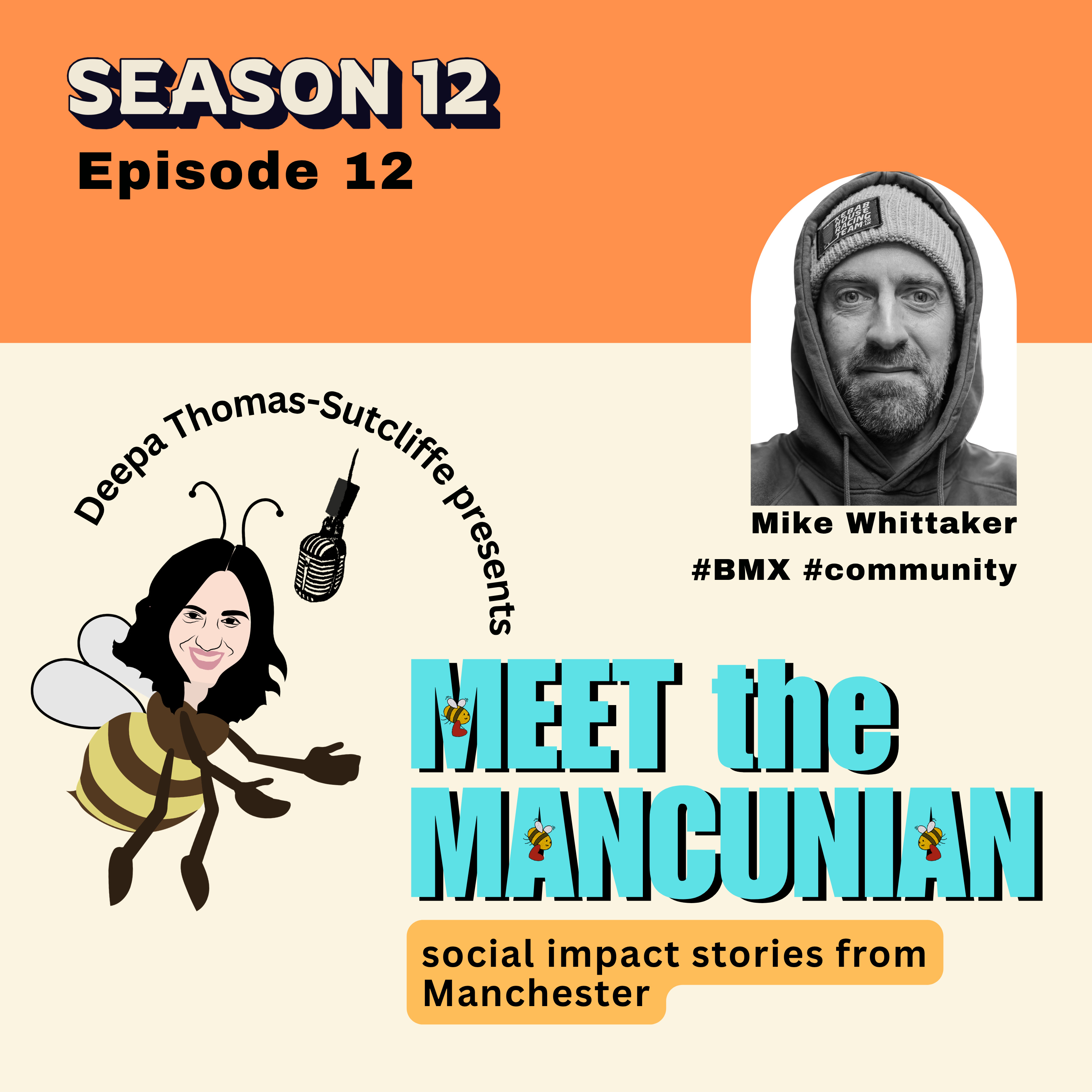
In the Season 12 finale of the Meet the Mancunian podcast, host Deepa Thomas-Sutcliffe speaks with Mike Whittaker, a BMX volunteer and racer at Bruntwood Park BMX Club in Cheadle. Mike shares how BMX filled the community gap he felt after leaving the police, leading him to volunteer on track repairs and later head up maintenance, while also returning to racing himself.
After breaking his T12 vertebrae, he committed to regional and national racing, documenting events on YouTube to encourage adults to start (or return to) the sport and build connection, including a growing dads’ community. He discusses launching Resilient Team Racing to promote positivity and mental health, fundraising through photography for homelessness charity Coffee4Craig, and preparing to represent Great Britain at the 2026 World Championships in Brisbane.
Did you know:
· BMX stands for Bicycle Moto-X and began as the bicycle equivalent of motocross.
· BMX is an Olympic medal sport since 2008
· There are over 5,000 active BMX racers in the UK and over 60 active BMX clubs.
Key resource:
Time stamps of key moments in the podcast episode & transcript:
(00:57) Meet Mike Whittaker
(01:16) From police to purpose
(01:49) Joining BMX volunteering
(03:45) Injury and racing comeback
(05:36) Building Adult BMX community
(08:30) Resilient team racing
(10:32) Photography fundraising impact
(25:56) Signature questions
(32:33) Life lessons
🎧 Listen on Apple Podcasts, Spotify, YouTube or https://www.meetthemancunian.co.uk
#Manchester #SocialImpact #Podcast #BMX #Community
I hope you enjoyed listening to the podcast episode. Please do check out my other podcast episodes for a bit of inspiration.
Episode 12.12 Mike Whittaker transcript
Intro
[00:00:00] Hello, and welcome to Season 12 of the Meet the Mancunian podcast: social impact stories from Manchester. I'm your host, Deepa Thomas-Sutcliffe, and I'm so glad you're here today.
[00:00:12] This season, I'll be speaking with people who are driven by passion and guided by purpose, individuals working in different ways to shape Manchester and strengthen our communities.
[00:00:23] In each conversation, we'll explore what motivates them, what keeps them going, and what impact their work is having across our city. These are honest human stories about why people care deeply about what they do.
[00:00:38] New episodes drop every Tuesday during the season. You can listen on Apple Podcasts, Spotify, YouTube, or at www.meetthemancunian.co.uk.
[00:00:48] Thank you for joining me. In the season finale, let's meet this week's Mancunian guest talking about supporting the BMX racing community
Ep 12.12: Meet Mike Whittaker
[00:00:59] Deepa Thomas-Sutcliffe: Passionate about fundraising creatively? We hear from Mike Whittaker, BMX volunteer and racer, in Mike's own words. Thank you so much, Mike, for joining me today
[00:01:10] Mike Whittaker: Thank you, Deepa, for having me. I really appreciate it
[00:01:13] Deepa Thomas-Sutcliffe: Looking forward to hearing all about your interesting story.
From Police to purpose
[00:01:16] Deepa Thomas-Sutcliffe: But first, tell us what first sparked your passion for supporting the Manchester community
[00:01:22] Mike Whittaker: I think it probably started with me when I was a police officer. I was a police officer for Greater Manchester Police for about 11 years. Played quite a large role in the community doing that. And as I left, I think I've always been trying to find a gap that sort of fills that bit of service that I left.
[00:01:38] Deepa Thomas-Sutcliffe: That's really amazing and lovely to know that you were one of the GMPs, who are been keeping people safe. The Greater Manchester Police, for those listeners around the world.
Joining BMX volunteering
[00:01:49] Deepa Thomas-Sutcliffe: Tell us about how did your passion for BMX racing start. And I know you're involved in more than one capacity.
[00:01:55] Mike Whittaker: I got involved in BMX racing in about 2024 when my young lad at the time, about 13, 14, got back into BMX and wanted to attend his local BMX track, which is called Bruntwood Park BMX Club.
[00:02:09] Through going to the BMX club, I just got involved with a group of people and just found myself being part of something and starting to volunteer in a capacity that I never thought that I would do. From leaving the police, I was always a bit standoffish with people, and I didn't ever feel part of anything until I got to that BMX club.
[00:02:28] Deepa Thomas-Sutcliffe: Tell us more about the volunteering. What form did that volunteering take?
[00:02:33] Mike Whittaker: It started quite simply by just helping out on some of the track days where sometimes I would help with some of the repairs. Somebody would ask me to move something or set up what we call a gate, which is a system that we use to start the BMX races off at the top of the hill.
[00:02:47] And just slowly over time, that developed into a more of a permanent role, which kind of ended and resulted in me from 2024 to 2025 taking over the maintenance of the actual track or heading up the maintenance. I had a bit of a team of people underneath me that were helping me to maintain that.
[00:03:04] Deepa Thomas-Sutcliffe: That's really interesting. And then you also got into other aspects of BMX, isn't it?
[00:03:10] Mike Whittaker: The problem that I have as a person is if I'm stood there watching my son ride, because I've always been a passionate mountain biker, I really wanted to get involved. So as soon as I realised that he was going to stay in the sport for a period of time, I started riding myself.
[00:03:26] And I found a lot of camaraderie between me and some of the dads which basically got us into a point where we were entering some of the club races. So that's the low-level races that we hold at each one of the sort of independent club tracks like ours, and doing that on a Saturday afternoon every now and again, entering a club series.
[00:03:44] Deepa Thomas-Sutcliffe: Really interesting.
Injury and racing comeback
[00:03:53] Deepa Thomas-Sutcliffe: And when you think about all the aspects of your volunteering and the work that you're doing around the BMX racing community, what's the change you're trying to make and what does success look like for yourself and the people that you serve through this community?
[00:04:02] Mike Whittaker: It's probably easier to tell you a little bit about how things have changed for me. So I went from club racing in 2024, and I actually had an accident where I broke my back. I broke my T12 vertebrae.
[00:04:14] Deepa Thomas-Sutcliffe: I'm so sorry to hear about that.
[00:04:16] Mike Whittaker: It's all right I broke my T12, but it was a stable fracture. It wasn't horrendous, but it put me in a position where I really had to choose whether I was going to race and take it seriously or not. And I chose to get back on the bike and chose to race in both a regional and national series for 2025.
[00:04:31] And as part of that, what I wanted to try and do is show people that even though, like I'm over the age of 40 now, I'm actually 44, and I started racing properly when I was 43. And I wanted to show people that through a bit of determination and consistency, that you could actually try and achieve something.
[00:04:47] I'd set myself a goal to just race all the races and see where I come. But through doing that, I decided I was going to record those races and put them on YouTube in a way to try and encourage people to do the same thing. I think there's loads of blokes my age where you start to almost lose focus on where you're at.
[00:05:06] Some people get a little bit disheartened with becoming older and you don't think you can achieve anything or that you might be too old to start something new. And I just wanted to disprove that myth.
[00:05:16] Deepa Thomas-Sutcliffe: I love that. I'm 50 myself, and I think you can always learn new things. So this year it's been learning Italian and other things that I'm doing with on the educational front.
[00:05:26] More power to you to shine a light on no age is too old to get started on something you really enjoy, so that's brilliant.
Building Adult BMX Community
[00:05:36] Mike Whittaker: It was through that I started to realise that really blokes of my age, unfortunately, we don't talk to each other enough in some circumstances. Your friend group tends to get a little bit smaller as you get older. And what I found was through trying to introduce some more adult lessons on a Thursday night at coaching and trying to get a couple more of the dads down, that really we've built a bit of a dad community as well.
[00:05:58] So not only was there the racing aspect of it, but the training aspect together brought a load of blokes together who potentially would've been a bit like me, where I was a little bit more introverted, a little bit more... I kept myself to myself is the way I would put it. But those like-minded people got together and bonded over spending time together and riding bikes.
[00:06:16] Deepa Thomas-Sutcliffe: And that community is so important when people are feeling isolated, isn't it? It's that connection.
[00:06:22] Mike Whittaker: I don't think you realise you're feeling isolated as you get older. I didn't realise that I needed BMX. I realise now that I needed that community and I needed to be part of something. It was the bit that was missing from me from leaving the police, where you were very clearly defined in a community of police officers.
[00:06:40] And I've been gone now for about 10... It's 10 or 11 years now I've gone, and there was always a little bit of me that was missing, and I think this filled the gap for me. And I think that in turn is a small part of what's missing from most blokes who have been involved in sport, who've been quite active, and are getting to that point where we've got kids and maybe we're not putting ourselves first.
[00:07:01] And we're letting them do their own thing. And it's just about saying, "It's all right for you to go riding your bike for a bit. It's all right for you to race if you want to race, and take it as far as you want to take it."
[00:07:10] Deepa Thomas-Sutcliffe: Oh, that's lovely.
[00:07:12] Can you share a bit about the impact of what you do? And I know you fundraise for Coffee4Craig as well, so please do talk about that
[00:07:19] Mike Whittaker: So the cool thing about what I do for BMX is on a couple of different levels. Last year has been really about trying to encourage people back into the sport at my age or even below. Whoever wants to come into the sport to try and encourage them and break down some barriers by showing them on YouTube what the actual sport looks like from somebody who's competing rather than on the sidelines.
[00:07:39] I think you only get half of a picture of what happens in a BMX race by standing on the sidelines. So I literally record all the way through being in the pens, which is an area where we basically wait to be queued up to race and through the racing, and give them a bit of a commentary about how my race went, and I speak to some of the other racers at the events as well.
[00:07:59] Effectively, that has encouraged other people back into the sport and I've had some really nice feedback from blokes and ladies both at home and abroad who've gone back to their local BMX tracks. I've always been very much happy to have people at our BMX track, but at any BMX track.
[00:08:14] I see the community not only as something that's in Cheadle and in Manchester, but is wider than Manchester. The UK BMX community is a small amount of people. And it needs to be fed by some of these people coming back into the sport and some of the kids coming into the sport as well.
Resilient Team Racing
[00:08:30] Mike Whittaker: This year has been massively focused on building what is a mental health race team for me or a race team called Resilient Team Racing. And that initiative is really to try and bring together people who would otherwise be struggling in some element o-of their life.
[00:08:49] It's complicated, but because loads of people race for different reasons. But in a BMX race, there are eight people generally in a BMX race, and there's only one winner. Seven people on that gate line up knowing that they're going to lose.
[00:09:03] But by getting on the gate, that's actually the greatest part of BMX. The scariest part and the biggest challenge is getting to that gate, and there's a lot of stuff that goes on to get you there. And once on there and once involved in a race the elation that you kind of feel when you finish that is almost second to none.
[00:09:22] There's not really much like it. It's really exciting. There's loads of adrenaline going and there's a real sense of achievement, and that sense of achievement should be carried regardless of where you finish your position.
[00:09:34] In my eyes, those people have already beaten 99% of people who won't get on the bike and won't put themselves out there and do that. And the whole idea of Resilient Team Racing was that both myself, a chap called Matt Walsh, and a chap called Lee Grant got together as dads and we thought we wanted to try and make a difference and encourage people that might be at the back of the pack or might be in a mid pack to come and join a team of like-minded people that are going to promote positivity within the sport.
[00:10:01] That was always the aim, and that's what's taking place this year. That's my passion project, if that makes sense. I want to encourage as many people as I can into the sport and welcome them in. I've seen firsthand the positive aspects of what can happen with a sport through my own kids and seeing how they can basically develop as teenagers.
[00:10:19] Deepa Thomas-Sutcliffe: That's really amazing. I love this resilient team. What did you call it? Resilient team racing, and the fact that you're trying to encourage more people to get into BMX racing again or start afresh.
Photography Fundraising Impact
[00:10:32] Deepa Thomas-Sutcliffe: And tell us a little bit about the fundraising that you do as part of the impact?
[00:10:36] Mike Whittaker: I've got loads of hobbies. But one of my other hobbies and passions is photography. I use my photography to basically generate fundraising. At the minute I'm doing it for Coffee for Craig, and Coffee for Craig is a homeless charity in Manchester City Centre that feed the homeless five days a week. They open their doors, take people in and provide services a friendly ear for people to talk to and provide proper food for them. And I love the idea of that.
[00:11:02] The reason why I'm passionate about Coffee for Craig is when I was a police officer, I always struggled with the concept of giving effectively homeless people money. In my sort of police officer's mind, I struggled with the concept of what was going to happen to that money.
[00:11:14] But I love the fact that what I can do by selling a print and making a donation to Coffee for Craig is I can feed somebody, and the money goes direct to feeding them. The money goes direct to supporting them. What it isn't going directly to do is to potentially support in either bad habits or something else that's going on that's not helping that situation. And that's why I love it.
[00:11:35] The story that Risha has with her brother's passing, it really touched me. It touched me because I've seen situations like that and been to situations like that as a police officer, where unfortunately I've seen homeless people pass away. And I think I was seeing it from the other side really with Risha's story.
[00:11:52] Deepa Thomas-Sutcliffe: Definitely Coffee for Craig is wonderful and Risha was on the podcast some seasons back. And she's been amazing, like many Mancunians, introducing me to many passionate people such as yourself. Brilliant what you're doing for them.
[00:12:06] Can you share a moment that made you stop and think, "Yes, this is why we do what we do"?
[00:12:11] Mike Whittaker: In respect of the BMX stuff, when I first came to the BMX club and I started bringing my daughter she was probably quite a bit younger, I would say maybe 12, yeah, 11 or 12 years old. She would cling to me and she would shy away from speaking to other people.
[00:12:29] Through being at that BMX club, she has opened up, she's grown friendships. I've seen her develop as a woman now, into a very chatty and very loving and very caring, 15-year-old girl There's been several points where I've stood there and I've admired her from afar in the way that she's come on and the courage that she's shown in trying to beat those demons, is the way I would call it.
[00:12:55] And it's that kind of stuff that really hits me with BMX. It's seeing the kids come to the track, not being able to really ride a bike, seeing them take part in their first race and be excited, but then seeing them develop over the years into these absolutely top-performing racers.
[00:13:13] I'm massively proud of one of the lads that's at our club who's world number three, aged 12 years old. Leo Rowlands is he's a young boy who I can actually turn around and say I admire. The tenacity that he's shown through his racing, the adversity of losing, of crashing, of picking yourself back up, of dragging yourself to a world championships and coming out world number three at 12 is phenomenal.
[00:13:38] There's so much to be gained from losing, , especially in a society now where we're very much focused on making sure nobody really gets upset and that nobody really loses. There is resilience to be got from that. There is life lessons to be learnt from that, and I think BMX gives you that.
[00:13:54] I think that's why I feel so passionate about it, because it's kind of like all those little life lessons that some of us learn over them years, you can learn that on a track. You learn the thing of picking up your friend when they fall off their bike and making sure they're okay. The compassion, the empathy, and the ability to be able to talk to each other.
[00:14:12] You're able to learn to articulate some of them fears when you're trying to do a new thing like jumping a bike or what we call manualing a bike, picking a bike front wheel up and going through certain obstacles. But you learn to conquer those fears. You gain confidence. You fall back off again. You lose confidence. You pick yourself back up. You gain that confidence again, and sometimes you win, and sometimes you lose, and you learn that's not forever.
[00:14:37] Winning is not forever. Losing is not forever. But that journey, that friendship that I've seen them kids get from each other and the bonds they kind of form between each other, that's what makes me stand back every now and again and just think this is-- to me, it's the greatest sport in the world.
[00:14:54] Deepa Thomas-Sutcliffe: Thank you so much for sharing both your daughter's story and also Leo's story. And also really powerful just think that there is almost a human evolution that people are going through gaining confidence and community through their journey on the track.
[00:15:10] What's been the toughest part of the journey so far, and what's helped you navigate that?
[00:15:15] Mike Whittaker: There's been loads of tough things. I think hurting myself and breaking my back was hard. Having the support of the people around me to not laugh at me, to say, come on, you can't do this." I know there will have been people looking at me, thinking perhaps this is that point in time, you're 41, 42, you need to maybe stop. You've damaged your back, you've hurt yourself, you're not good enough. Stop.
[00:15:39] I openly get that verbally from people. I got encouragement. When I first joined in the racing to do the regional races and national races, I found a group of men who took the, took me, put their arm around me and said, "You can do this. We all do this racing. You can do this."
[00:15:58] Not to say, that there was nothing special about those blokes. Some of those blokes are amazing riders, far better than me. I am literally your average rider who has been consistent and been pushing himself constantly to be able to get where I've got to.
[00:16:11] But those blokes took me in and put their arm around me, and I felt a sense of camaraderie that can only be gotten from being involved in it ,from being in the thick of it, from putting it on the line by being on the gate and racing.
[00:16:24] There's no other way to understand what we do than, other than to be in it and to be doing it, to understand that fear and to accept that, we're going to race regardless of being scared.
[00:16:34] Deepa Thomas-Sutcliffe: Thank you for sharing that you've gone through those tough moments of hurting yourself really badly, but then finding the support and the will to work through it and bounce back.
[00:16:46] Mike Whittaker: Hard to work out whether it's the will or sometimes you're just a bit crazy. I managed to break my hand before one of the national races in Manchester last year, a week before. And somehow, people say you're brave, but I'm not sure I'm brave so much as just I'm somewhere between massively disciplined and slightly crazy, and I really wanted to...
[00:17:06] If I could hold onto them handlebars, I wanted to be able to race. But it was that determination that made the difference really between me, making the qualifications for the World Championships and coming seventh in the UK or perhaps not doing. It would've been easy to turn around and go: "Do you know what? That race is seven days away. I can't get the swelling down. Let's not race."
[00:17:25] The sensible thing would be not to race. But I think the people that are competitive in their nature like me, I don't think we can do it, unfortunately.
[00:17:35] Deepa Thomas-Sutcliffe: You do you, as a trainer said last week to me. Each person has to embrace their level of competitiveness challenge, and many other things. So as long as you're not compromising your health absolutely should do that.
[00:17:50] When the work becomes heavy or the progress is slow, what helps you stay motivated and hopeful? Is there a ritual or a mantra or a belief that keeps you going?
[00:18:01] Mike Whittaker: I believe in being grateful. It's a really deep feeling of being grateful for everything. So even when I damaged my back, I was grateful for the ability to get back up, to get back on the bike. I had a friend who unfortunately lost his life through cancer, where he had a brain tumor in the bottom of his spine, and he never, ever gave up.
[00:18:23] When the doctors told him he had three months to six months to live, he denied them that and lived another sort of year and a half, two years. He inspired me to always look at things, I suppose the same way.
[00:18:36] It's the gratitude for being wherever I am now. I never lose sight of that. As much as I always push myself to go further, I'm always really cognitively trying to think about being thankful for where I am now and what I've got now.
[00:18:51] I don't think we know where life's going to take us. I don't think we know what's going to happen tomorrow or whether, whether we're ever going to be better at something. But I've always learned that through hard work, discipline, consistency, the small things, the small increments, they happen over time. And it's the same thing I tell the kids.
[00:19:10] When I see a kid being really hard on themselves, "I can't manual this, I can't jump this," which are all technical terms with BMX. I always say, "Just keep trying. Keep plugging at it. That little bit at a time, little bit at a time, and before you know it, six months has gone and they are doing the techniques and tricks that they couldn't do before."
[00:19:28] Most of things in life are just about not giving up. It's just about keeping on going. Life can be tough, but I think you've just got to keep going. And you've just got to be grateful for what you've got. It's all a journey at the end of the day.
[00:19:40] Deepa Thomas-Sutcliffe: I think that journey part is so important because we need to be grateful for the here and now. We can always have aspirations for what's next as well.
[00:19:49] So what's next for you and your mission? What's 2026 have in store?
[00:19:54] Mike Whittaker: 2026 is a massive year for me. I always feel like I've hugely bitten off more than I can chew. But I'm fortunate enough to be supported by some absolutely great people and some great businesses. I am, going to the 2026 World Championships in Brisbane. I will be competing for Great Britain.
[00:20:09] I will be picking up my jersey for Great Britain in June, and I'll be out into Australia in July. The real aim for this year, in all honesty, is to really enjoy the sport to really enjoy this season of national racing and seasonal regional racing, and more importantly this trip of a lifetime to Australia.
[00:20:29] Where we say about being grateful before, there is absolutely no guarantee that I'll ever make another world championships. It's never guaranteed with what we do within that sport, unfortunately. Anything can happen and unfortunately, you might not qualify. Being able to be given the opportunity to go is an honour, it is a privilege, and I can't wait. That's going to be the absolute highlight of the year, I think, Deepa
[00:20:51] Deepa Thomas-Sutcliffe: Sounds brilliant. And I haven't been to Brisbane, but I have been to Sydney, and I can just say Australia is wonderful. And I wish you luck. It's amazing to be representing your country on the world stage
[00:21:04] Mike Whittaker: It's an honour. I never thought that was going to be possible. And if I think if I'd started that season off thinking that's what I was going to do, I don't think... when I thought about that was what I was going to do anyway.
[00:21:13] If you'd said to me I would finish seventh in the UK in the National Series, I wouldn't have, I wouldn't have agreed with you. I would've said that, it's far beyond me. But perseverance again, determination, it just seemed to, it seemed to come together.
[00:21:27] Deepa Thomas-Sutcliffe: Absolutely. I think that never giving up is really important.
[00:21:31] So thinking about our listeners, many of our listeners may want to help, but they don't always know how. Where can individuals make the biggest difference in a simple, everyday way? This might be in the context of BMX racing, but just in general volunteering.
[00:21:45] Mike Whittaker: You've got to have a will to try and leave the world in a better place than you found it. And I think that no matter where your passions kind of lie, I think the thing I would take away as a 44-year-old bloke is don't care too much about what other people are thinking.
[00:22:02] Find a passion that really sets your heart on fire, follow it, and see if you can get other people to follow it, and see if you can inspire other people to do those things by just being a good person, by just turning up and helping within that field.
[00:22:18] I never thought that I would turn up to a BMX track, end up on a committee as a volunteer. I have volunteered, I don't even know how many hours last year to changing the track, to updating the track, to helping out at races. It's not fathomable if you do it that way, but I would always advise people to just take one step every time closer to being that better person.
[00:22:41] Say yes when somebody asks you if you can do something. Maybe go and ask somebody if they need any help. I think a lot of people when they came to the BMX track for us, keeping it within BMX, they felt like they weren't able to ask because they thought everybody else had a specific job or they, they had it covered.
[00:22:58] The honest answer is clubs like ours and other organisations, other sports organisations will always need people to help out. And if you're showing willing, I think it will go really far, and there's nothing more rewarding than being involved in that situation.
[00:23:12] It's double-sided for me with BMX. Selfishly, this year is going to be massively about me going to the world championships and seeing how I can do and representing Great Britain. But the other side of me is going to be cheering on these other racers within my race team. It's going to be trying to see if these people can excel and seeing how I can help them.
[00:23:30] I think if we have a conversation in a year's time, I think the most rewarding thing will be seeing those other people succeed. Your own success only lives so far, but knowing that you've made a difference to those kids or even the adults is probably the greatest reward. And I think if people can get that in their head, I think people will volunteer for stuff. I think people will make a difference.
[00:23:50] Deepa Thomas-Sutcliffe: Like you, I'm very much all about the purpose, and I think that's so important that you find that passion area and then you volunteer or support people in that passion area. And then, your volunteering really stay ... it's wonderful cycle of, what we call the virtuous cycle, where you feel good, you get a sense of community, and you keep doing it and hopefully support many people on that journey.
[00:24:15] Is there something about your work or the voluntary sector that you wish more people truly understood? For example, what does BMX stand for? I don't know.
[00:24:23] Mike Whittaker: I actually don't fully know what it what it stands for. It's something like bicycle motocross. BMX was always bred out of motocross without the engines. So it's been around for years and years, and some of the racers that I actually ride with have been like multiple world champions or have been one of them.
[00:24:42] Alan Hill, who's an absolute legend, has been national champion on two disciplines of bikes. We do have different size bikes even as adults. But he's been a national champion at two different disciplines for 10 years in a row, and he's raced since the '80s and '90s.
[00:24:58] So I suppose the thing I would want people to know that they possibly don't know is that these kind of organisations, everybody you see within a BMX race other than the racers, they're volunteering. The majority of those people are there not getting paid. I think some of them barely get expenses, but they're volunteering their time.
[00:25:19] The big thing I've always tried to push with my YouTube channel for the BMX side is to say to people, "Go down to your local club. If you like what you're watching, go down to your local club, get involved. You don't have to ride. You can volunteer and you can help out." Without those people going, the races don't take place. And it's even at that level, the national level and regional level, like they're volunteers that have given up their time.
[00:25:42] Deepa Thomas-Sutcliffe: That's really powerful. The fact that even at the national level, like you said, everybody needs volunteers and you're encouraging people through your YouTube channel and through this podcast to go to their local clubs and see how they can support them.
Signature questions
[00:25:56] Deepa Thomas-Sutcliffe: I'm going to the signature questions as it's Meet the Mancunian.
[00:25:59] The first one for you: If Manchester had a superpower, what would it be and how have you seen it in action?
[00:26:06] Mike Whittaker: If Manchester had a superpower, it would be bringing people together at times where the absolute worst could happen. I've seen it happen on several occasions, but stuff that comes back to me.
[00:26:18] For me as a serving police officer, probably the biggest thing that happened in my time the death of Fiona and Nicola when they were killed by Dale Cregan. And I specifically remember being at court on the day of their funeral when the funeral procession was coming down Deansgate.
[00:26:37] And it fills me with emotion still even now, but when I stood outside there as a detective in my suit, I suppose saluting the funeral procession as it goes past, the amount of Mancunians that stopped, that stood still, that remained silent and that knew, something horrific had happened and something monumental was happening by the fact that these girls were going past.
[00:27:01] It really brought me to that sense of how powerful Manchester can be when we stand up against people we aren't happy about. That, when we stand there in defiance of acts that are just so terrible that should never have happened, we don't ignore it as Mancunians. We don't ignore it as Manchester
[00:27:16] Deepa Thomas-Sutcliffe: I don't know about this particular incident. Could you just tell me again?
[00:27:19] Mike Whittaker: Nicola and Fiona, they were both serving police officers when there was a fugitive called Dale Cregan, who was at large in Tameside. So basically, he was hiding out. He'd been involved in the murder of another family, and he made a phone call to get the police to come to an address in Hattersley.
[00:27:38] And unfortunately, he shot Nicola, I think, as she came to the door, but he also shot and threw a hand grenade at Fiona. But it was the single most horrific act against a police officer that I had seen while serving.
[00:27:52] I know the Arena bombing stands out a lot for people and it certainly does for me. I don't want to take the valour of what some of those people have been through for the Arena bombing, because I was not there.
[00:28:03] But I specifically remember going to the scene in Tameside as a police officer to effectively guard it and to look after some of the flowers that were being laid, and it touched me in a way that , no police officer goes to work expecting that they won't be going home. And it cuts me quite deep that both them girls were absolutely lovely girls, and it, they just didn't make it home that night.
[00:28:24] Deepa Thomas-Sutcliffe: Oh, I am so sorry. It is brilliant that Manchester always looks after its own and people stand together.
[00:28:32] Mike Whittaker: I definitely felt it that day. As horrible as that situation was, it was almost a beautiful sight to behold.
[00:28:39] Deepa Thomas-Sutcliffe: If you could gift the city one new value, habit, or mindset, what would you choose to strengthen community life?
[00:28:46] Mike Whittaker: I would say know your neighbour. I think the thing that's missing from a lot of people and a lot of communities now is not knowing your neighbour. I live in an area where I know my neighbour on both sides next door. First name terms. They need anything, they come to me. If I need anything, I go to them. I think we're missing that.
[00:29:05] I think I've seen through service, through the police, and through speaking to people at the BMX communities, I think we're missing that, and I think as people, we develop, we grow, and we get better as people through community. I know I found that through the BMX community.
[00:29:23] I can't lie that when I left the police, I wasn't a massive fan of wanting to be in a community. I didn't see myself as being somebody who'd want to volunteer for something like that. But I found that through doing that, through taking those steps, to get involved, unbeknown to me, I feel like I've become a better person.
[00:29:40] I don't think we're ever at a finished article, but I feel passionate about helping other people now. I feel passionate about giving my time for other people, and I understand now that the reward from that is that feel good factor that you just don't get anywhere else.
[00:29:54] Deepa Thomas-Sutcliffe: And I like that very much about knowing your neighbour. Like you, I know both my neighbours. They're both beautiful senior citizens, and I've been for my 102-year-old neighbour's birthday parties every year as well.
[00:30:05] It is very special because, I guess there is a little bit of camaraderie from living in the same area and having some of the same concerns while, of course, connecting with other people in the wider community.
[00:30:17] If you could have a 10-minute conversation with a community hero from Manchester's past or present, who would it be with, and what would you ask them?
[00:30:26] Mike Whittaker: I've known Risha for a period of time now. I don't ever get sick of hearing her story and her enthusiasm for Manchester's homeless. I would absolutely love to continue the conversations that I've had with her to talk about the impact that losing her brother had on her in creating Coffee for Craig.
[00:30:47] How she coped with the distress of finding that out. Effectively, the loss of her brother was found out through Facebook. How she gathered the courage to be able to face that by going to see other homeless people in similar situations and trying to make a difference.
[00:31:04] And throughout all the adversity of hearing probably countless nos and countless adversity against what she was e-effectively trying to do by lack of funding or lack of interest in it. Just how she persevered, how she went from that street kitchen getting premises, to getting themselves to the point where they're now in a premises that's right next to Strangeways over in Manchester, and how she copes with that. I don't think I'd ever get bored of that story is the honest answer.
[00:31:34] She inspires me because she gives her time. Where we have where we have a society now that has so many opinions about charities and the way that they behave, like I know that lady has given up an awful lot in order to try and keep them doors open.
[00:31:48] It's her story, so I'm not going to get into the personal details of it, but I know she has, and I know the funding's been cut, and I find myself inspired by her. And that is, it's the whole reason why I give that money from M Prints is because that's the least I could do.
[00:32:04] Deepa Thomas-Sutcliffe: She has shared her very inspiring story, of course, of a few years ago on the podcast, and you're absolutely right. She's very giving, not just for the homeless people, but also for people like myself. She connected us together, and she's connected me with very many other guests and personally invited me to events to meet other people, which I'm really grateful for. Shout out to her. She is a community hero, and thank you for choosing her.
Life Lessons
[00:32:33] Deepa Thomas-Sutcliffe: Looking back, what's a life lesson or a piece of wisdom that this journey has taught you, something that you carry with you always?
[00:32:40] Mike Whittaker: I think the thing I carry with me constantly, is that life is short, that we don't always get, we don't always get opportunities to redo things. We don't get the opportunities that present themselves today may not be the opportunities that present themselves tomorrow.
[00:32:57] I chose to ride because I might not be able to ride tomorrow. I don't know what the next injury's going to be. I don't know what life's going to have for me around the corner. I've seen friends lose loved ones. I've lost loved ones myself, and there's been no rhyme or reason to that stuff.
[00:33:13] So I would say to people, what makes you happiest, obviously, as long as it's not hurting anybody else. Inspire others to try and gain confidence to do what they find happiest and spread that.
[00:33:28] There's too many people spreading negativity and embracing, either a culture of nastiness or sort of negativity towards other people's commitments or goals. Help people achieve their goals if it's within your power to do it. There's no reason to not celebrate with other people.
[00:33:46] Deepa Thomas-Sutcliffe: I think that's beautiful. Both the fact that life is short and we should seize the opportunities which are currently available to us, but also how can we best support other people, whether it's being mentoring or supporting a cause or any other way that you can support people. So thank you for sharing two very important life lessons.
[00:34:09] And what's the best way for listeners to connect with you, to support your mission and learn more?
[00:34:14] Mike Whittaker: If they want to get me on socials I have got an Instagram page which is @ mikewhitaker653bmx. I'm also on YouTube if you want to see what the UK BMX scene is all about. I've got a YouTube channel which is simply my name, which is Mike Whittaker. You should find me underneath that.
[00:34:31] And if you fancy coming down to Bruntwood Park BMX Club, you want to get involved in BMX in Cheadle, then please do contact the club at Bruntwood Park BMX Club.
[00:34:41] Deepa Thomas-Sutcliffe: Thank you so much, Mike. It's been a really interesting conversation, and I've learned a lot about the world of BMX racing, which I must say I didn't know very much about.
[00:34:51] Mike Whittaker: I'm glad to be able to share it with you.
[00:34:53] Deepa Thomas-Sutcliffe: And also with hopefully many listeners around the world. Thank you so much for taking the time.
Outro
[00:34:59] Thank you for listening to the Meet the Mancunian: social impact stories from Manchester. If today's episode resonated with you, please share it with someone who believes in the power of passion and purpose, or leave a review to help others discover the podcast.
[00:35:14] You can connect with me on social media @MeettheMancunian on Instagram, Facebook, and Blue Sky, and @MeettheMancunianPodcast on YouTube.
[00:35:24] I'm Deepa Thomas-Sutcliffe, and I'll be back with another story from the people shaping Manchester.
[00:35:30] This is the last episode of Season 12, and the Meet the Mancunian podcast takes a break until October 2026.
[00:35:38] Until then, thank you for listening and for being part of this community
