
 Apple Podcasts
 Spotify
 RSS Feed
 Amazon Music
 YouTube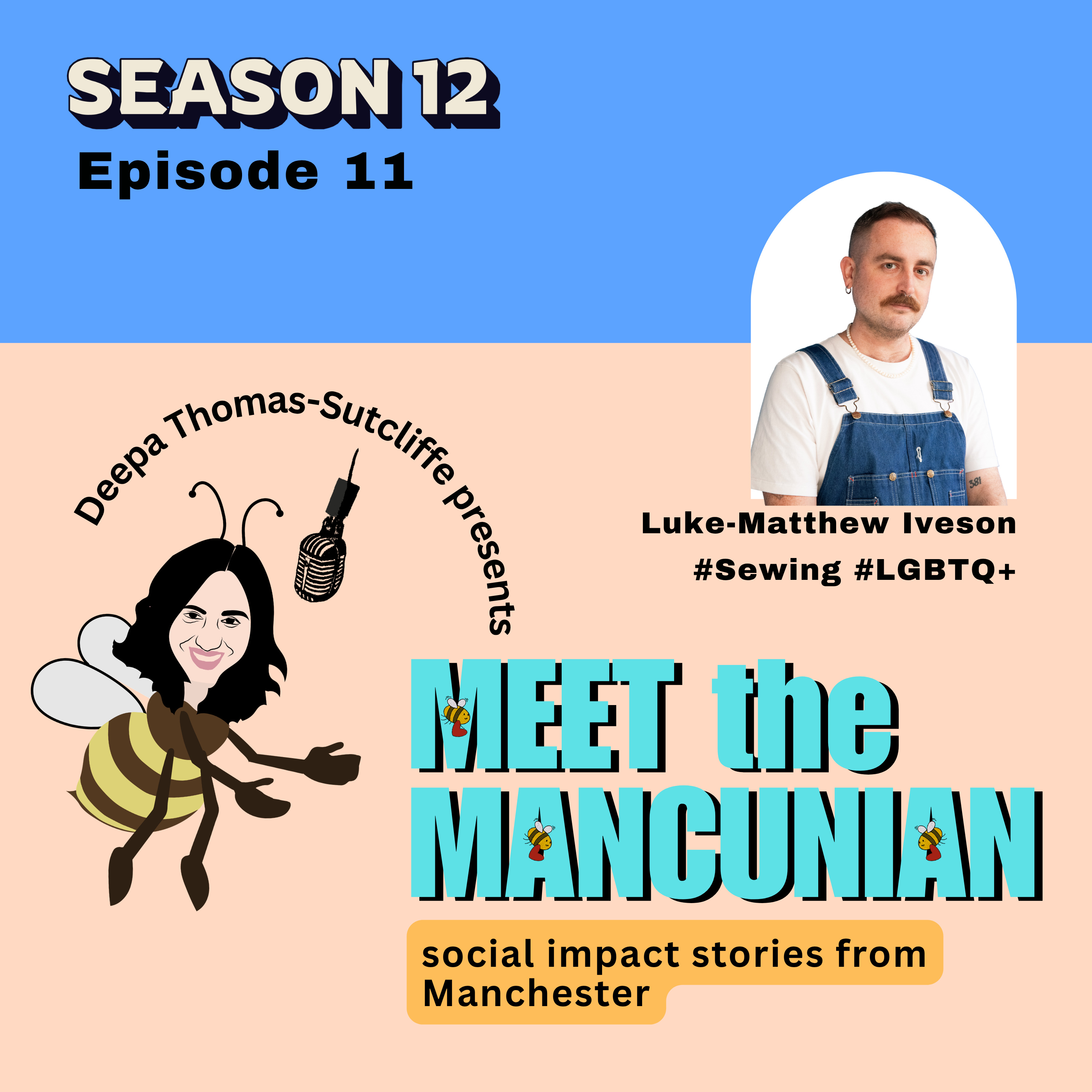
In episode eleven of Season 12 of the Meet the Mancunian podcast, host Deepa Thomas-Sutcliffe speaks with Luke-Matthew Iveson, a community sewing teacher and Season 10 winner of the BBC’s The Great British Sewing Bee. Luke shares how learning to sew from their grandma and working as a corporate diversity and inclusion consultant led to a shift into community-based workshops after the show gave him a platform and visibility as the first non-binary winner.
Luke explains how sewing supports self-expression, creativity, and confidence—especially for LGBTQ+ people while also addressing barriers like cost, lack of access to sewing machines, and the loneliness of the hobby. Luke reflects on the impact of representation, shares a powerful story involving a trans young person, and their plans for inclusive classes, patterns, and outreach with groups including the Proud Trust and Stonewall.
Did you know:
· About 4% of the UK population identify as lesbian, gay, bisexual, trans, or binary
· Sewing, quilting, and textile arts hold deep roots in the queer community.
· Modern queer sewing spaces prioritise inclusivity, with thriving communities focusing on gender-affirming clothing alterations and creative self-expression.
Key resource:
Time stamps of key moments in the podcast episode &transcript:
(01:47) From Hobby to Community
(02:56) Winning Sewing Bee
(04:44) Workshops and access
(06:44) Defining success
(10:03) A class that mattered
(11:24) Handling criticism
(14:10) Staying motivated
(15:51) What’s next
(16:48) How you can help
(18:45) Myths about sewing
(20:22) Signature questions
🎧 Listen on Apple Podcasts, Spotify, YouTube or www.meetthemancunian.co.uk
#Manchester #SocialImpact #Podcast #Sewing #Community #LGBTQ+
I hope you enjoyed listening to the podcast episode. Please do check out my other podcast episodes for a bit of inspiration.
Episode 12.11 Luke-Matthew Iveson transcript
Intro
Hello, and welcome to Season 12 of the Meet the Mancunian podcast: social impact stories from Manchester. I'm your host, Deepa Thomas-Sutcliffe, and I'm so glad you're here today.
This season, I'll be speaking with people who are driven by passion and guided by purpose, individuals working in different ways to shape Manchester and strengthen our communities.
In each conversation, we'll explore what motivates them, what keeps them going, and what impact their work is having across our city. These are honest human stories about why people care deeply about what they do.
New episodes drop every Tuesday. You can listen on Apple Podcasts, Spotify, YouTube, or at www.meetthemancunian.co.uk.
Thank you for joining me. Let's meet this week's Mancunian guest talking about encouraging the sewing community.
Episode 12.11: Meet Luke-Matthew Iveson
Deepa Thomas-Sutcliffe: Passionate about expressing yourself, we hear [00:01:00] from Luke Matthew Iveson, a community sewing teacher.
In Luke's own words.
Luke-Matthew Iveson: As part of the winning the show, it created a huge platform for me to go out and meet different people. There’re many sewing festivals around the UK that, I was able to go to and meet people who love sewing. And what I heard from many fans, especially people in the LGBTQ+ community, was that they really valued having that representation, and they had similar reasons of why they got into sewing.
Deepa Thomas-Sutcliffe: Thank you so much, Luke-Matthew, for joining me today
Luke-Matthew Iveson: Thank you so much for having me. I'm excited to be here.
Deepa Thomas-Sutcliffe: Delighted to hear about your interesting story. What first sparked your passion for working with the Manchester community?
From hobby to community
Luke-Matthew Iveson: I am very passionate about sewing, and it had always been a hobby that I'd picked up from my grandma and done throughout my life. And I had a corporate job as a diversity and inclusion consultant [00:02:00] for big corporate.
And I was so passionate about working with organisations for the impact that I could have for businesses. And after being on "The Great British Sewing Bee" and having that as a platform, I wanted to shift the work that I did with organisations and bring that more back to the community.
Because I feel, not only am I getting to meet people and meet the community that I'm a part of, but giving back to a community as well. So very different from the corporate lifestyle, and I've been loving every minute of it.
Deepa Thomas-Sutcliffe: Great to know that. I'm also very passionate about the whole inclusion space, so there's so many dimensions of that. And absolutely I can understand working with the community being really powerful as well.
Tell us about your journey to be a community sewing teacher. You said that the Great British Sewing Bee, so maybe just because we've got listeners around the world, just a minute about what that is.
Luke-Matthew Iveson: Of course,
Winning Sewing Bee
Luke-Matthew Iveson: "Great British Sewing Bee" is a TV programme, a [00:03:00] competition show on the BBC, and it's for amateur sewers around the UK to basically compete to be Britain's best amateur sewer. So as you expect, they are non-professional sewists who love sewing as a hobby and come at it from very different points of view.
I'm sure we'll talk about how I got to sewing. But I entered that show because I've been a big fan of the show, but what I didn't necessarily see was as much queer representation as I wanted to see on the show. And I thought, "I'm quite good with a sewing machine. I can sew clothes, so let's see." And I applied, and I won Season 10, which was incredible.
Deepa Thomas-Sutcliffe: Brilliant. From season 10 then to Season 12 here. Not that we're as famous as the British Sewing Bee.
How did that then get you on your journey to working with the community to help them with sewing?
Luke-Matthew Iveson: As part of the, winning the show, it created [00:04:00] a huge platform for me to go out and meet different people. There's many sewing festivals around the UK that I was able to go to and meet people who love sewing. And what I heard from many fans, especially people in the LGBTQ+ community, was that they really valued having that representation, and they had similar reasons of why they got into sewing.
It got me thinking about why I got into sewing in the first place, and it was all really around self-expression. As queer people, that's so important to us to be able to express ourselves and things like high street fashion, fast fashion doesn't serve that, and a lot of people get into sewing. So that was the main reason.
Workshops and access
Luke-Matthew Iveson: But interestingly is sewing's quite a lonely hobby. You tend to sit on your own making something. And I wanted to combine those two elements and create workshops and go and do community workshops at other venues [00:05:00] for people to love the hobby as much as I do and get as much out of it as possible.
Deepa Thomas-Sutcliffe: I'm fascinated that there are sewing festivals. I did have a passion for sewing and I think a bit more embroidery when I was growing up. And very recently my mother completed one of the embroidery kits that I didn't complete, and it was a half and half, which was so nice to see.
But also, the fact that you're saying that this concept that we all go through of isolation because, how do you bridge that isolation even with a hobby? Can you make it all about the community? And it's really interesting that you outreached to the community to bring your passion for self-identity and self-expression to others.
Luke-Matthew Iveson: I think there's also something around hobbies. If you are a painter, it's quite accessible for you to go and buy some paint from a shop and a piece of paper and create something. Sewing can be expensive as well to get the right equipment, and that's another reason [00:06:00] why I wanted to create a space for the community to come.
In Manchester, there isn't many spaces where people can go and access machines. So if people don't have a machine at home, they have a space to be able to explore that. And I find a lot of the people that are coming to my classes are queer people.
They have never switched on a sewing machine. They've never even touched one. And they're always my favourite classes because they come, they feel so comfortable to be in the space. We talk about some of their challenges around self-expression and what they'd want to achieve. And then they're able to learn a new skill as part of it, as well as meet other people from the community
Deepa Thomas-Sutcliffe: Oh, that does sound really interesting, and I guess it'll be a wide range of people you're catering to.
Defining success
Deepa Thomas-Sutcliffe: When you think about this change that you're trying to make, to make sewing a way to express your self-identity, what does success look like for you and the people you serve?
Luke-Matthew Iveson: I think it's giving confidence to a [00:07:00] community that still today is having their confidence knocked, whether that's politically, socially, economically. It's still challenging to be a queer person in many countries including the UK.
And I think something like being able to be creative is so empowering for an individual's confidence. But then to be able to create something that you can wear that truly expresses yourself from the inside out is also really important, and I think it gives off the right signals for people to be able to express themselves authentically.
So for me, it would be getting absolutely everyone in the community being able to sew their own clothes because they can't find what they are looking for or what suits them authentically in the high street.
Deepa Thomas-Sutcliffe: I like that. Both creativity and expressing yourself, both are important because I guess the creativity leads to your finding what's really helps you [00:08:00] express. And it's really good. And I do agree that there's still lots of room for all communities to be accepted, but also for people in the LGBTQ+ community to be accepted.
When you think about the impact of what you do, what would you say is the impact?
Luke-Matthew Iveson: I think the impact that's probably had the biggest impact on me is again, being able to travel around the UK to different places and meet other queer people and hear their stories around their own passion for something creative like sewing. And, how they want to express themselves and have a person that they can resonate with , that has an influence.
"The Great British Sewing Bee" was an incredible experience for me, but it also opened up this platform that I do feel like I have a responsibility to use in a [00:09:00] way that serves my community.
And just the messages that I got straight after the show and for the content that I also put out around my life as a queer person the educational side, people just thanking me and validating that they have someone that they can look up to or someone that helps them feel seen, it's truly overwhelming.
As a queer person, I have my kind of role models as well, and being able to even fathom that I could be someone's has had a huge impact on me. And again, as I mentioned it's a huge responsibility for me as well. So it goes back to that community element. I need to be able to give back as well as serve that community.
Deepa Thomas-Sutcliffe: I find that very powerful to say that people are feeling seen and heard by seeing somebody like yourself be the champion for themselves. And hopefully they will also get encouraged to aspire to participating in the Great British Sewing Bee or [00:10:00] other sewing contests if that's what floats their boat.
A class that mattered
Deepa Thomas-Sutcliffe: Can you share a moment that made you stop and think, "Yes, this is what we do, and this is why we do it"?
Luke-Matthew Iveson: It was a recent class actually before Christmas. I had a mum come to one of my classes. They were extremely passionate about sewing, and they came to one of my bag-making classes and had a great time.
And we got chatting about their child who was trans and was super, super creative but had huge anxiety about going out in public, going meeting people. And through their teenage years had become really isolated.
She told me that they'd watched the Sewing Bee together, and a few weeks later they both actually came to one of my classes, and I was able to to their child and teach them a skill that they really wanted to pick up.
And again, I think that, that had a real lasting impact on [00:11:00] me because that's why I do all of this. It's to make people feel comfortable, make people feel seen, teach them a skill so that they can go off and have confidence and be able to express themselves. So that was really powerful for me.
Deepa Thomas-Sutcliffe: It does sound like a very powerful story, and I hope the child keeps enjoying this journey of creativity, self-expression, and confidence. I think the confidence part is so important,
Handling criticism
Deepa Thomas-Sutcliffe: What's been the toughest part of the journey so far, and what helps you navigate that?
Luke-Matthew Iveson: I'll be quite candid on this one actually. I wasn't the first queer person to be on "The Great British Sewing Bee," but I was the first non-binary person. And having certain comments was tough.
Not so much for me, but for my friends, family to be able to see them. And whilst that was maybe the most difficult thing to navigate because I'm used to them, as a queer person, we experience them all the time.
But it was thinking about the fans that might be [00:12:00] watching the show seeing them as well, and I think that I found that really tough to experience. So again, it just makes everything that I'm doing now worthwhile.
Deepa Thomas-Sutcliffe: And what would you say is the best way to just navigate a situation like that when you get criticism?
Luke-Matthew Iveson: You've got the phrase of take it with a pinch of salt, and I think you're so right. I think as humans, if we can keep in the back of our minds that everyone has an opinion just like we do, we're then able to push that opinion aside and not see it as fact.
Whereas actually many people if they're discriminated against, if they experience microaggressions, they see those behaviours, those words as facts, and that's where people get really affected.
Whereas I think if you can think critically in that moment, I'm saying this knowing full well it's very difficult to do that. But if you can think critically in that moment that's someone's opinion it allows you to then navigate that [00:13:00] in a different way.
And I've certainly learnt that the hard way as a queer person, as a diversity inclusion consultant, as a drag queen. There's moments that, I've certainly got frustrated and angry. But that's the one thing that I think has always allowed me to not take things to heart or too personally.
It's someone's opinion. It's not a fact. I know how I want to show up authentically. I know that I'm loved by my friends and my family. I can lay that to rest. And I think it can be quite powerful if you can get yourself in that headspace.
Deepa Thomas-Sutcliffe: I like that very much. And it may not be in that immediate moment because it's hard in that immediate moment. At least when you reflect, say that, "Oh, it was somebody's opinion," maybe by their own experience, but there's an education story here that maybe needed to educate them.
But obviously in that moment, I like that you say that label it as not fact. And therefore say everybody's entitled to an opinion and move on from there. But [00:14:00] it is not easy in the moment when you're going through the critique, especially if it's public critique. You're trying to keep your head straight and navigate what's going on.
Luke-Matthew Iveson: Exactly.
Staying motivated
Deepa Thomas-Sutcliffe: When the work becomes heavy or sometimes progress gets slow, what helps you stay motivated and hopeful?
Luke-Matthew Iveson: It's an interesting one because I think I learnt this from being a diversity and inclusion consultant. You can work with organisations that are so passionate about making that change, and it's really rewarding. You can also work with organisations that are doing it from a tokenistic side and just want to be seen as doing the right thing.
I don't work as a DEI consultant anymore. With everything that has happened in the UK and the US, politically speaking, with organisations, the DEI landscape has completely changed. And I found that really difficult because I wanted to make that positive impact for employees across many organisations.
And I think that's why I [00:15:00] moved into more of the community-based work that I do because I can see more of a direct impact. It's cutting out that kind of middle person of an organisation and being able to, create that impact firsthand.
I think that's the challenge is thinking about how I can create a real impact for the community that avoids any of that kind of tokenistic pink wash, green wash type work that you can see. I think sometimes that can be a challenge.
Deepa Thomas-Sutcliffe: I think that's completely right that there's unfortunately people who do it just because it's expected of them, not because they want to embed it properly in the organisation. I do understand, and by working directly with the community, I guess you have more of a role to shape the community impact.
What’s next
Deepa Thomas-Sutcliffe: What's next for you and your mission?
Luke-Matthew Iveson: I think what people can expect is hopefully me doing more of what I'm doing. More classes that cater for different [00:16:00] communities as well. It doesn't have to just be communities that I'm a part of.
There might be other communities that I can create those safe spaces for those classes. I'm working on more sewing patterns that people can sew up at home and looking at how I can make them as inclusive as possible.
Because again, people go to sewing because they're not finding what they want on the high street. But still sewing patterns can mirror some of the challenges that people get from the high street.
Working with different people to make sure that the things that I create are as inclusive as possible. And then just doing more kind of community outreach, whether that's working with schools and colleges, charities that I work with, like the Proud Trust and Stonewall and having that impact on the community as much as I can through the work that I do.
Deepa Thomas-Sutcliffe: Sounds wonderful, and more power to you.
How you can help
Deepa Thomas-Sutcliffe: Many listeners want to help, and they don't always know how. Where can individuals make the biggest difference in a simple, everyday way? How can people get involved with [00:17:00] sewing for self-expression, creativity and confidence?
Luke-Matthew Iveson: I think if people want to help others build that self-confidence and that creative expression, it's really about giving them the platform to do that. If someone knows of someone that is struggling with their self-expression, their confidence, how they express themselves to the world, tell them about sewing.
People don't necessarily always connect the two. I think what I've found through the work that I do as a sewist is it's a very privileged craft. There's a certain demographic that's attached to sewing.
It's seen as a middle class white woman hobby that people get to do because their husband might be the breadwinner. They have a Thursday afternoon off and they can do sewing.
But it's just not the case. And it's so interesting that I will speak to people all over the world, but [00:18:00] there's times I've had conversations with people in Manchester and they say you sew? Isn't that just for old people?"
And as I get to talk to them about what sewing can do for me, I'm having younger and younger people come to my classes because they just never even thought of sewing to be as a powerful hobby as it is. So I think if you do know someone that is struggling with some of those elements, talk to them about sewing.
Maybe it's another craft that they could get themselves into, because as much as crafts are a nice hobby that people can do at their free time, they're also really mindful and they can get you looking inwards as much as it is as looking outwards as well.
Deepa Thomas-Sutcliffe: I like that about mindfulness as well. Very interesting.
Myths about sewing
Deepa Thomas-Sutcliffe: What's something about sewing that you wish more people truly understood? I think there's a lot of myths you might want to bust here.
Luke-Matthew Iveson: I think the biggest myth is who sews. And, you can watch "The Great British [00:19:00] Sewing Bee," and you will see in every season, 12 completely different people from different walks of lives.
And that was such a joy for me to be a part of. And I'm still friends with everyone from my season, but I've been able to meet other people from different seasons as well. And it really shows the diversity out there in the world.
And I think people think a sewing class is the same demographic of people making a cute flowery pillowcase, and it really just is not that. It's a craft, but it's a tool that you can learn new skills and express who you are as a person.
There's nothing quite like having an idea of what you want to wear, whether it's a three-piece suit or just a small bag that you can create. Being able to then source the fabric, [00:20:00] make it with your own hands, wear it out in public, and the best bit is getting people to comment on that. "Oh, where's that bag from? Where's that dress from that you've made?" "Oh, I made it myself." It's the best feeling.
Deepa Thomas-Sutcliffe: I like that about the biggest thing about sewing is who sews, and probably the answer is everybody can, and I'm sure you'd encourage everyone should as well.
Signature questions
Deepa Thomas-Sutcliffe: I will now move us to the last section, which is the signature questions I ask all my guests.
If Manchester had a superpower, what would it be and where have you seen it in action?
Luke-Matthew Iveson: Love that question. If Manchester had a superpower, I would say conversation would be its superpower. Being fortunate enough to travel to different places, there's nothing quite like being in Manchester and sat on a bus and someone will have a conversation with you, and you will learn about someone's life.
You could be walking down the street and people will say hello. People aren't afraid to have a conversation with you. [00:21:00] And I think especially in our digital world at the moment, people don't talk enough to each other. And that's something that I think Manchester has never lost.
Deepa Thomas-Sutcliffe: I think there's a real spirit of community and everyone's welcome. So you can be born here, bred here, moved here, and you get integrated.
If you could give the city one new value, habit, or mindset, what would you choose to strengthen community life?
Luke-Matthew Iveson: Strength I think would be a good value. Again, thinking about where the world is evolving, in my opinion, I'm sure many of your listeners will agree, it's a difficult place to be still. And I think many communities, especially the Manchester community, needs to have strength to not necessarily go the same way as other cities or other communities and have strength in its authenticity. And Manchester is such an authentic to live in. I think strength would be a good value to keep.
Deepa Thomas-Sutcliffe: Like that [00:22:00] as well. It's important, for every city to keep evolving, and Manchester's had to evolve so much, and that grit probably creates the strength, doesn't it?
If you could have a 10-minute conversation with a community hero from Manchester's past or present, who would it be with, and what would you ask them?
Luke-Matthew Iveson: I think the first person I'd love to have a conversation with is Andy Burnham at the minute. I think he's done so much for the city. I think there's so much more that he can do with his influence as well. I think he is very much focused on the community, and he's very passionate about that.
And I would love to be able to talk to him about more that we can do for Manchester, even off the top of my head thinking about Manchester Pride. It's evolving next year. It's not going to look like how it has been run. Next year will be run by the council, and I think there needs to be more conversations had around that. So I think he would be a very good person to speak [00:23:00] to.
Deepa Thomas-Sutcliffe: That's really interesting that Manchester Pride's going to have a new organiser, so to speak. Quite different perhaps the ethos.
Life lessons
Deepa Thomas-Sutcliffe: Looking back, what's a life lesson or a piece of wisdom this journey has taught you?
Luke-Matthew Iveson: A life lesson would be to stay authentic in the confidence that, that I have. I think growing up as a queer person it's certainly challenging because the heteronormative world that we can live in, you are essentially the opposite of that.
And whilst there is representation, there's not enough to make you feel seen or heard. And I've been fortunate to have a family that has always loved and promoted who I am as a person. But it still can be really difficult to keep that confidence alive. It's like a little flame, isn't it? It will dim and sometimes feel like it's going to go out.
And I think the biggest lesson that I've learned is to be able [00:24:00] to keep that flame alive so that other people can see it, and it then has an impact on them as well. So even in the days that I'm feeling, sick or super tired or not very confident, but I might have a workshop or a class to attend, I always try and go with 100% confidence and authenticity because again I can have that impact on someone else
Deepa Thomas-Sutcliffe: I like that. So I guess stay authentic, but also constantly have that impact on other people and be for other people what maybe you didn't have or you had but not enough in the world. And I can understand that anybody who's different does get a bit of that. But I believe people are basically good and we're all getting a little more understanding and thoughtful.
Connect and support
Deepa Thomas-Sutcliffe: What's the best way for listeners to connect with you and support your mission?
Luke-Matthew Iveson: I have a website which is sewlukeivo.com. And that's also my social handle across most of the platforms. And on my [00:25:00] website they can see the classes that I've got coming up. They can reach out if they'd like me to support their cause or if they're looking for a community workshop as well. That's the best way for them to contact me and the work that I'm doing as well. So everything's on there
Deepa Thomas-Sutcliffe: Thanks so much, Luke. It's been an absolute pleasure to talk to you today
Luke-Matthew Iveson: Oh, it's been my pleasure as well. Thank you so much for having me
Deepa Thomas-Sutcliffe: Very welcome.
Outro
Thank you for listening to the Meet the Mancunian: social impact stories from Manchester. If today's episode resonated with you, please share it with someone who believes in the power of passion and purpose, or leave a review to help others discover the podcast.
You can connect with me on social media @MeettheMancunian on Instagram, Facebook, and Blue Sky, and @MeettheMancunianPodcast on YouTube.
I'm Deepa Thomas-Sutcliffe, and I'll be back next Tuesday with another story from the people shaping Manchester.
[00:26:00] Next week, in the season finale, we hear from Mike Whittaker about BMX racing.
Until then, thank you for listening and for being part of this community.
